
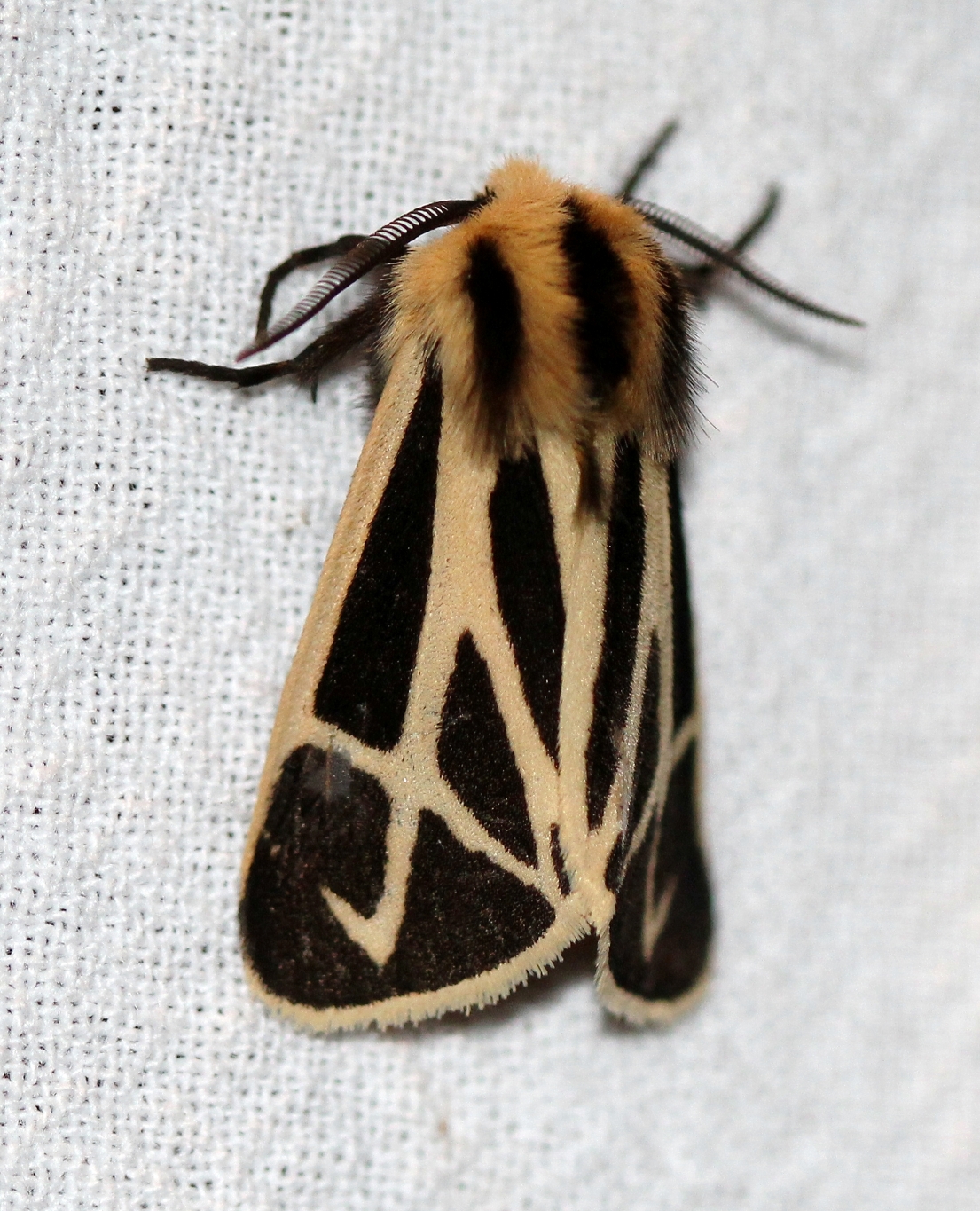
In an earlier post, I wrote about Williams’ tiger moth (Apantesis williamsii). In this one, I present two more Apantesis species: Apantesis phalerata (Harnessed Tiger Moth) and Apantesis virgo (Virgin Tiger Moth).
Most Apantesis moths are characterized by dark forewings and numerous, often parallel, crisscrossing white or off-white lines. The patterns are usually distinctive enough to determine species, but not always.
What’s in a name?
The genus name Apantesis is from the Greek word “apantēsis”, translated as “meeting, an encounter/reply” and “to meet face to face“. It describes a custom of meeting visiting dignitaries where citizens would gather to welcome and escort the dignitary or hero in a procession. I’m not sure why this word was used to name the genus.
Harnessed Tiger Moth (Apantesis phalerata)
Harnessed Tiger Moth (Apantesis phalerata) is part of a group of similar species that includes Apantesis nais, Apantesis carlotta, and Apantesis vittata. Characteristics of the forewing pattern overlap in all four species, making accurate determination difficult, if not impossible, from a photograph. Had this moth spread its wings, exposing the underwings, then the choice might have been between Apantesis phalerata and Apantesis carlotta. Or maybe not.
Genital dissection is considered to be the only reliable way to determine these Apantesis species accurately, but I’m not willing to chop up a moth that rarely gets this far north. I’m just going to call my moth Apantesis phalerata because it looks more like identified specimens than it does the other three species. Additionally, the orange thorax appears to be another characteristic in photos of moths identified as Apantesis phalerata, distinct from the other three. Of course, I could be completely wrong.
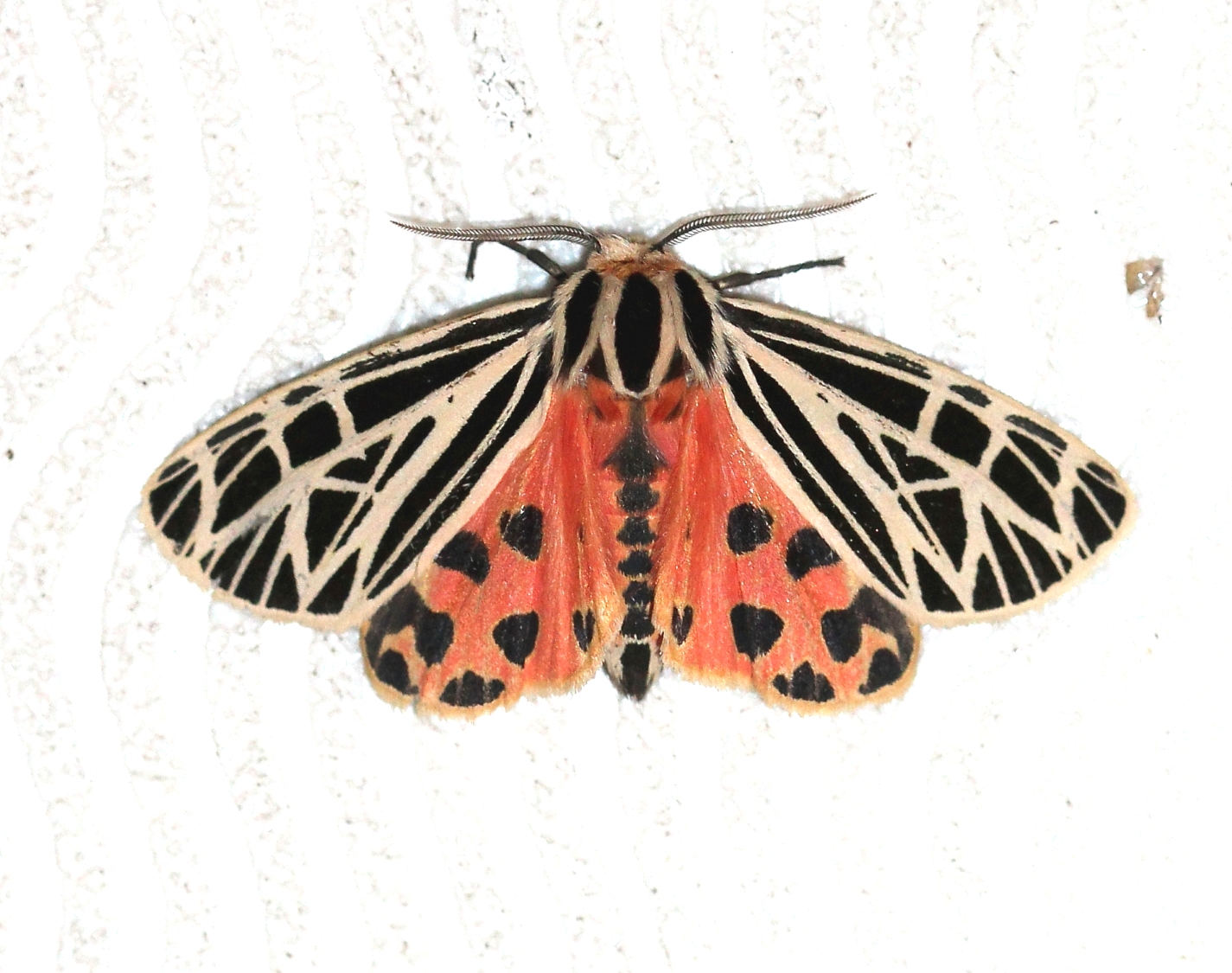
Virgin Tiger Moth (Apantesis virgo)
Identifying Virgin Tiger Moth (Apantesis virgo) is not as fraught as it is with Apantesis phalerata. Apantesis virgo is a large white, black, and red moth, 20 to 27 mm long. Black in color, the forewing has distinct off-white veins and transverse lines in the postmedial and subterminal areas. The hindwing may be bright pink, red, orange, or occasionally yellow, with an antemedian and outer margin lined with a row of black spots. There is also a patchy marginal band.

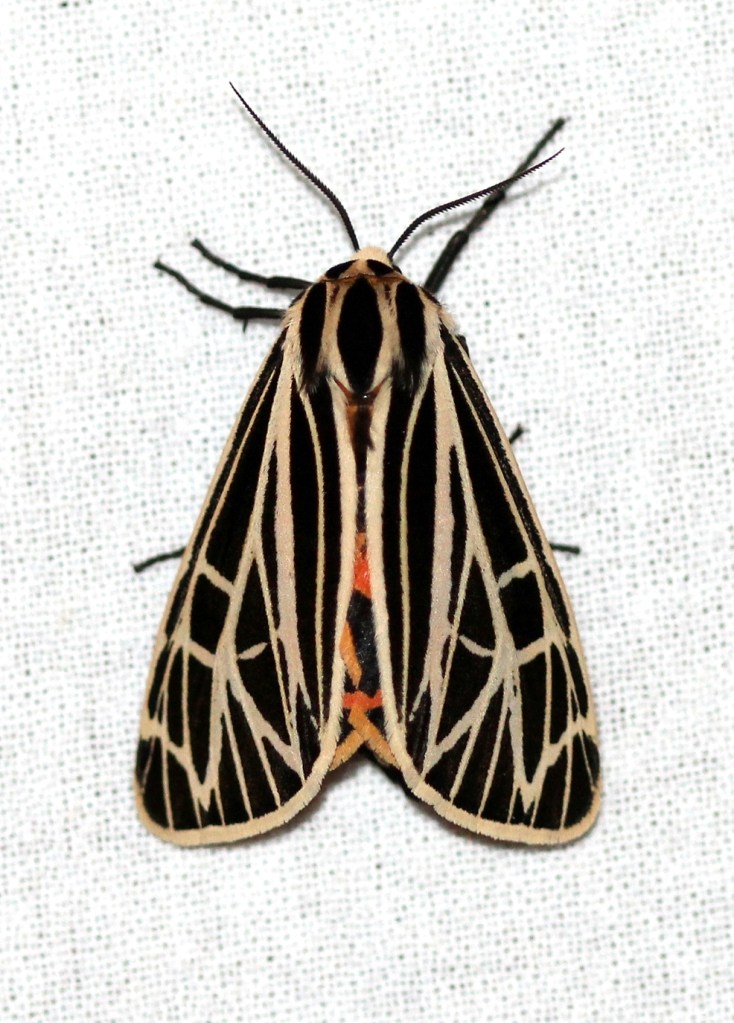

Larvae and host plants
Larvae of Apantesis moths are similar in appearance. Black and bristly, Apantesis virgo larvae have orange-brown spiracles; the setae beneath the spiracles may be orange. Brown to black bristles cover the black larvae of the Apantesis phalerata, which frequently have a pale dorsal line. Larvae of both species feed on low-growing herbaceous plants.
Range and distribution
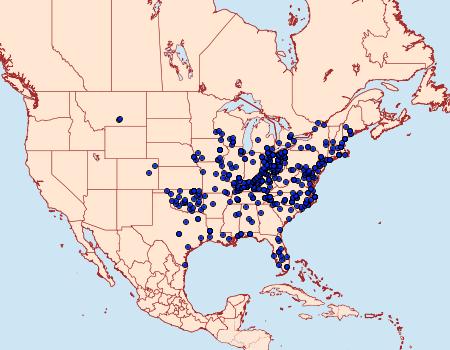
The following two maps from the Moth Photographers Group show the range and distribution of Apantesis virgo and Apantesis phalerata.

 Not Very Far Away
I finally found the entry for the virgin tiger moth on my blog so I’ve seen that one. Thanks for the information on it and its “cousin.”
On that same page of my blog is the rosy maple moth (Dryocampa rubicunda.) These pretty pink moths are fairly common here, Have you seen them?
LikeLiked by 1 person
I have seen Dryocampa rubicunda only twice but I’m sure it is more common nearby where there is more sugar maple and red maple. My woods has only a few red maple but that will change in the next decade I think. Hundreds have been popping up all over in the last ten years. Many are now over my head. Its a huge change in the tree species composition.
LikeLiked by 1 person
Interesting. It sounds like the average winter temperature has risen as it has here. Our current plant hardiness zone used to be used for northern Massachusetts
LikeLiked by 1 person
It is warmer here and the summer growing season is getting longer with fewer late and early killing frosts. Some farmers are growing field corn now something no one could do 50 years ago. Winter temperatures are generally less horrible than they were when I first moved here in the 1970s. We’re now zone 4. Used to be zone 3.
I’m seeing more oaks seedlings in my woods now. We never had any until about 20 years ago when I found a sapling white oak, a sapling red oak, and a three sapling bur oaks. They grow locally on soils with more silt and clay but never in my forest which is (soon to be was) aspen-birch-spruce-fir which is on a sandy loam. The presence of sapling oaks and so many red maples is all the more amazing given the large deer population.
LikeLiked by 1 person
It’s amazing how something can be so interesting and so disturbing at the same time. It’s also disturbing how so many people can deny what they can see with their own eyes.
LikeLiked by 1 person
And its happening rather quickly. Another thing I’ve noticed is the lack of spruce and fir seedlings. There are two reasons I think for this and both have to to do with the warming weather. More frequent ice storms are damaging mature trees thereby reducing cone production. Heat and disrupted rainfall are weakening the mature trees so they are more susceptible to fungi and wood boring insects.
The ground flora is changing. It used to be mosses and grasses like Oryzopsis and Schizachne. Now three is a lot of Carex pensylvanica which has rapidly expanded since 2020. The Carex forms a sod that makes it difficult for tree seedlings to establish. Where the maple and oaks are showing up the Carex is sparse right now.
I was reading a report from the MN DNR where there is concern that the aspen-birch-spruce-fir forests will dimmish significantly and I think I am seeing this now.
LikeLiked by 1 person
We’re far enough south so we don’t see a lot of spruce and fir but there are pockets where they’ll do well. Or there used to be, anyway.
Most disturbing here is the loss of many of the older maples. Crowns thin when branches die back, and I see it happening a lot. These weakened trees become more susceptible to insects and disease and all of the sudden you start seeing a lot of naked crowns in the fall canopy on what used to be unbroken, colorful forested hillsides.
We’ve seen moderate drought for several years in a row now with much less rain and higher temps, and I have a feeling that trees like maples that like long cold winters are going to slowly move north. Winters are noticeably warmer with much less snowpack, so I see large, open areas where the snow was often waist deep when I started blogging 15 years ago. Tree roots have a better chance of freezing without the insulation that snow provides so it seems like we’re in a strange circular cycle that just isn’t good for trees that have thrived here for centuries. They can’t seem to get a break, neither in summer or winter.
We’ve always had a lot of sedges like Carex pensylvanica in our forests but I’ve noticed that they and many of our ephemeral wildflowers like trout lilies, spring beauty and red trillium are flowering earlier. I used to start looking for blossoms in April but now I start in early to mid March.
Changes like these aren’t isolated, they’re everywhere, and I think the whole of nature is entering a period of upheaval, at least here in the northeast.
LikeLiked by 1 person
Our snowpack is also less most years. The exception being 2022-2023 when we got more than two feet in a couple of days in December 2022. That was a wet snow with rain and sleet, something becoming more common here in the last 20 years. Many acres of MN forests were severely damaged by the sleet and wet snow. The rest of that winter it didn’t snow much.
The following winter there was less than an inch of snow on the ground. When it dd snow it would soon melt. A lot of trees suffered from that too as did forest floor plants. There was a patch (~200 sq ft) of Lycopodium lagopus in my woods that was pretty much freeze dried for lack of snow cover. It had been there for over 40 years. A few small pieces made it but they aren’t doing well. Another large patch seems to be completely gone.
Another lycopd that was never very common where I am, Huperzia selago has gone from four little patches since 1994 to one. Huperzia lucidula, which I never saw here until 1994 (a few scraggly stems) is now everywhere and in large clumps. Same thing with Diphasiasturm digitatum, once scarce and now abundant while D. complanantum has all but disappeared.
The DNR and others are worried about sugar maple here, too. It will probably expand to new sites in the northern parts of the state, where it exists in specific places along the North Shore and only in those, and become scarce further south. And with spring warm up happening earlier the sugar maple harvest is being affected.
LikeLike
We’ve had occasional “snowy” winters in the last decade but even so, they’re nothing like winter used to be. One year I had paths dug in the backyard and the snow was nearly shoulder deep. And I’ve only lived here for a little over 30 years. As you say, the snow is heavy and wet and it melts quickly on the above freezing days. These days most storms are under 6 inches and most of them don’t really need to be plowed.
That’s too bad about your clubmosses. I’m not sure we have Lycopodium lagopus or Huperzia selago here. I can’t remember ever showing either one on the blog so that means I couldn’t have seen them. I have seen Huperzia lucidula but rarely. I think they’re more northerly species.
One you’ve named that is common here once again is fan clubmoss (Diphasiasturm digitatum.) It was over collected to make Christmas wreaths in the past, to the point of being nearly wiped out. I see more and more each year though, so it’s a strong plant. Diphasiasturm complanantum is fairly common as well.
I haven’t thought about it lately but we actually have many clubmosses here, mostly in more coniferous parts of forests under Eastern hemlock and white pine. Of course it takes heavier snowfalls to cover them when they grow under evergreens so maybe I should take a “clubmoss specific” walk to see how they’re really doing. They might be drying up.
LikeLiked by 1 person
Lycopodium lagopus and Huperzia selago are both northern species. I suspect that snow or no snow they will decline as summers get warmer. H. lucidula is a eastern US species and maybe likes things a bit warmer which is why I think it is suddenly becoming more common here. We’re at its western range limits.
Do you have any thoughts on the ground pines (Lycopodium dendroideum, L. obscurum)? I’m not sure why it is going away here. I know on part of my property someone collected (without my knowledge or permission) thousands of stems for many years so that’s the explanation for that but I can’t figure out why it s declining where there was no collection.
Our snowfalls, except for that big blizzard in 2022 (the Blue Blizzard they called it), are smaller like you’re experiencing. This winter could be different. Predictions are for wetter and colder. I hope wetter doesn’t mean slush, rain, and ice. I’m not sure what they mean by colder given that our average winter temperature is now about 4 degrees warmer since 2000. Fewer cold snaps, too.
LikeLike
It’s hard to say why a specific clubmoss would die off but I wonder if in your case it wasn’t soil compaction from all the foot traffic that must have taken place over the years when they were being harvested by the unknowns. One thing I can say that I’ve never seen is any species of clubmoss growing on a trail. They’ll thrive on trail edges but when you stand back and look it looks like they’ve been mowed down to soil level where the trail runs. That’s because of foot traffic compacting the soil.
Other changes might be forestry in the area that has let in more light, or more or less rainfall due to climate. Clubmosses are tough but they like the conditions to remain the way they are. They’re sensitive to change. I’ve seen spots where they’ve yellowed and died simply because an old oak or maple fell and opened a huge hole in the canopy that let in more direct sunlight. Direct sunlight is their enemy, as is wet ground.
I’m going to go exploring today to see what the clubmosses in this area are doing, and I’ll let you know.
LikeLike
It was only one or two people who came out in the fall to harvest so foot traffic is probably not the problem. That area has been under continuous forest cover for at least 70 years and clubmoss is recovering. I’ll know more when I visit that area in the next few weeks.
But on the east side where no harvesting ever took place the ground pine species have declined. On the other hand the D. digtatum is and H. lucidula are thriving and expanding. They’re expansion is recent mostly since 2005. The first time I saw either species was after1994 and there were only a few small plants. Now they are everywhere mostly under forest cover but one patch of D. digitatum began growing in an old field (now more shaded by large aspen). That patch is massive now. I even found a small plant of D. digitatum growing in a sunny spot of what used to be a hayfield now a gone wild with a little help from me.
The other clubmosses doing well are L. annotinum. and L. clavatum They don’t seem to have suffered any die back. L. clavatum grows well in sunny and lightly shaded places. L. annotinum is in the forest and on hummocky places in a confer swamp.
I think I will make it a point to get a population count of the L. dendroideum and L. obscurum on both the eastern and western forested areas.
Looking forward to what you find.
LikeLiked by 1 person
I like these tigers
LikeLiked by 1 person
They are much friendlier.
LikeLiked by 1 person