
Wordless Wednesday
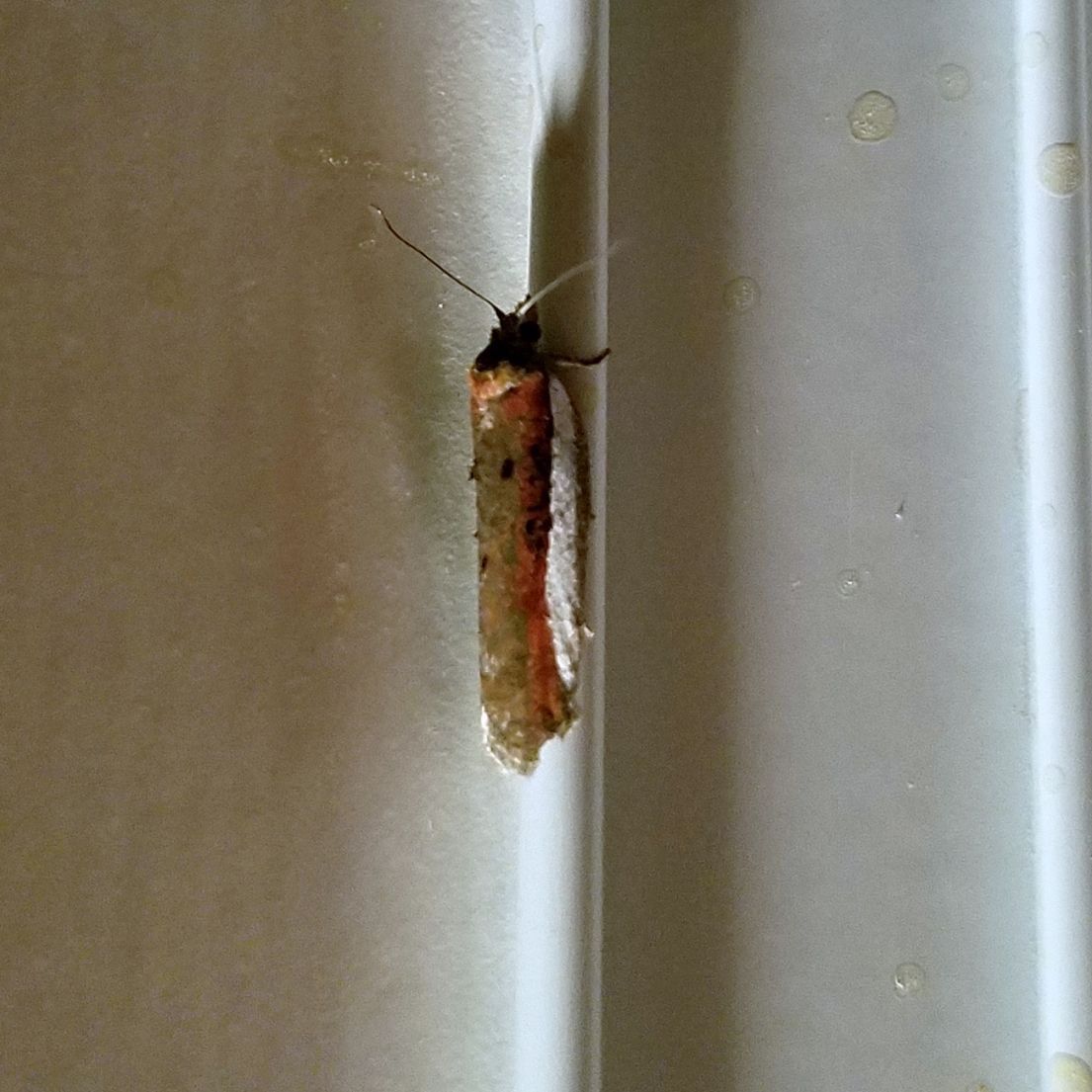
These tiny Tortricid moths with white stripes along their wing margins are really confusing me. On Monday I wrote about a moth that didn’t seem to be a close fit with the description for the species Ancylis albacostana which I thought it might be. It was by accident I figured it out. The moth is Acleris celiana and not an Ancylis at all. I was out on my porch Monday night sipping espresso and taking photos of little moths, caddisflies, and some sort of wasp (a species of Ophion I think) when this same kind of moth flew in. I got one shot before it took off and had to wait awhile before it came back and I could get more shots. Later, while going through photos on the Moth Photographers Group (MPG) trying to figure out another species I came across this which looks a lot like the moth I had just found. I have posted the images on Bug Guide and BAMONA and am awaiting comments on the species identity. (Update on 05-29-18: Bug Guide says it is Acleris celiana not Ancylis albacostana.)
Coleman first described Acleris celiana in 1869 under the name Teras celiana. “Anterior wings rich dark chocolate-brown slightly mottled with dark gray. There is a tuft of pale ochreous scales on the center of the disk, and beyond, in the apical portion of the wing a few scattered similarly colored raised scales. Fringes gray.” There is no mention of the white band. However, both Bug Guide and MPG show specimens of Acleris celiana with and without white bands.
Kearfott’s description of Ancylis albacosana reads “Fore wing lead color, rather heavily overlaid on inner two-thirds below the costa (main vein along leading edge of wing) with brownish and blackish scales. From the base to the apex on the costa is a pure white band, widest at end of cell, where it is nearly a quarter the width of wing; continuing to base with only a trifle less width, and lower edge curving evenly into costa and ending in a point at apex.”
I’m leaning strongly towards Acleris celiana on this one. Finding Ancylis albacostana would be great but the species is not, as far as I know, documented from Minnesota although there is at least one record from adjacent Wisconsin.
As for the rest of Monday night’s mothing, I found three more moth species and got a very clean shot of the caddisfly Glyphopsyche irrorata. Two of the moths are in Agonopterix (possibly A. canadensis and A. clemensella) and one is another Acleris (possibly Acleris forbesana). And now it is 10:10 PM Tuesday night and I’m staying up late looking for more moths. So far I have two new ones to figure out.


SOURCES
Kearfott, William Dunham (1905). Descriptions of New Species of Tortricid Moths From North Carolina, With Notes. Proceedings of the United States National Museum, Vol. 28: 319-364. Description on page 360.
Robinson, Coleman, T. (1869). Notes on American Tortricidae. Transaction of the American Entomological Society (1867-1877). Vol. 2 (1868/1869):261-288. Description on page 283-284.
Genus Ophion – Short-tailed Ichneumon Wasps at Bug Guide.
Species Acleris celiana – Hodges#3533 at Bug Guide.
620033.00 – 3533 – Acleris celiana – (Robinson, 1869) at Moth Photographers Group.
And warm, too, at a sweltering 50° F, so I made plans to be up late looking for moths and caddisflies. I turned on the porch light, made a little cup of espresso, and waited awhile. When I went out I almost couldn’t believe what I saw: Ancylis albacostana. The broad white band on the forewings certainly seemed to point to that species. But there were some differences. First, the wings are not uniformly leaden gray. Instead, there is a very noticeable amount of red forming a narrow triangle above the white band and is separated from that by a narrow black line. Then, below the white band is a narrow ash gray band. The main part of the forewings are leaden-gray. Finally, near the beginning of the forewings are two raised bumps. When I compared this moth to available photos it seemed not match well at all. The description of Ancylis albacostana by Kearfott is also at odds with this moth’s appearance. In an earlier post (here) I stated I had found Ancylis albacostana but later retracted that (there) when it appeared the moth in question was actually Capis curvata.
Also attracted to the light last night were five individuals of the caddisfly Glyphopsyche irrorata and three of the moth Agonopterix argillacea. I’ll be up late again tonight to get more photos of this Ancylis and other moths.

SOURCES
Kearfott, William Dunham (1905). Descriptions of New Species of Tortricid Moths From North Carolina, With Notes. Proceedings of the United States National Museum, Vol. 28: 319-364. Description on page 360.
Species Ancylis albacostana – White-edged Ancylis Moth – Hodges#3387 at Bug Guide.


It is April and spring is should to be well underway with flowers in the woods, trees putting out leaves, bees flying about, and frogs calling from the woodland ponds. But here in northern Minnesota you wouldn’t know it with the cold weather, occasional snow, and bleak landscape with only the conifers for greenery. There is still snow in the woods where the trees are thick and block the sun. The ground remains frozen except in the sunniest of sites and so none of the forest wildflowers have come out of dormancy. Even so, trees and shrubs are beginning to awaken albeit about 30 days late. The earliest of these are tag alder (Alnus incana ssp. rugosa), American hazel (Corylus americana), beaked hazel (C. cornuta), and tea-leaf willow (Salix planifolia). Following closely is the quaking aspen (Populus tremuloides) but only some groves (clones really) are flowering. Red maple (Acer rubrum) flower buds are swelling and I expect they will be in full bloom in a week. So far none of these shrubs or trees have produced any leaves. That will come later when flowering is over and temperatures are warmer at night.
Trees that flower in the early spring are mostly wind-pollinated a good strategy since insects may still be in hibernation or slow to move about. Tea-leaf willow is an exception and produces abundant pollen and nectar which attracts small wasps, solitary bees, beetles, and flies. These insects pick up pollen from the staminate flowers and transfer it to the pistillate flowers. Tea-leaf willow plants are either staminate or pistillate so the insects need to go from one to the other in the right order to effect pollination. The flowers of tea-leaf willow are fragrant and so lure the insects to them. But if insects are scarce like they are this year tea-leaf willow can still pollinate some of its flowers by wind pollination. Red maple is insect pollinated and has thick nectar-secreting glands in its bright red flowers to attract bees and other nectar feeders of many kinds. For a few days there will be a red glow in the forest canopy while the red maple is bloom.
Rain is forecast for early next week but the chances for a good downpour are very low. This is not a desirable situation as the low humidity, dry grass, and constant winds make fires more likely. A couple of rainy days and nights would certainly reduce the chances of a fire. Sunny weather isn’t all it’s cracked up to be.
So far I have heard no frogs in the woodland ponds and am wondering where they are. In past years wood frogs have begun calling in mid-April even when there was a bit of ice on the ponds. There ought to be some by now with the warm weather. I hope this isn’t an indication of a problem.
 Not Very Far Away