Mushrooms, moss, and algae

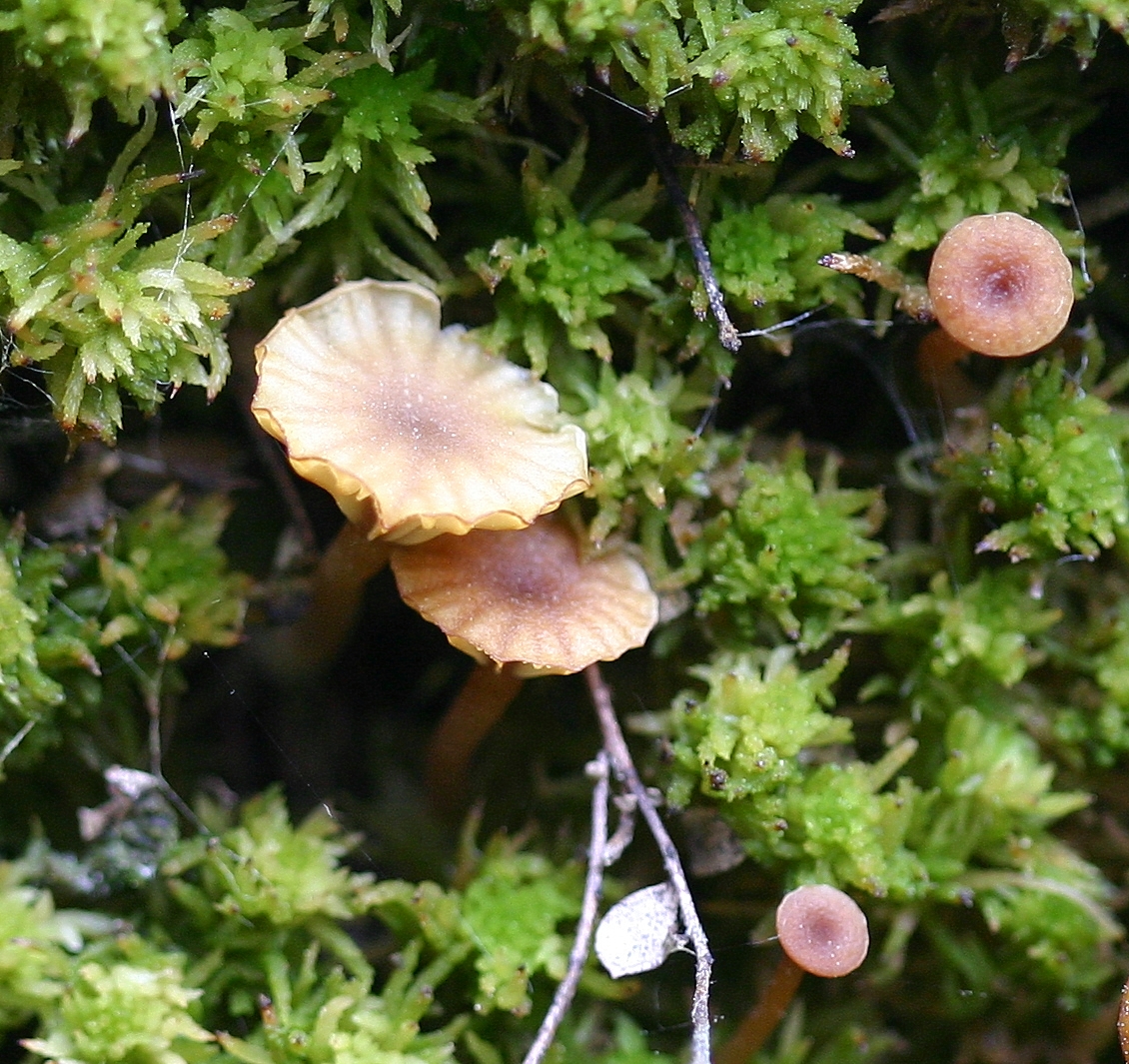
Omphalina mushrooms sprouting from peat moss growing on a wet vertical rock face.

This delicate, tiny mushroom growing from Sphagnum moss is a species of Omphalina, possibly in the Omphalina pyxidata complex. Omphalina is a Basidiomycota, one of five divisions in the Kingdom Fungi. Basidiomycota is the fungus division that includes the white button mushroom, shiitake, boletes, and bracket fungi, among many others.

The Sphagnum moss from which the mushroom is sprouting was growing in an unusual place. It was in a shaded spot in a forest on a north-facing vertical rock face with water seeping from cracks.

On some of the moss plants there is bumpy green growth that may be an algae (Coccomyxa?). Is this Omphalina mushroom part of a basidiolichen and not a mere saprophyte?

Basidiolichens are a lichen symbiosis composed of a green alga (sometimes with a cyanobacterium) and a Basidiomycota fungus. Most lichens are formed by fungi in the division Ascomycota.

Omphalina fruiting bodies sprouting from Sphagnum moss. On the moss just below the largest mushroom are granules of a green alga.

The genus Omphalina has undergone taxonomic revisions lately and has been split into other genera. One of these is Lichenomphalina, a basidiolichen. Maybe the mushrooms in the photos are a Lichenomphalina, but until I go back to the site where I found it, I won’t know for certain.

More reading

Scutellinia scutellata (Eyelash Cup Fungus)

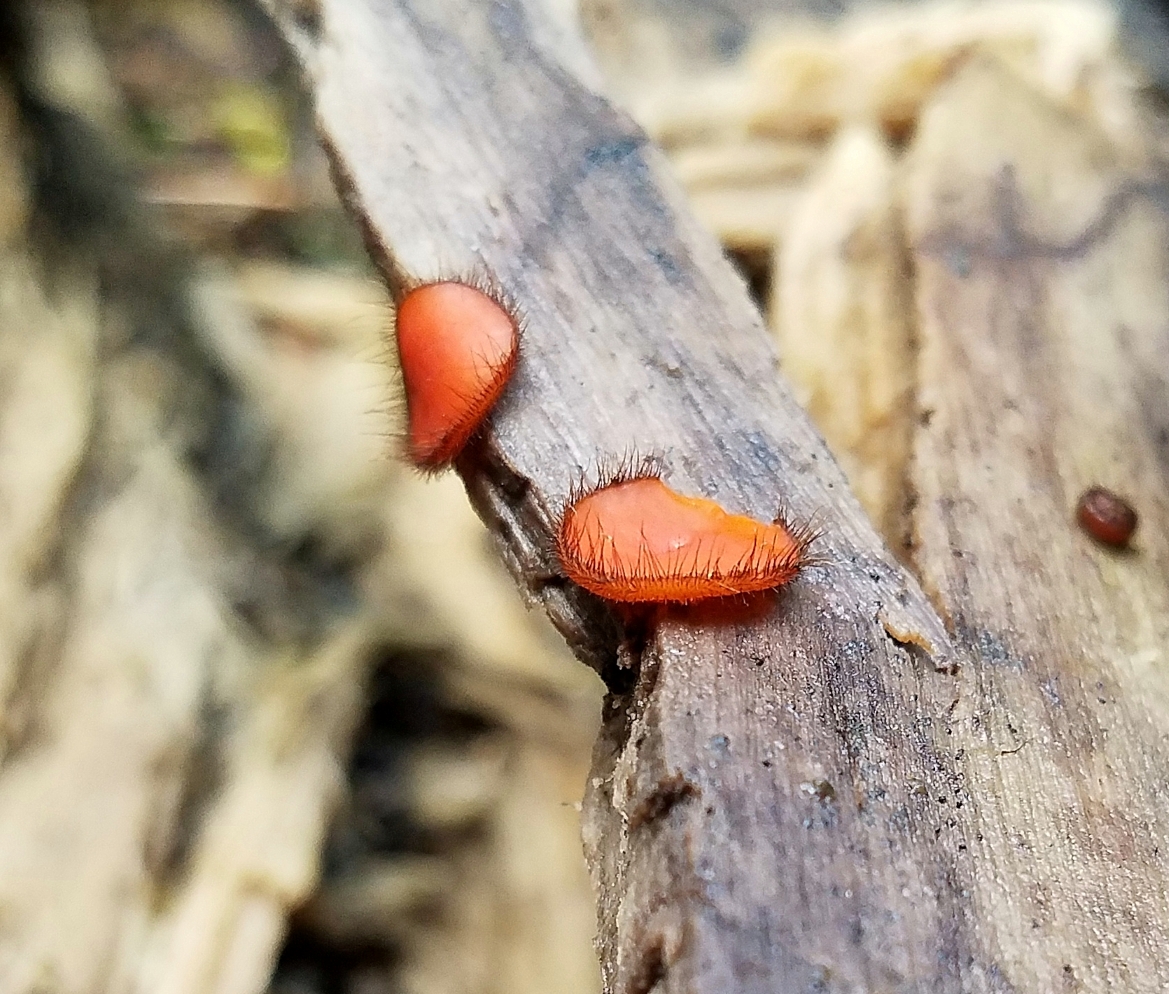
Scutellinia scutellata (Eyelash Cup Fungus) on a piece of an aspen log lying in a wet forest. September 02, 2016, St. Louis County, Minnesota, near Astrid Lake.

This pretty orange fungus with the fringe of fine black hairs is Scutellinia scutellata (Eyelash Cup Fungus). It is an Ascomycota, like the resinicolous Sarea difformis and the old wood-dwelling whisker lichens (Calicium species).

Scutellinia scutellata is a saprophytic fungus that decomposes decorticated damp wood in forests. I often find it on spongy wet logs and fallen branches. Sometimes it grows by itself, but other times it may grow with small, leafy liverworts and mosses.

I’ve noticed that many Ascomycota species exhibit seasonal fruiting. For example, hairy ebony cups (Pseudoplectania sp.) fruit in April, morel mushrooms (Morchella angusticeps) fruit in May, and the false morel (Gyromitra infula) fruits in October. Scutellinia scutellata fruits from late June into October, especially if rainfall is abundant.

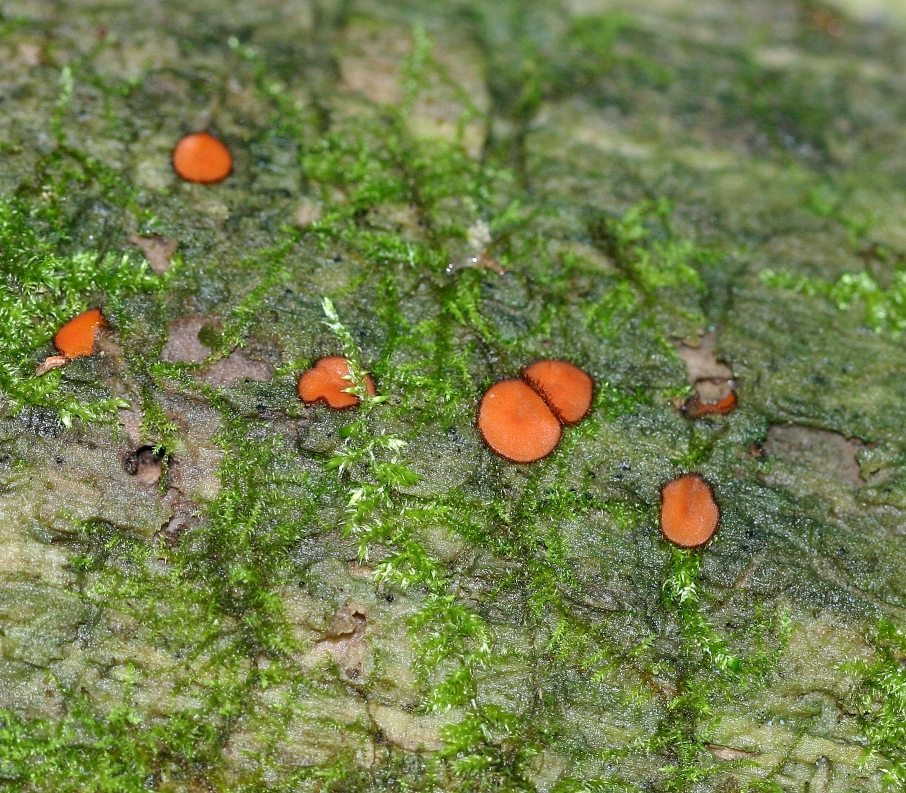
The fruiting body of Scutellinia scutellata is a disk-shaped scarlet-red to bright orange cup up to 1.5 mm across and fringed by black hairs. The lower surface is brownish and covered with small hairs.

Scutellinia scutellata with mosses on a damp decomposing aspen log. October 28, 2019, Carlton County, Minnesota.

Diversity of species

There are at least 100 species in the genus, and identification hinges on microscopic features of the spores and hairs. I’m fairly confident that this one is Scutellinia scutellata. However, reliable identification can be hampered if there is extreme variability and overlapping of morphological characters.

Symbiosis with bacteria

Scutellinia scutellata grows in association with extracellular bacteria. This association is crucial to its survival and growth. “All attempts to culture hyphae in the absence of bacteria failed. To our knowledge, this represents the first report of these versatile Acidovorax-like bacteria having established symbiotic relationships with members of both Fungal and Animal Kingdoms.” (Giordano et al, 2013)

Sources

Sarea difformis: A fungus that lives on conifer resin

Black spruce resin with Sarea difformis.

Conifer resin oozing from a tree is an inhospitable place. The terpenoid chemicals in resin are toxic to many forms of life, but not all. Even though conifer resins are full of anti-fungal and anti-bacterial compounds, some organisms have found a way around that. One of these is a fungus called Sarea, a genus of fungi that grows on the resins of pines, spruces, firs, and cedars. Organisms that live on resins are called resinicolous (resin plus “colous” meaning “inhabitant”).

From lichen to fungus

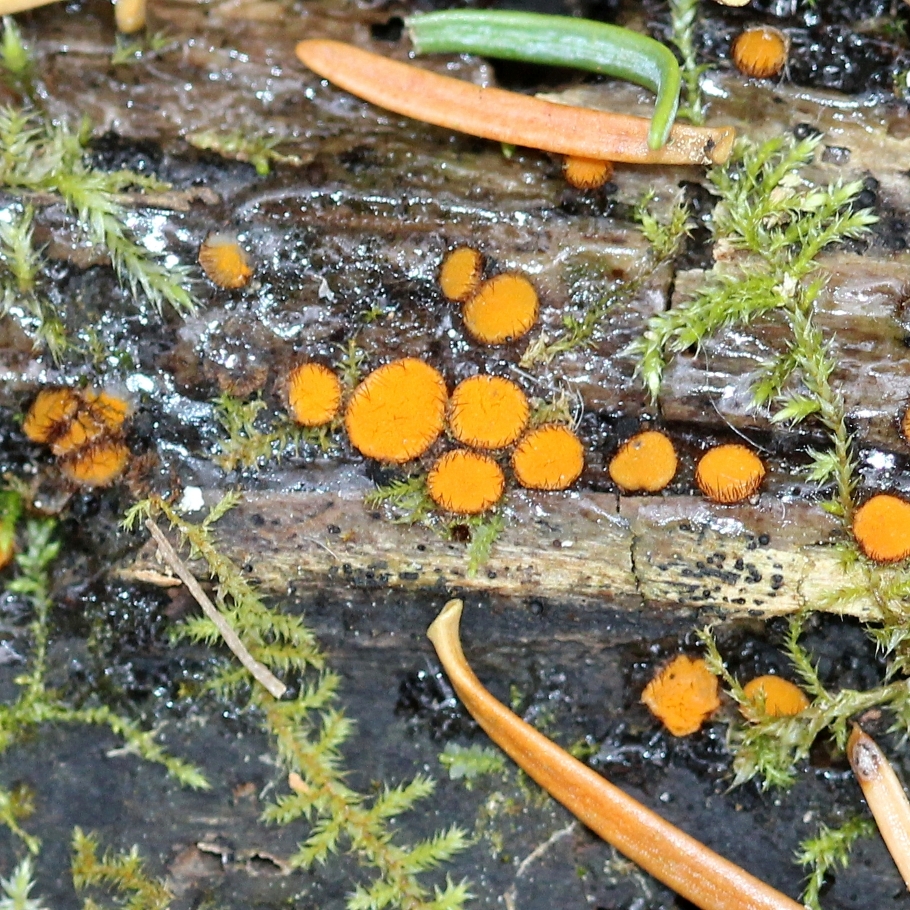
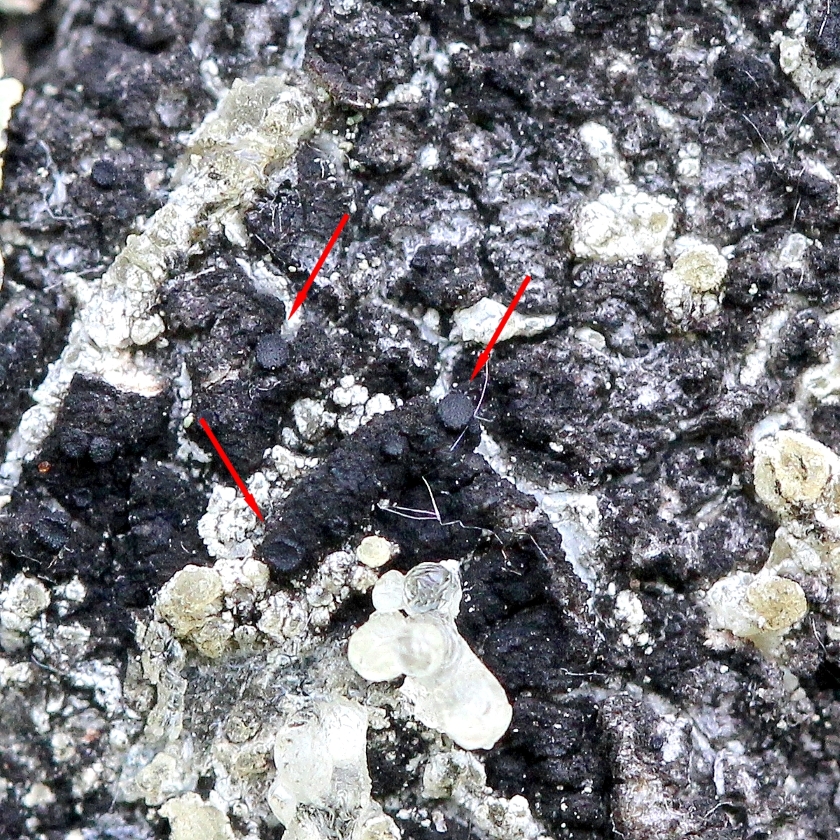
At one time, Sarea was thought to be a lichen, but because it lacks a photobiont (symbiotic photosynthetic organism), it has been “demoted” to a fungus. The tiny (barely 1 mm across) fungus bodies pictured above and below growing on the resin of a black spruce are, to the best of my knowledge, the apothecia (reproductive structures) of Sarea difformis. Cross-sections of the fruiting body examined under a microscope would make identification more certain, but that’s a bit out of my reach right now.

A few small fruiting disks (marked by red arrows) of the fungus Sarea difformis are growing on the darker portions (are those part of the fungal body?) of the resin. Can you find more?

I have looked for research papers on how Sarea can live on conifer resin, but the results have not yielded much information. Does it actually break down the resin components into simple carbohydrates? If so, then does it do this on its own, or is there a symbiotic relationship with bacteria or another fungus? Are the fungal hyphae growing in the resin or merely on top? How does it disperse? A lot of questions, and I’m sure there are answers somewhere.

Taxonomy

Sarea is a genus in the phylum Ascomycota (cup fungi, sac fungi), which includes familiar mushrooms like morels and the blue mold in Roquefort cheese. The taxonomy of the genus Sarea is not entirely settled, so some species may be moved to other genera, and species from other genera may be moved to Sarea. Also, new species are being discovered.

A similar resinicolous species that might be encountered in northern coniferous forests is Sarea (Zythia) resinae. It can be distinguished morphologically by the color of its apothecia. Sarea difformis has black apothecia, and Sarea resinae has orange apothecia.

Rare?

Sarea is not a rare fungus, but because of its small size and peculiar habitat, it is just rarely seen. It occurs throughout the cooler regions of the northern hemisphere.

Sources and additional reading

Pins and needles

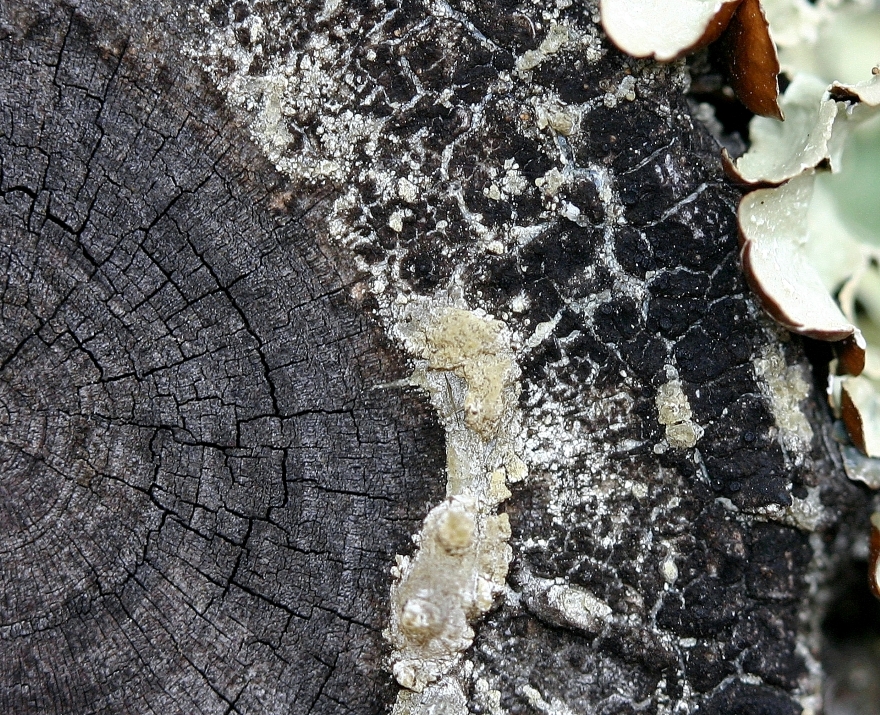
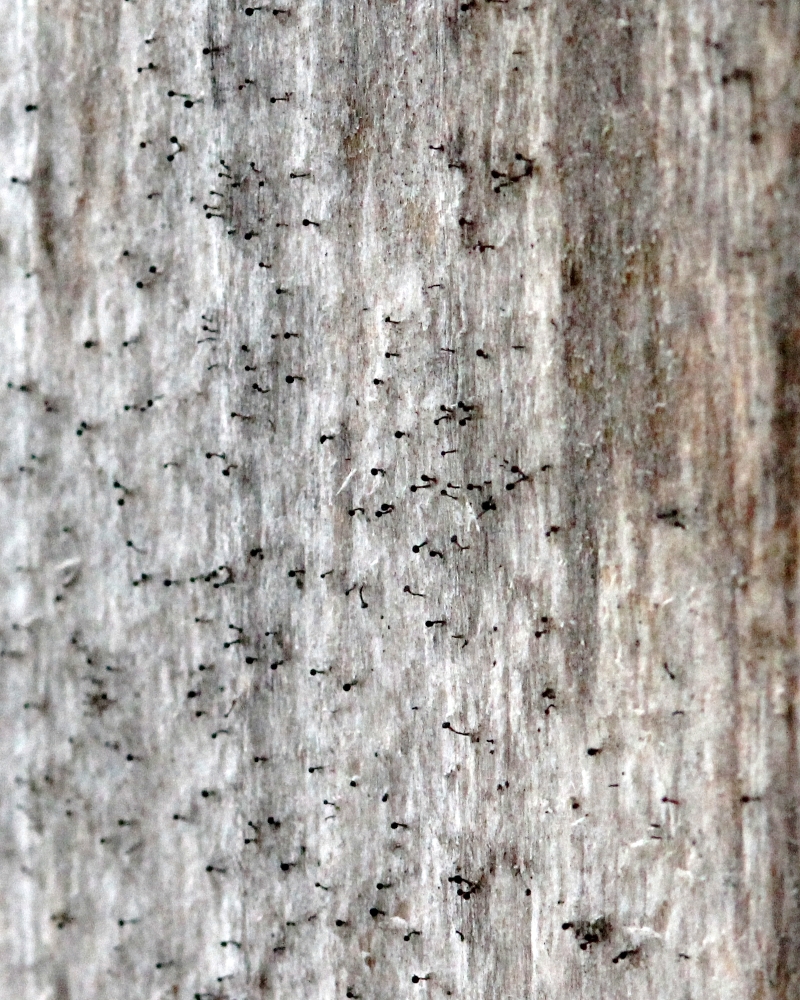
This may be a Calicium species. It has an immersed thallus. It is growing on weathered white cedar wood at the edge of a forest, and shaded most of the day.

The black stubble in the top photo are the fruiting bodies of a lichen. I found them growing on a piece of weathered cedar of an old birdhouse. I had set up that birdhouse about twenty-five years ago at the edge of a field and forest. Over the years, as the forest grew around the birdhouse, these tiny lichens began growing on the wood.

Lichens are a varied lot. Depending on the species, they can look like dust, little shrubs, gossamer, leaves, or overlapping shingles. Some lichens, like the one in the top photo, resemble whisker stubble or tiny straight pins. They are, fittingly, called whisker lichens and pin lichens.

Whisker lichens are minute, measuring just 1 to 2 millimeters in size. Most only grow on old wood or the bark of old trees. Many species are considered indicators of stable forest environments with long-term ecological continuity.

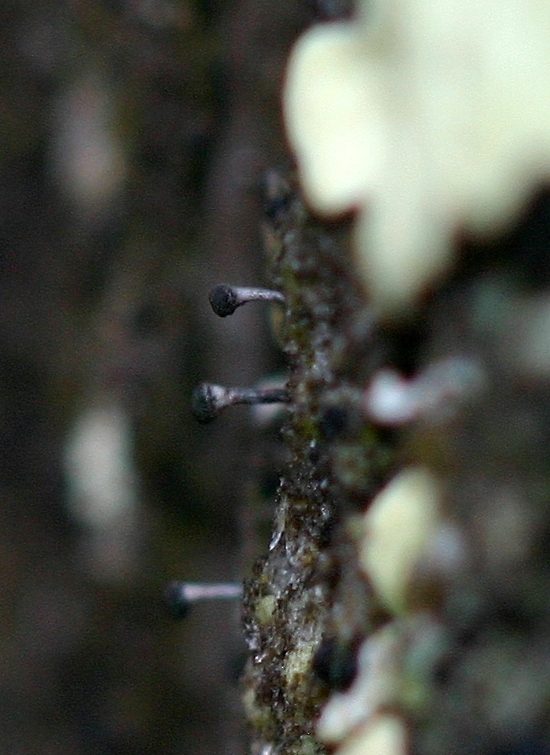
Whisker lichen apothecia. This species has an immersed thallus. Growing on a weathered balsam fir stump near the edge of a small wetland in a forest.

Taxonomy

The fungal partner (mycobiont) in whisker lichens are members of the Ascomycota, a group of fungi known as cup fungi or sac fungi. Familiar Ascomycota include morels, penicillium molds, and yeasts that are used to ferment bread and beer.

The algal partner (photobiont) is a green alga, usually a species of Trebouxia, a genus of unicellular algae that exists in almost all habitats. They can be free-living, but many species form symbiotic relationships with fungi to form lichens.

Description and terminology

The thallus (body) of whisker lichens may be minutely rough-surfaced (verruculose-granular) or immersed. If immersed, the fungal hyphae and the algae photobiont grow just below the surface of the substrate.

Whatever the thallus form, the apothecia (fruiting bodies) are borne on a long or short stalk, or rarely, sessile. They may be gray, blackish-brown, or greenish-black. At the top of the apothecia is a globose to lenticular capitulum (“little head”), a cup-shaped structure that produces spores.

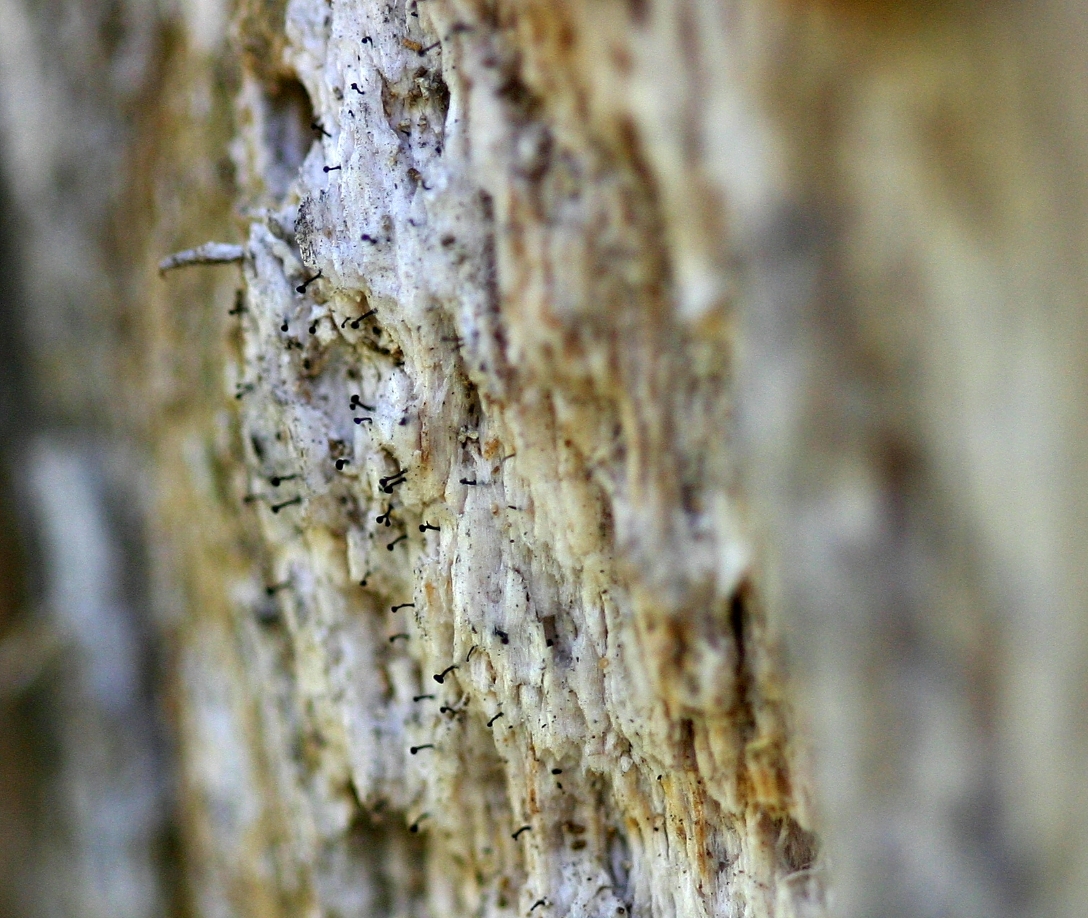
A species of whisker lichen on an old white pine stump. Possibly a Calicium species.

Determining species

Species determination in whisker lichens is complicated. Morphological characters can only go so far. At best, you might get to genus. For positive identification, microscopic examination of the capitulum and spores is necessary.

Finding whisker lichens

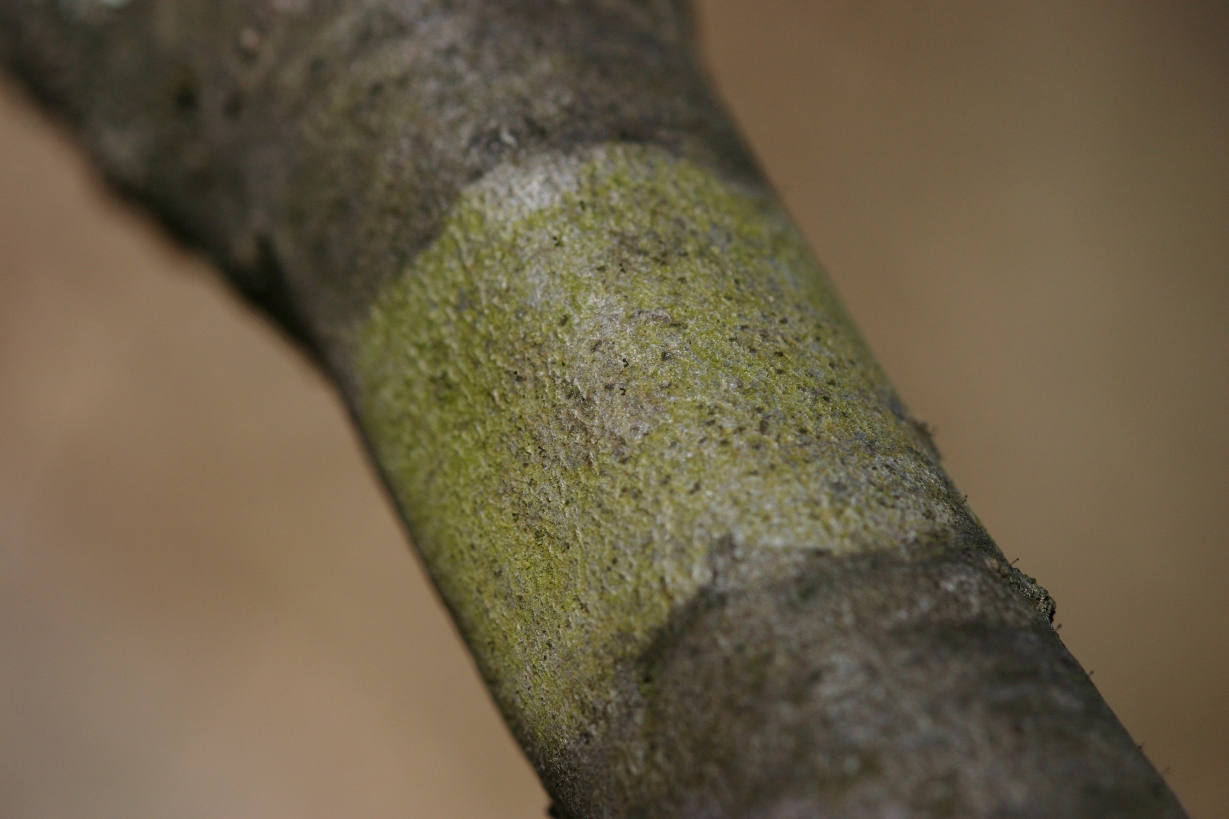
Tiny whisker lichens are growing on or from this green crustose lichen on an alder branch.

I have found whisker lichens growing on weathered jack pine twigs while photographing other lichens. Most of the ones I have seen seem to prefer old, weathered wood, but I did find one on green crustose lichen that was growing on an alder branch. It may have been a lichen parasite. These are interesting fungi that you can find with a hand lens, or in my case, a macro lens, scanning up and down the trunks and branches of trees, weathered wood, and other lichens.

Further reading