Pins and needles

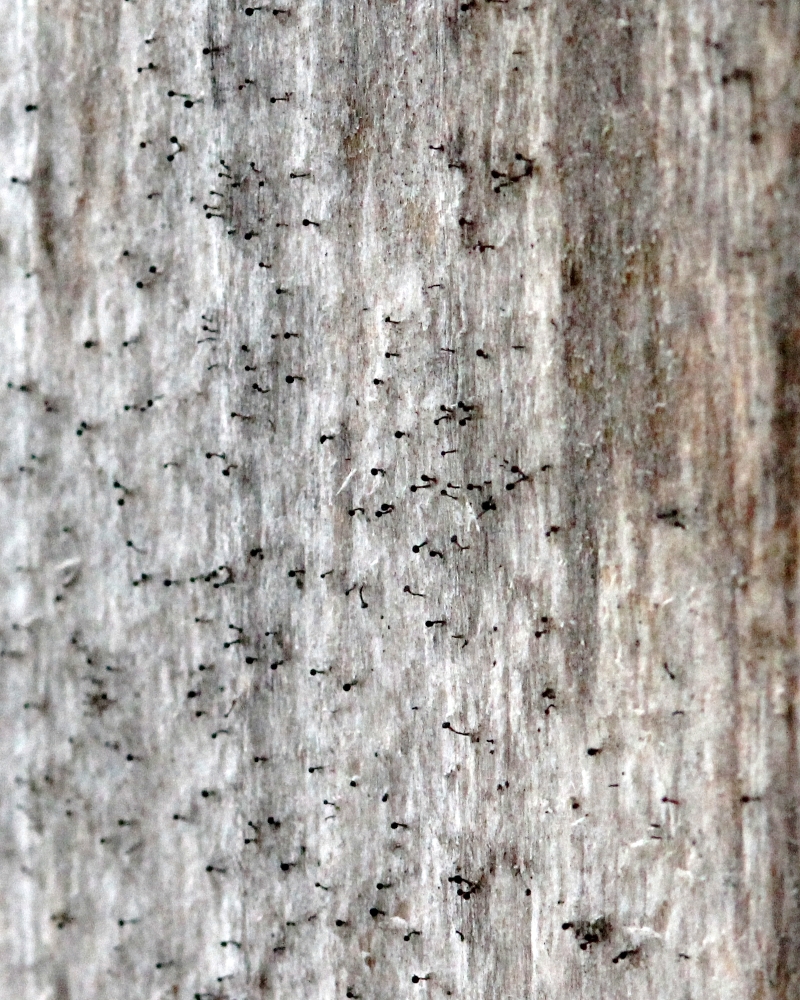
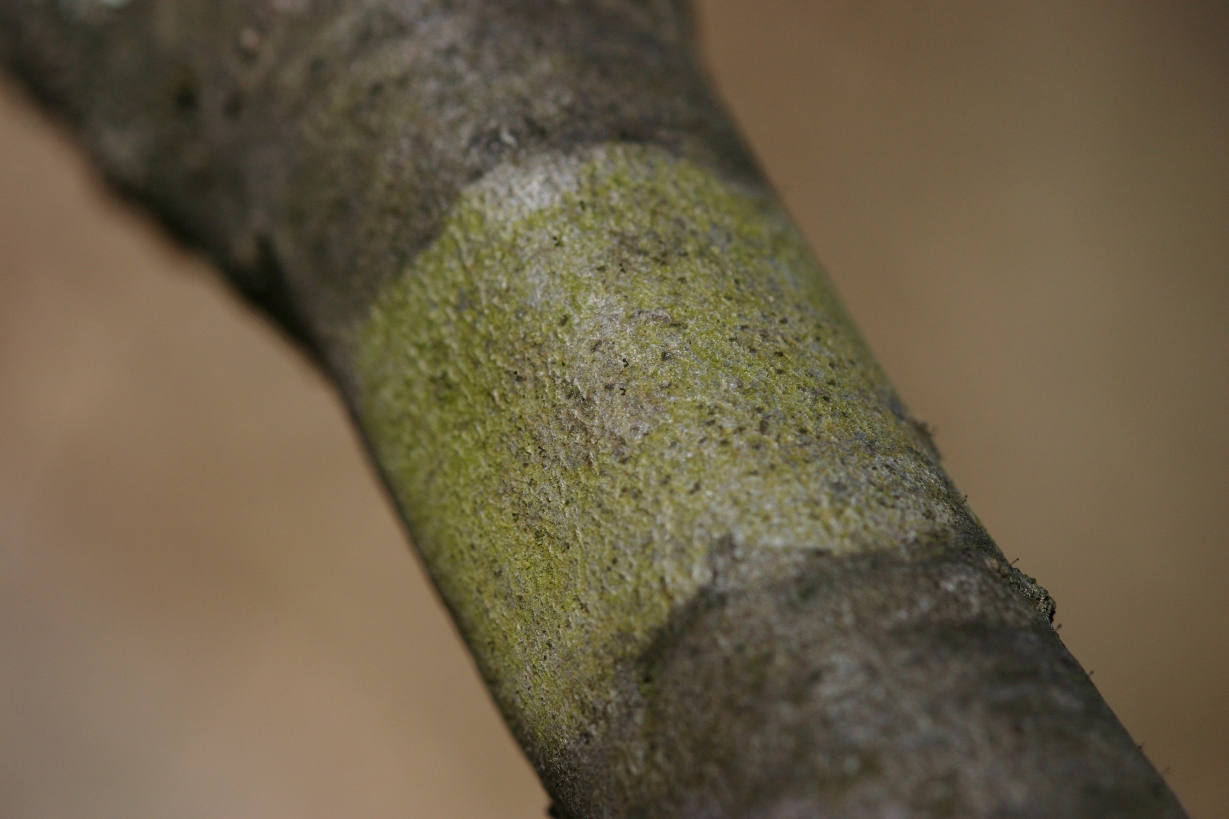
This may be a Calicium species. It has an immersed thallus. It is growing on weathered white cedar wood at the edge of a forest, and shaded most of the day.

The black stubble in the top photo are the fruiting bodies of a lichen. I found them growing on a piece of weathered cedar of an old birdhouse. I had set up that birdhouse about twenty-five years ago at the edge of a field and forest. Over the years, as the forest grew around the birdhouse, these tiny lichens began growing on the wood.

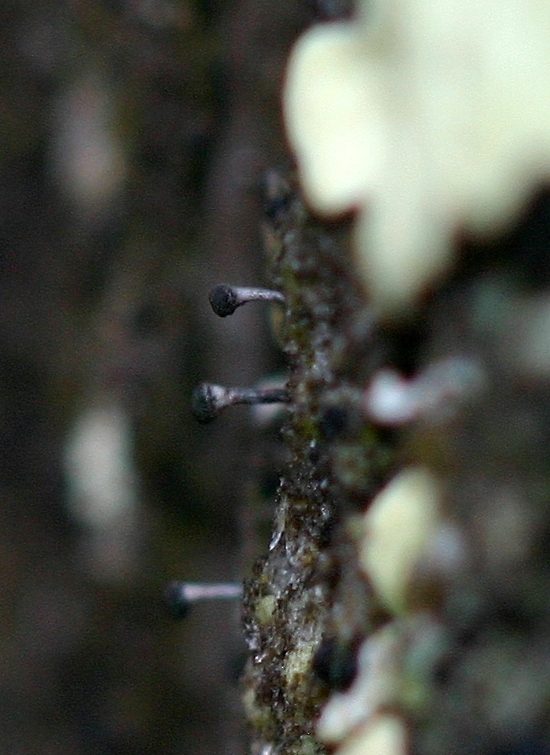
Lichens are a varied lot. Depending on the species, they can look like dust, little shrubs, gossamer, leaves, or overlapping shingles. Some lichens, like the one in the top photo, resemble whisker stubble or tiny straight pins. They are, fittingly, called whisker lichens and pin lichens.

Whisker lichens are minute, measuring just 1 to 2 millimeters in size. Most only grow on old wood or the bark of old trees. Many species are considered indicators of stable forest environments with long-term ecological continuity.

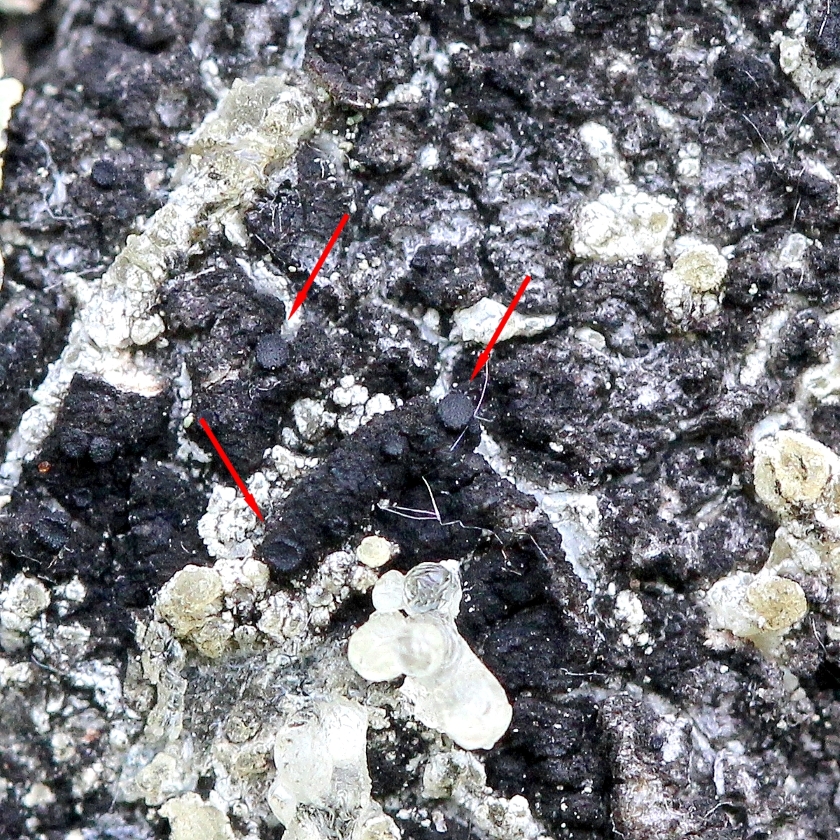
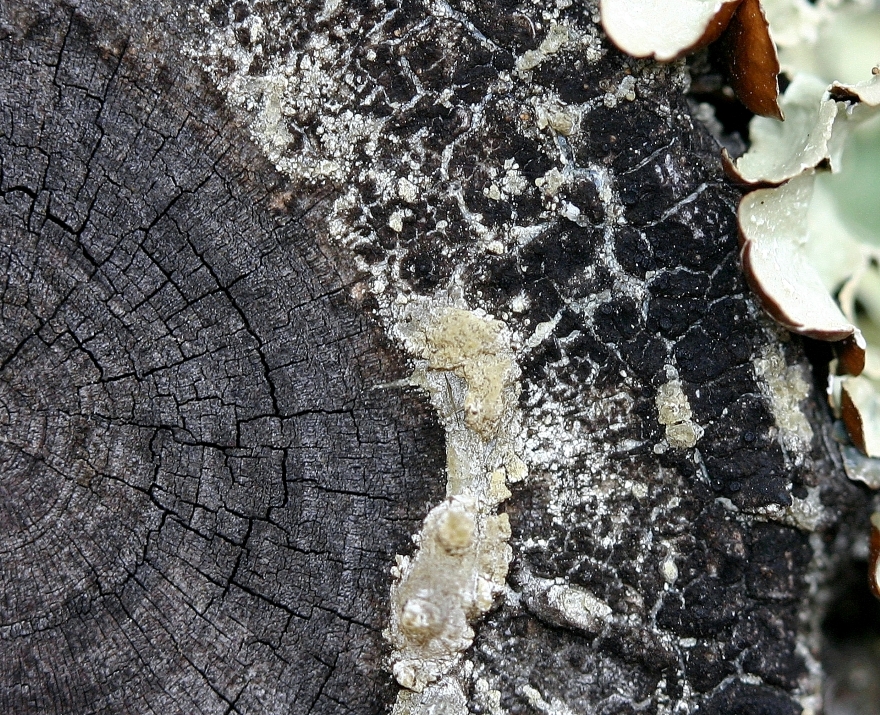
Whisker lichen apothecia. This species has an immersed thallus. Growing on a weathered balsam fir stump near the edge of a small wetland in a forest.

Taxonomy

The fungal partner (mycobiont) in whisker lichens are members of the Ascomycota, a group of fungi known as cup fungi or sac fungi. Familiar Ascomycota include morels, penicillium molds, and yeasts that are used to ferment bread and beer.

The algal partner (photobiont) is a green alga, usually a species of Trebouxia, a genus of unicellular algae that exists in almost all habitats. They can be free-living, but many species form symbiotic relationships with fungi to form lichens.

Description and terminology

The thallus (body) of whisker lichens may be minutely rough-surfaced (verruculose-granular) or immersed. If immersed, the fungal hyphae and the algae photobiont grow just below the surface of the substrate.

Whatever the thallus form, the apothecia (fruiting bodies) are borne on a long or short stalk, or rarely, sessile. They may be gray, blackish-brown, or greenish-black. At the top of the apothecia is a globose to lenticular capitulum (“little head”), a cup-shaped structure that produces spores.

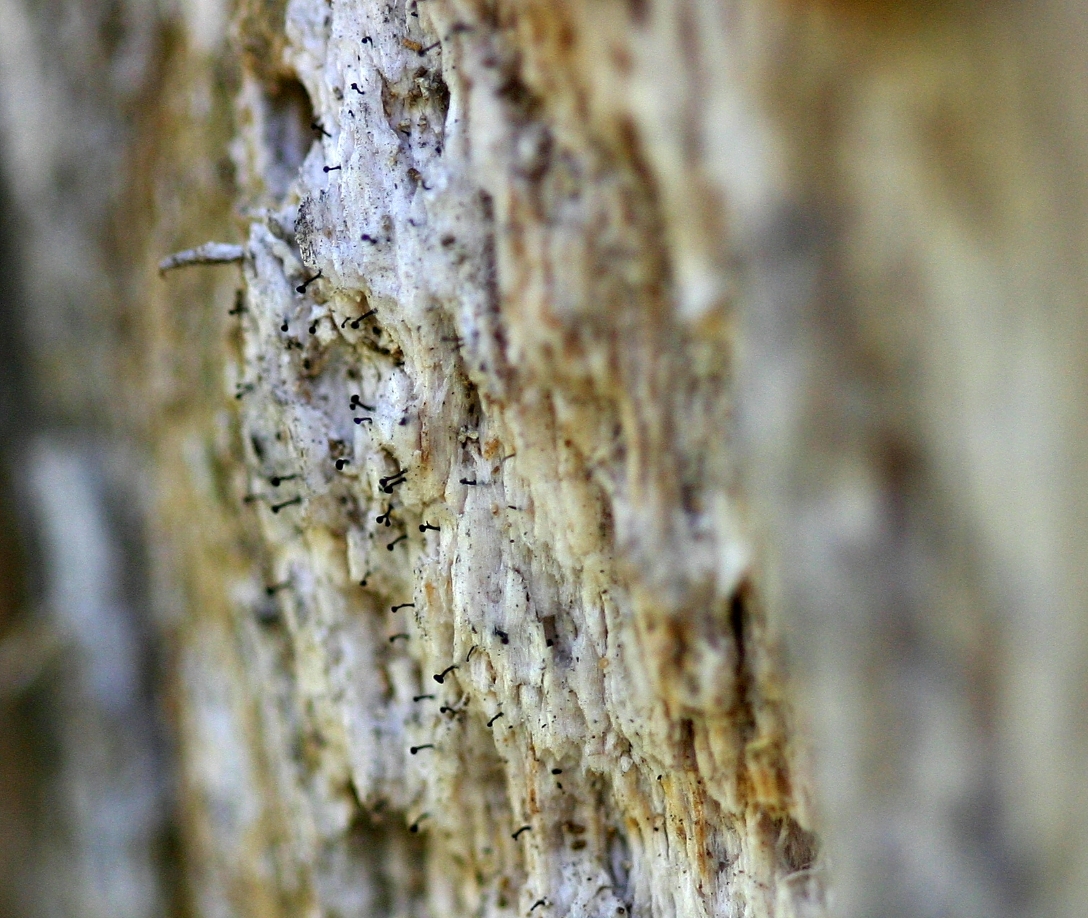
A species of whisker lichen on an old white pine stump. Possibly a Calicium species.

Determining species

Species determination in whisker lichens is complicated. Morphological characters can only go so far. At best, you might get to genus. For positive identification, microscopic examination of the capitulum and spores is necessary.

Finding whisker lichens

Tiny whisker lichens are growing on or from this green crustose lichen on an alder branch.

I have found whisker lichens growing on weathered jack pine twigs while photographing other lichens. Most of the ones I have seen seem to prefer old, weathered wood, but I did find one on green crustose lichen that was growing on an alder branch. It may have been a lichen parasite. These are interesting fungi that you can find with a hand lens, or in my case, a macro lens, scanning up and down the trunks and branches of trees, weathered wood, and other lichens.

Further reading

Summer is over

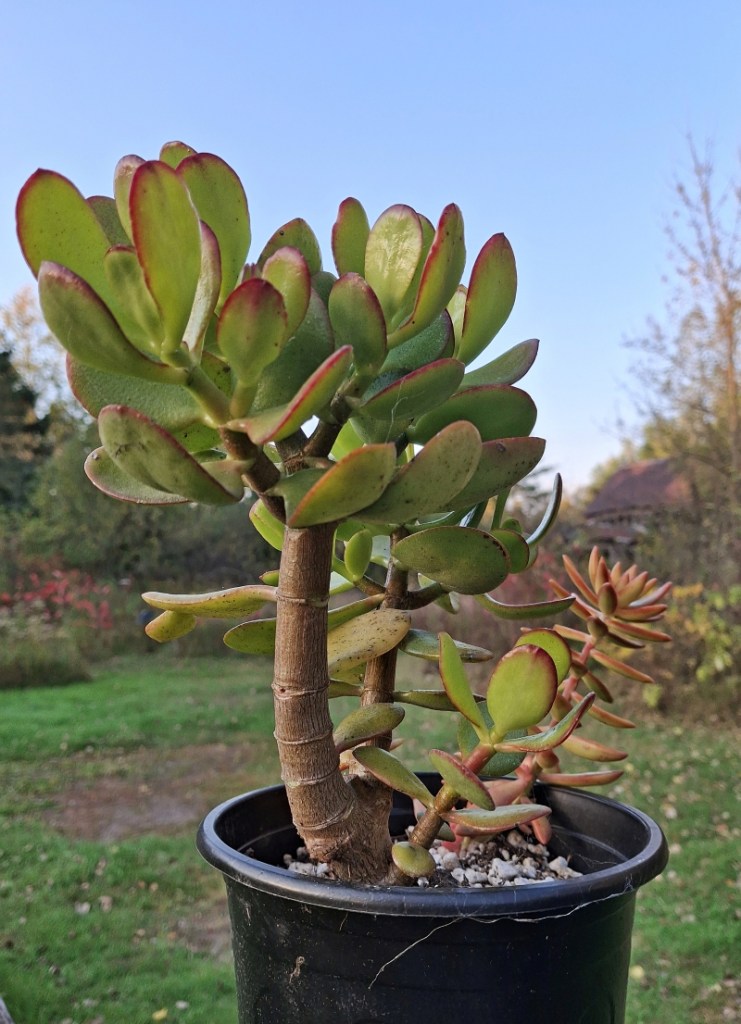
A jade plant I started from a cutting two years ago. In the winter, it lives under grow lights, but in the summer, it enjoys the fresh air and the rays of the sun. Tomorrow, it will have to come back indoors along with the Echevarria, Sansevieria, Tradescantia, and the epiphytic Zygocactus, Hatiora, and Rhipsalidopsis cactus.

We’ve had exceptionally warm weather for the last week, and even before that, the temperatures were just plain nice. But Sunday is the last day of temperatures in the 70s and 80’s. Yesterday it was 90 degrees in the shade. Tomorrow it will cool down to the 60s, and there is a chance of frost for three nights in a row.

After Monday, I will probably have to cut them down and store the tubers for the winter. The same is true for the tuberous begonias and the gladiolus. And all the houseplants I set out for their summer vacation will need to be brought back in.

A stalled high-pressure system is bringing the warm weather. Winds are from the south and gusting to 30 mph. The warm weather, while enjoyable and welcome so late in the year, is bringing problems to the already dry forests and fields. Even the wetlands are dry. Very dry.

A View from LeVeaux Mountain

LeVeaux Mountain is a part of the Sawtooth Mountains in northeastern Minnesota and located in Cook County. It rises about 1,586 feet above sea level and 986 feet above Lake Superior. On its south side it overlooks Lake Superior. On LeVeaux Mountain’s north are spectacular views of a forest including a stand of ancient sugar maple. To the east is the Onion River named after all the wild leeks that grow in the sugar maple forests. To the west are miles of thick forest and swamps.

A section of the Superior Hiking Trail goes by LeVeaux Mountain with a small spur loop on the west side that makes accessing the mountain possible. Most of the land that includes the mountain is part of the Superior National Forest and so anyone can walk off the trail without violating private property laws. However, the terrain is rugged and steep cliffs and talus slopes ring much of the mountain making casual hiking dangerous. I don’t recommend it for people unfamiliar with hiking in roadless or trail-less places. You could get seriously hurt.

I’ve hiked off trail on and around LeVeaux Mountain several times but I’ve gone prepared (including studying maps and aerial photos well beforehand) and dressed in suitable clothing not the shorts, t-shirts, and sneakers I often see on some day hikers using the trail. Such treks have been rewarding and physically challenging but that’s what I was seeking.

A Mystery Solved

This orange organism growing on the surfaces of fallen leaves in the woods has stumped me for years. I had long thought it was some sort of slime mold (Myxomycota), and every spring when I saw the little orange patches it forms on dead leaves and deer dung in the forest I would go searching websites to find out what this strange slime mold was. I never did figure it out until today when I looked very carefully at the cup-like structures and thought that maybe this is no slime mold but a fungus in Ascomycota (cup fungi). Within a few minutes I came across several photos of an orange fungus that looked very similar to this one. Not only that but I solved another new mystery, which was the white fungus with brown cups growing with the orange one. The answer to both mysteries was found at Sociedad MicológicaI Extremeña.

The orange fungus is Byssonectria, and the white one with dark brown cups rimmed with lighter brown is Pseudombrophila. Both are “vernal” fungi, that is, fungi that fruit in the cooler part of early spring. As for whether one is being eaten by the other, it only looks that way. These species grow in the forest on animal dung and where animals (deer in this case) have urinated. The Byssonectria may be B. terrestris (see key) , but I have not found out what the other one is apart from Pseudombrophila. Both species are classed in:

Kingdom – Fungi
Phylum – Ascomycota
Class – Pezizimycetes
Order – Peziales
Family – Pyronemataceae

SOURCES

Bysonectria terrestris at Sociedad MicológicaI Extremeña.

Harmaja, H. ( 986). Studies on the Pezizales. Karstenia 26: 41

Pfister, D. H. (1993). A Synopsis of the North American Species of Byssonectria (Pezizales) with Comments on the Ontogeny of the Two Species. Mycologia, 85(6): 952-962.

Seaver, F. J. (1951). The North American Cup-fungi (Inoperculates). Published by the author.