I found some more leaf mines

A leaf mine in a big-leaf aster leaf that was probably made by the larva of an Ophiomyia sp., a genus of leaf-mining flies.

Recently, I’ve become more interested in leaf mining insects after finding what might be the serpentine leaf mine of a Stigmella moth in a blackberry leaf. This wasn’t the first moth leaf mine I have found. In 2017, I identified another leaf mining moth, Phyllocnistis populiella, recognizing it from its leaf mine in a balsam poplar leaf.

Later, in 2019, I found the adult of another poplar leaf mining species, Phyllonorycter nipigon. Beyond that, my findings of leaf miners have been sporadic and by chance when photographing micro-moths at my moth lights.

Changing weather, changing focus

With the colder fall weather, it is more difficult to find insects and other arthropods. So, now I am turning my attention to the signs of them.

Out on my walks in the woods late last month, I came across five more serpentine leaf mines. The first was in a big-leaf aster (Eurybia macrophylla), which is shown in the photo at the top of the page. The other four were in wild red columbine (Aquilegia canadensis), coltsfoot (Petasites palmatus), goldenrod (Solidago gigantea), and bunchberry (Cornus canadensis). I couldn’t find larvae in any of them, but I think I have a good idea of what made them.

This leaf mine in a columbine leaf was probably made by a larva of Phytomyza aquilegivora.

Possible identifications

The leaf mine in the aster leaf was probably made by the larva of a species of fly in the genus Ophiomyia, leaf mining flies in the family Agromyzidae.

While I’m not absolutely certain, the leaf mines in the other four plants were probably made by the larvae of leaf mining flies in the genus Phytomyza, also in the family Agromyzidae.

I’ve probably seen the adult Phytomyza flies, but didn’t give them a second thought, assuming they were just some more pesky flies buzzing around my head looking for blood or sweat. Next year, I’ll be paying more attention.

Leaf mining flies are species-rich

There are at least 600 named species of Phytomyza, making it the largest genus of leaf mining flies in the world. Ophiomyia has over 200 species. Species of Phytomyza and Ophiomyia are host-specific, which accounts for much of the diversity in their genera.

Cerodontha is another species-rich leaf mining fly genus in the Agromyzidae, with 285 species worldwide. Cerodontha is a monocot specialist mining the leaves of sedges (Cyperaceae), soft rushes (Juncaceae), irises (Iridaceae), and grasses (Poaceae). Some Cerodontha species have been found in Minnesota and neighboring Wisconsin.

A quick search of species of Phytomyza and Ophiomyia that might occur in northern Minnesota shows at least twenty species and five species, respectively. The number of Cerodontha species in Minnesota is unknown. I think next summer is going to be an interesting one.

Further Reading

Every leaf of this bunchberry has a leaf mine.

Moths and Their Nighttime Floral Visits

Xestia normanianus, a dart moth, nectaring on lance-leaved aster (Symphyotrichum lanceolatum) at night.

What do moths do at night anyway? Some of them visit flowers for nectar.

Back in August, I was wandering about in the woods at night looking for foxfire fungi. At the head of the trail on my way out, I saw a sunflower plant with something on the flowers. It was a green tree cricket (Oecanthus) eating the stamens in the sunflower florets.

The next night, I went back but this time with my camera, hoping to find more tree crickets. I had my LED headlamp on like the previous night and used it to illuminate the flowers and foliage where I wanted to photograph. I also set the flash of my camera to “on”.

Although I could hear tree crickets in the bushes, I didn’t see any this time. What I did see were lots of moths on sunflowers and asters. Aiming the lamp’s beam at the flowers, I then pointed my camera at the moths and began taking photos. I wasn’t using a tripod, so many were blurry. Some were also overexposed by the bright LED light. But a few turned out.

The moth species (Xestia normanianus, Feltia jaculifera, and Nephelodes minians) I found on flowers at night came as no surprise. These and other dart moth species are common visitors to my moth lights. But it was exciting to see them going about their normal activities in a natural setting. I never did find any foxfire this year.

Moths weren’t the only visitors to flowers at night. I wonder if this crab spider was sleeping or waiting for a moth.

Greetings from two tiger moths

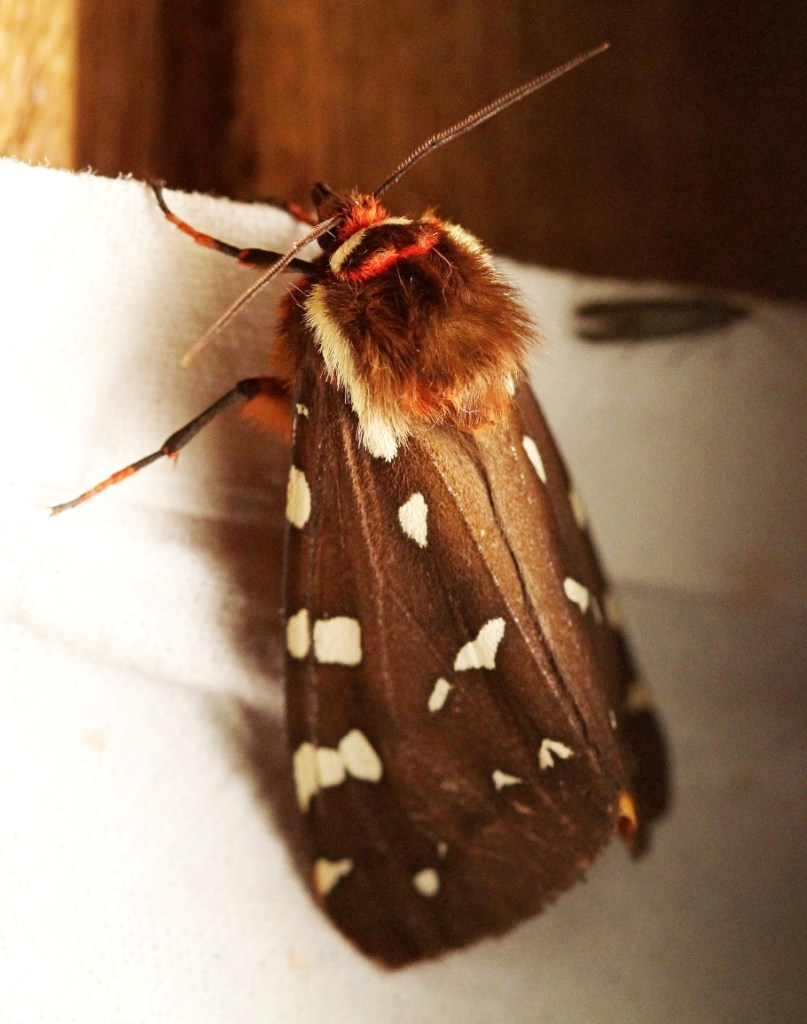
Apantesis phalerata (Harnessed Tiger Moth). The pectinate antennae indicate this is a male. Photographed on June 25, 2022.

In an earlier post, I wrote about Williams’ tiger moth (Apantesis williamsii). In this one, I present two more Apantesis species: Apantesis phalerata (Harnessed Tiger Moth) and Apantesis virgo (Virgin Tiger Moth).

Most Apantesis moths are characterized by dark forewings and numerous, often parallel, crisscrossing white or off-white lines. The patterns are usually distinctive enough to determine species, but not always.

What’s in a name?

The genus name Apantesis is from the Greek word “apantēsis”, translated as “meeting, an encounter/reply” and “to meet face to face“. It describes a custom of meeting visiting dignitaries where citizens would gather to welcome and escort the dignitary or hero in a procession. I’m not sure why this word was used to name the genus.

Harnessed Tiger Moth (Apantesis phalerata)

Harnessed Tiger Moth (Apantesis phalerata) is part of a group of similar species that includes Apantesis nais, Apantesis carlotta, and Apantesis vittata. Characteristics of the forewing pattern overlap in all four species, making accurate determination difficult, if not impossible, from a photograph. Had this moth spread its wings, exposing the underwings, then the choice might have been between Apantesis phalerata and Apantesis carlotta. Or maybe not.

Genital dissection is considered to be the only reliable way to determine these Apantesis species accurately, but I’m not willing to chop up a moth that rarely gets this far north. I’m just going to call my moth Apantesis phalerata because it looks more like identified specimens than it does the other three species. Additionally, the orange thorax appears to be another characteristic in photos of moths identified as Apantesis phalerata, distinct from the other three. Of course, I could be completely wrong.

Apantesis virgo (Virgin Tiger Moth) showing the underwings. The pectinate antennae indicate this is a male. Photographed on July 22, 2019.

Virgin Tiger Moth (Apantesis virgo)

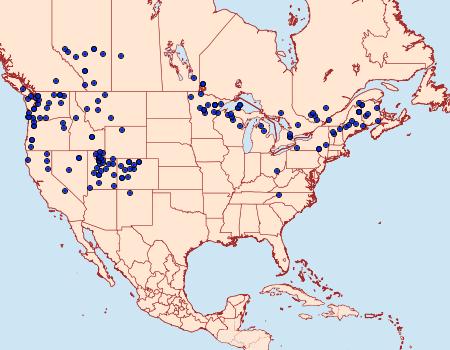
Identifying Virgin Tiger Moth (Apantesis virgo) is not as fraught as it is with Apantesis phalerata. Apantesis virgo is a large white, black, and red moth, 20 to 27 mm long. Black in color, the forewing has distinct off-white veins and transverse lines in the postmedial and subterminal areas. The hindwing may be bright pink, red, orange, or occasionally yellow, with an antemedian and outer margin lined with a row of black spots. There is also a patchy marginal band.

Larvae and host plants

Larvae of Apantesis moths are similar in appearance. Black and bristly, Apantesis virgo larvae have orange-brown spiracles; the setae beneath the spiracles may be orange. Brown to black bristles cover the black larvae of the Apantesis phalerata, which frequently have a pale dorsal line. Larvae of both species feed on low-growing herbaceous plants.

Range and distribution

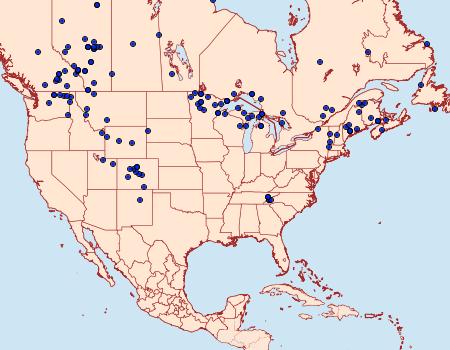
The following two maps from the Moth Photographers Group show the range and distribution of Apantesis virgo and Apantesis phalerata.

Going in circles

A Stigmella moth leaf mine in a bristly blackberry leaf.

While out one afternoon in my tamarack swamp hunting for dwarf mistletoe, the subject of a future post, I found this leaf mine in the leaf of a bristly blackberry. The blackberry is possibly Rubus flagellaris, but I’m still working out the identity of the species.

The leaf mine bears a strong resemblance to the leaf mines made by the larvae of the moth Stigmella villosella (Family Nepticulidae). Stigmella villosella is a specialist on Rubus species. The adult moths are minute with a wingspan of only 3 mm.

I doubt I’ll see this moth at my lights, but maybe next year, if I find an active leaf mine, I could raise the larva to maturity. I’m going to give it try anyway.

Another Rubus leaf, but without leaf mines, just a few holes all near the midvein made by some unknown insect.