Macrochilo bivittata is one of those moths I look forward to seeing every year. It isn’t a showy species, just a small triangular-shaped moth with four dark stripes against a buff to brown background, some prominent wing venation, and two pairs of dots. It is in the Herminiinae or litter moths, named because the larvae of many species feed on fallen or dead leaves and fallen fruit.
The reason I get excited about seeing it again is that where I live is one of the few known places in North America where it occurs.Across its range, Macrochilo bivittata is uncommon to rare. Minnesota and Wisconsin appear to have the largest number of observations. The rarity of Macrochilo bivittata may be a lack of verified observations and not rarity based on specialized habits or food requirements, loss of habitat, or replacement by a non-native species. More searches in appropriate habitat could help to resolve this.
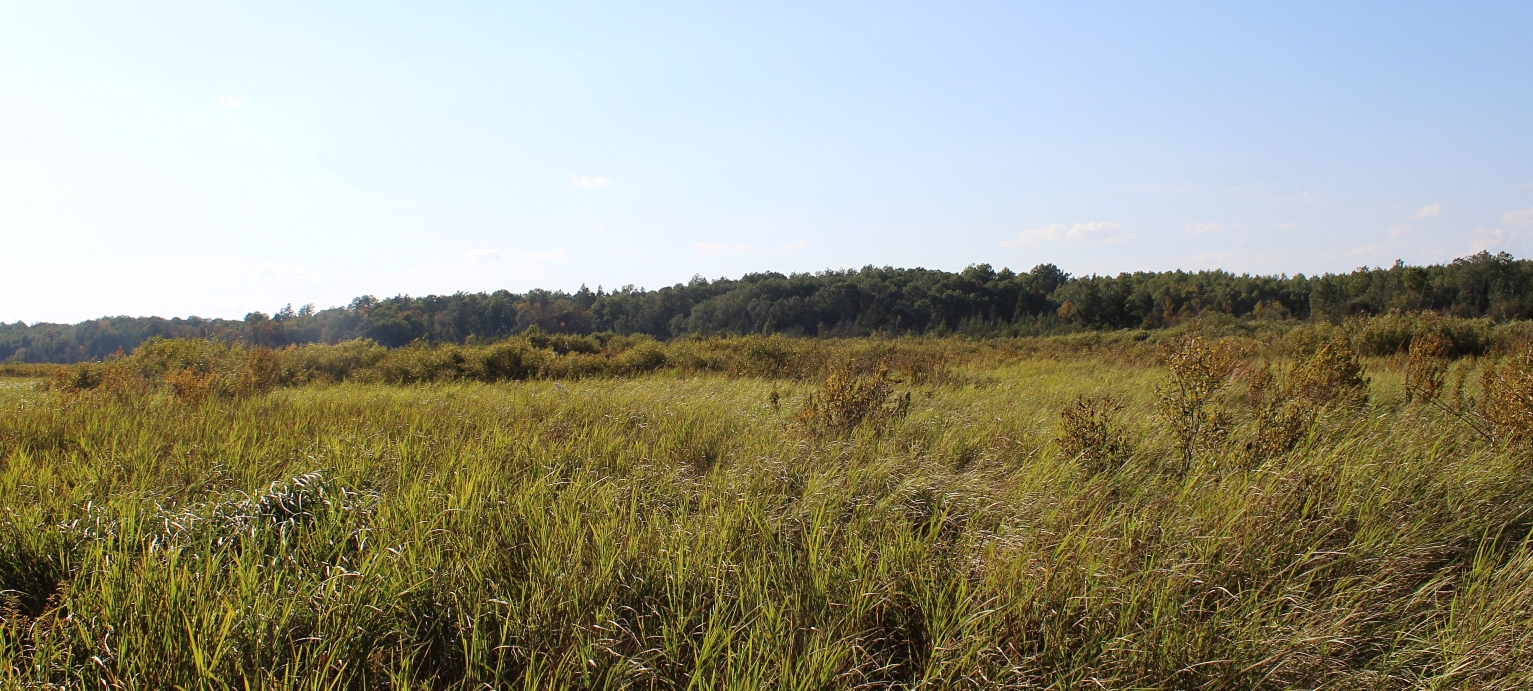
A few Macrochilo bivittata moths come to my moth light every year in July. But it is in a nearby old marsh grass hayfield, now reverting to sedge meadow-shrub carr wetland, where I see many more. As I walk through the tall grasses, sedges, and willow shrubs, dozens of these little moths fly ahead of me to escape the disturbance.
The sedge meadow-shrub carr wetland where Macrochilo bivittata lives. Except for a few patches of canary grass, most of the plant species here are native.
The food preferences of Macrochilo bivittata are not known. It is thought their larvae feed on leaf litter like other members of the Herminiinae. There is certainly an abundance of leaf litter out there under the grasses and willows in the old hayfield. Macrochilo bivittata seems to be doing very well with that.
I have two pots of basil on my porch for fresh basil leaves. Everything was going well with big plants with big leaves full of flavor and fragrance. One afternoon, I went to get a few large basil leaves. I was going to make an omelet with Gruyère cheese, onions, crushed garlic, cherry tomatoes, peppers, potatoes, and mushrooms. And fresh basil.
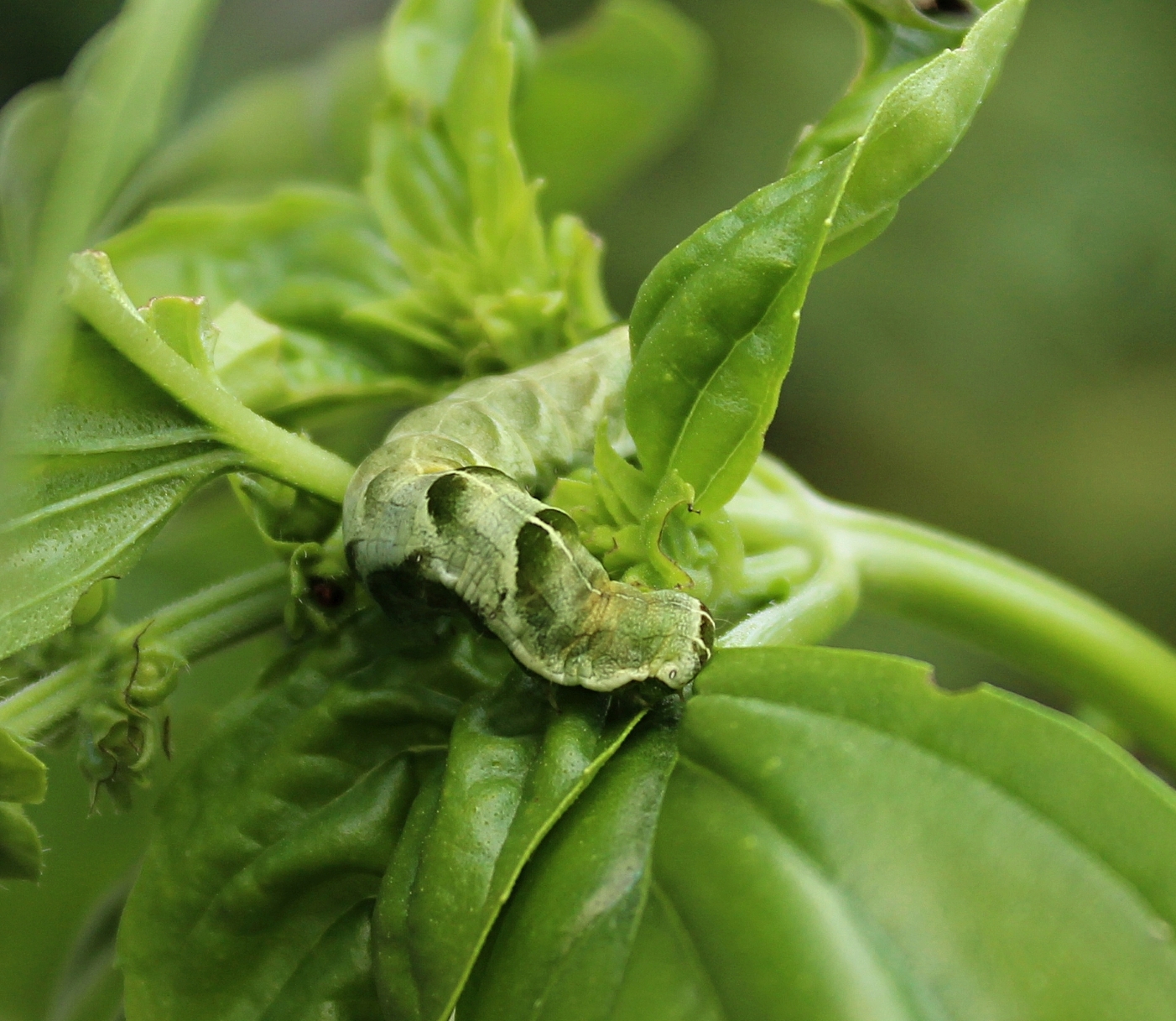
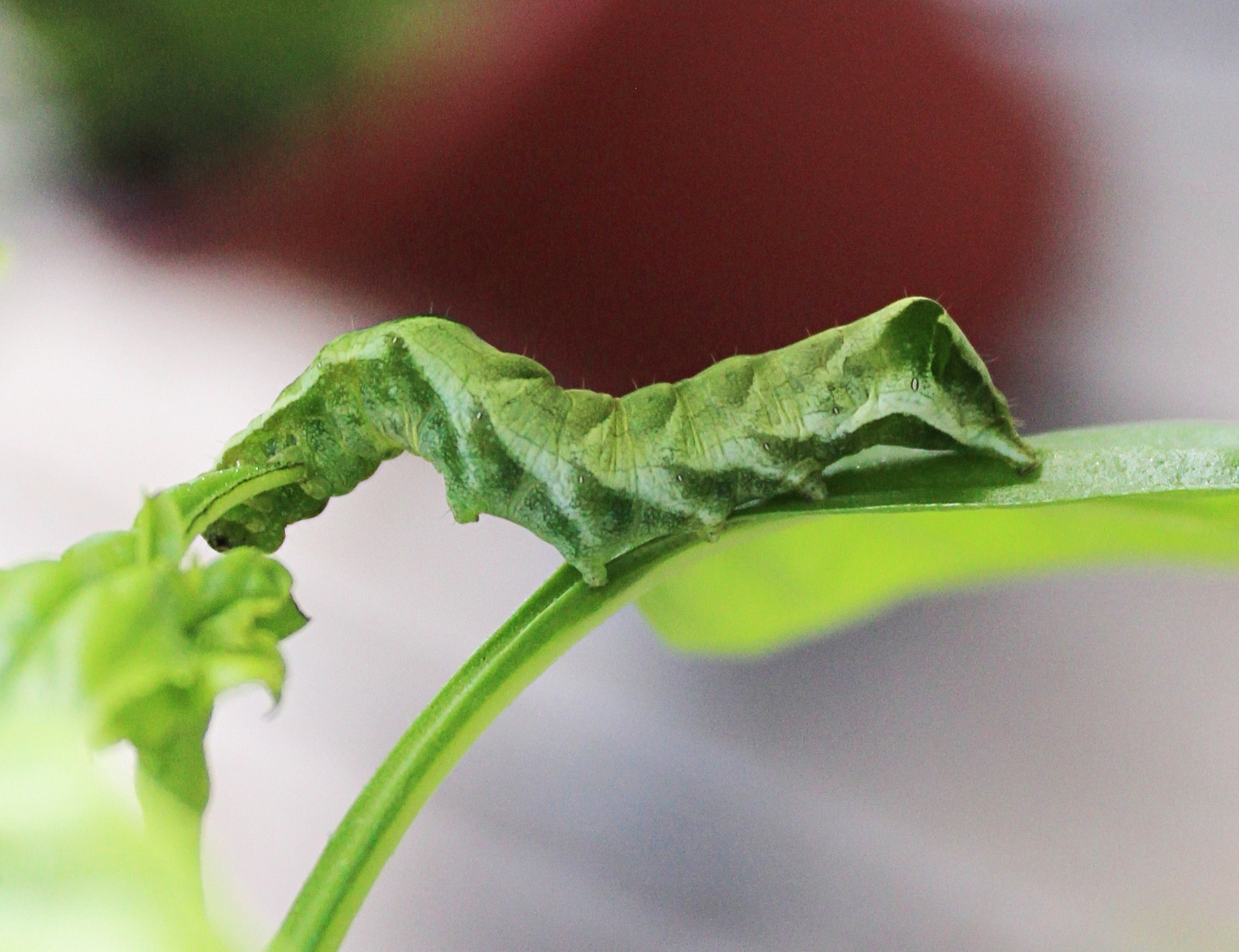
When I looked into one of the pots, there on the largest plant was this strikingly patterned green caterpillar. I’d never seen anything like it before. It reminded me of a sphinx moth caterpillar. But there was no horn or even a bump on the last segment. The head seemed to have the wrong shape, too. Maybe it was a cutworm caterpillar (Noctuidae: Noctuinae), not a sphinx (Sphingidae)?
After many pages at BugGuide, I was at the genus Melanchra. The first species to show up was Melanchra adjuncta (hitched arches), and my caterpillar looked just like it. To be sure, I continued on a little more but found nothing similar.
Basil isn’t the only plant Melanchra adjuncta eats. Their palate is open to a wide variety of herbaceous plants and even leaves of some woody plants. After eating for a few hours, the caterpillar left, perhaps to enjoy other plants on my porch.
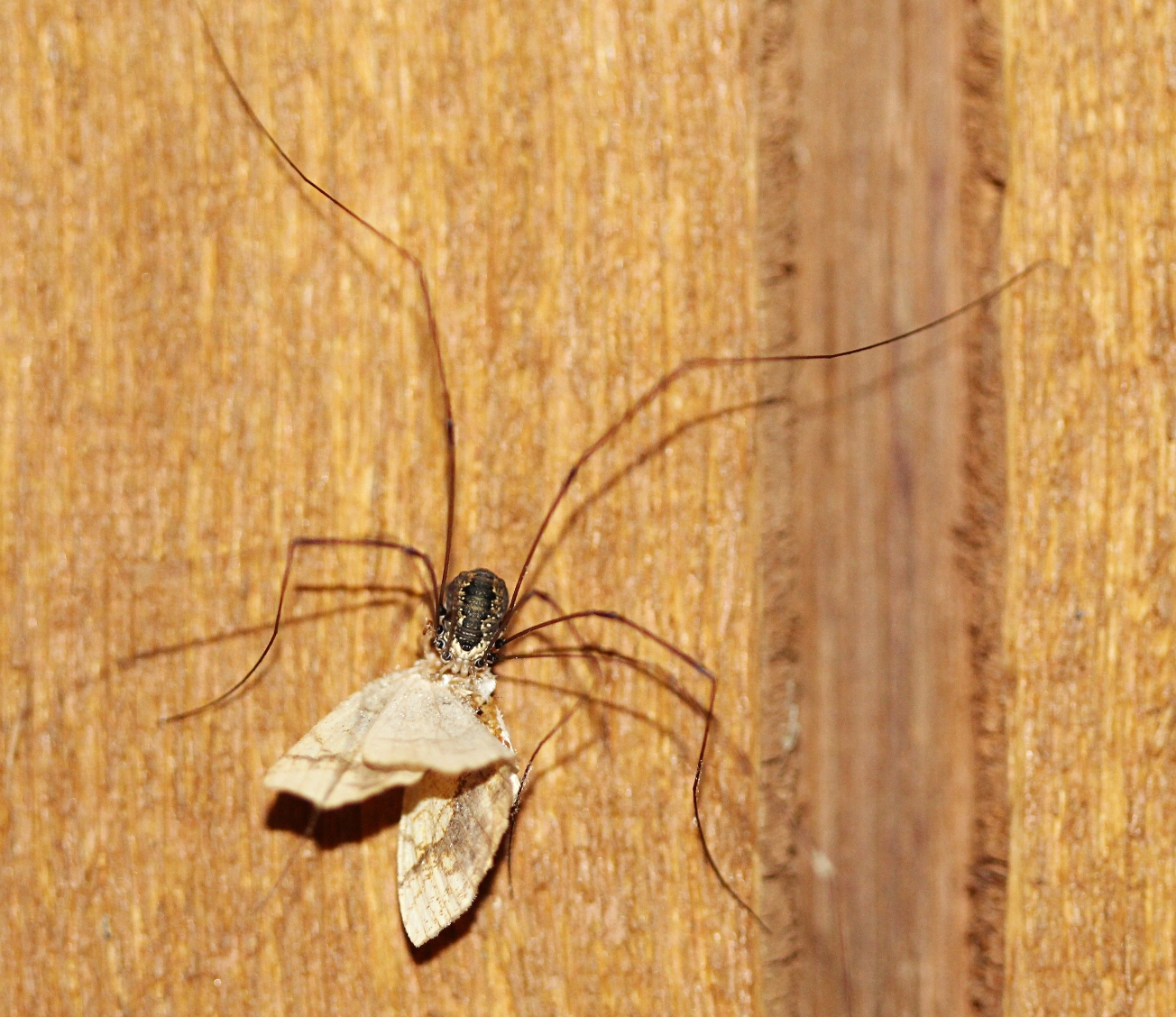
A harvestman (Leiobunum sp.), an arachnid, has captured and killed a horned spanworm moth (Nematocampa resistaria).
Attracting moths at night using lights has yielded an amazing number of species that I never even dreamed existed. My last count was at 865 moth species with 34 new species added to the checklist this year alone.
Many other insects, besides moths, come out at night to my lights. These include beetles, flies, Hymenoptera, and typical bugs. There are also leafhoppers, mayflies, caddisflies, Neuroptera, arachnids, myriapods, and Collembola. During the warmer, humid months of summer, there can be a lot of insect activity at the moth light.
People who put out bird feeders are often horrified when a shrike or hawk comes swooping in and takes away a chickadee. Those birds must eat, but that is not why we put out feeders. At night, attracting moths can pose similar problems with spiders, ants, and frogs drawn in by all the insect activity. Snakes then follow, hunting the frogs.
Here I present some photos of various predators that have come to my moth light. They include harvestmen, spiders, lacewings, ants, and frogs observed preying upon moths and other insects attracted to my moth light. The worst instance of predation, from my perspective, involved a fishing spider (Dolomedes tenebrosus). It captured and ate a twin-spotted sphinx (Smerinthus jamaicensis). I was upset, but it was too late for the moth. The spider’s venom acts quickly, and there was no saving it.
Arachnids: spiders and harvestmen
In the top photo is a harvestman (Leiobunum sp.), an arachnid, that has captured and killed a horned spanworm moth (Nematocampa resistaria). I have no idea how it accomplished this. They have no venom glands. They also lack sticky silk threads to snare prey like their spider relatives. Harvestmen are ambush hunters, but this is a large moth compared to the harvestman. Did it poison the moth using secretions from its scent glands (ozopores)? Does it use those secretions to secure prey, not just to deter enemies? All sources I have checked say no, but maybe this is something waiting to be discovered.
I should add that not all the harvestmen who come to the mothing light eat insects. One evening, I left out peels from very ripe bananas. I hoped the aldehydes and other volatiles would attract certain kinds of moths. That didn’t work, but I did see a harvestman consuming some of the pulp left on the skin. I wonder if it got its five servings a day of fruit?
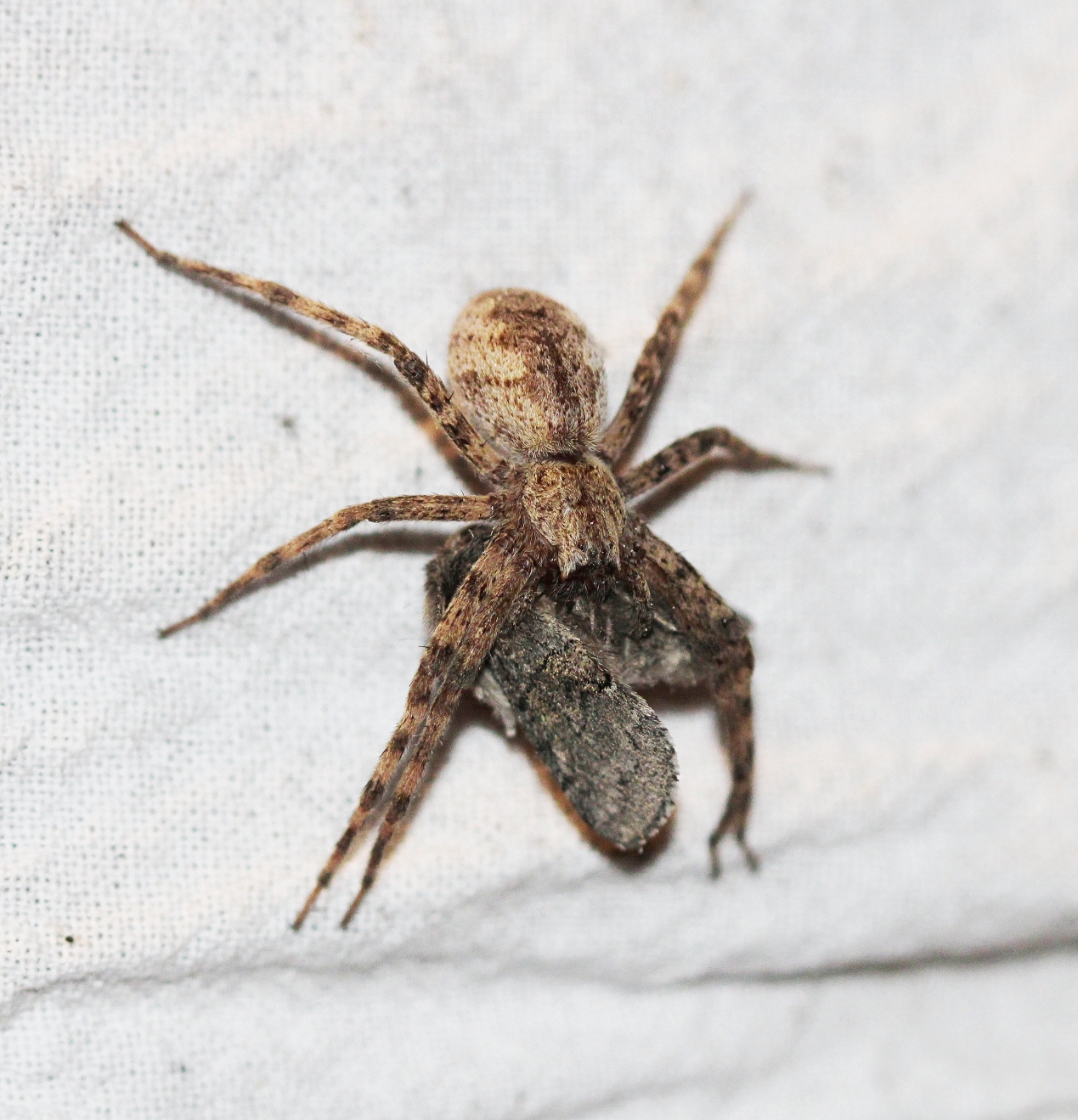
A fishing spider (Dolomedes tenebrosus) that has captured and is eating a northern gluphisia moth (Gluphisia septentrionis)
Above is a fishing spider (Dolomedes tenebrosus) that has captured and is eating a northern gluphisia moth (Gluphisia septentrionis). The same spider appeared the next evening and captured another northern gluphisia.
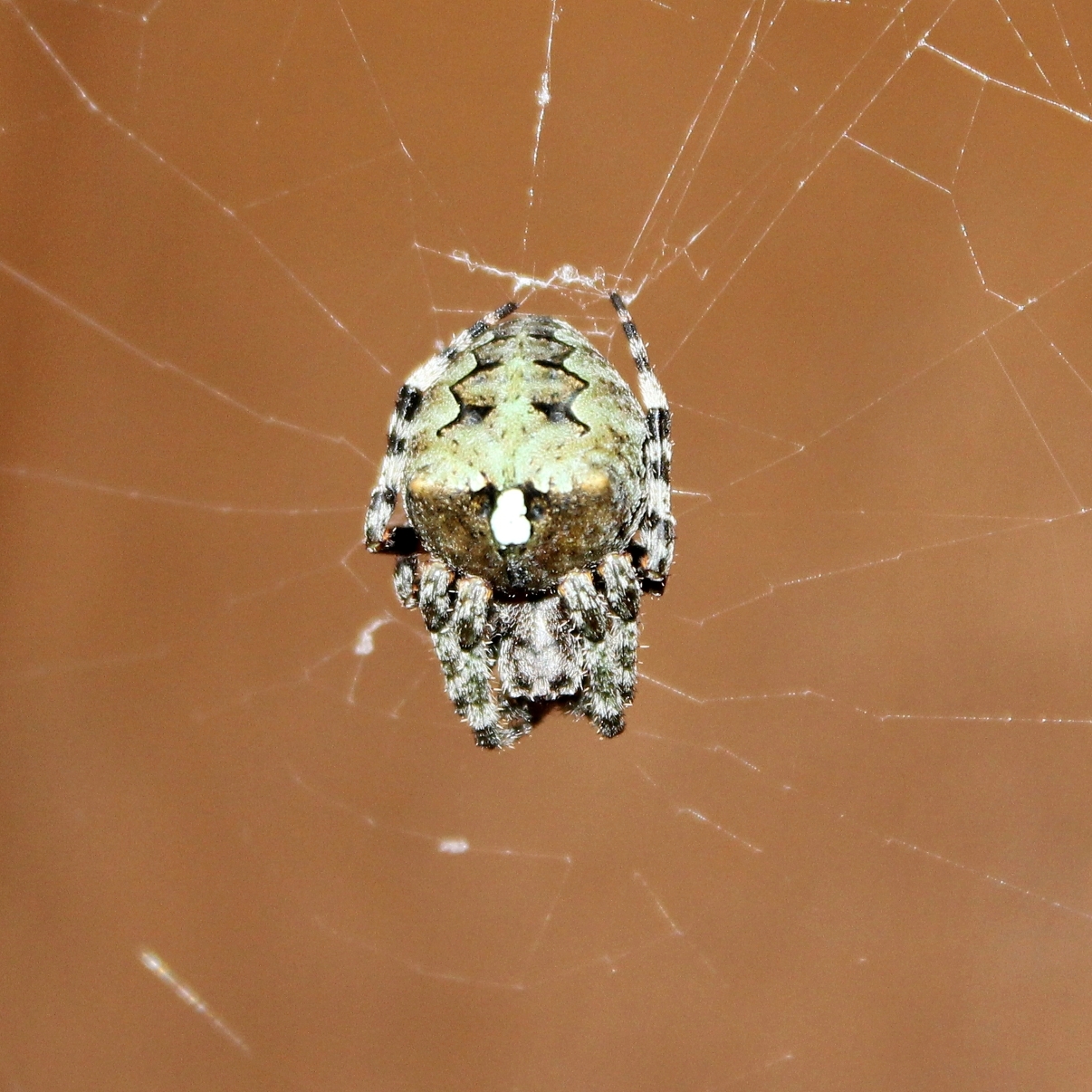
A female Araneus bicentenarius (lichen orb weaver spider) in the center of her web near the moth light.
Some spiders, like this lichen orbweaver (Araneus bicentenarius) above, build webs near the moth light. They do this probably because the corner of the porch wall offers a convenient trapping location. My moth light unintentionally lures moths and other insects near the orb web, where they can be trapped.
This spider didn’t stay long for some reason, and no insects were trapped. It may have been because a pair of eastern phoebes (Sayornis phoebe) were nesting in a little nook overhead. They may have created too much disturbance, or even eaten the spider. In any event, the spider was gone after one day. Phoebes do eat moths and I have seen them capturing moths that remained on the porch wall after sunrise.
Hymenoptera: ants
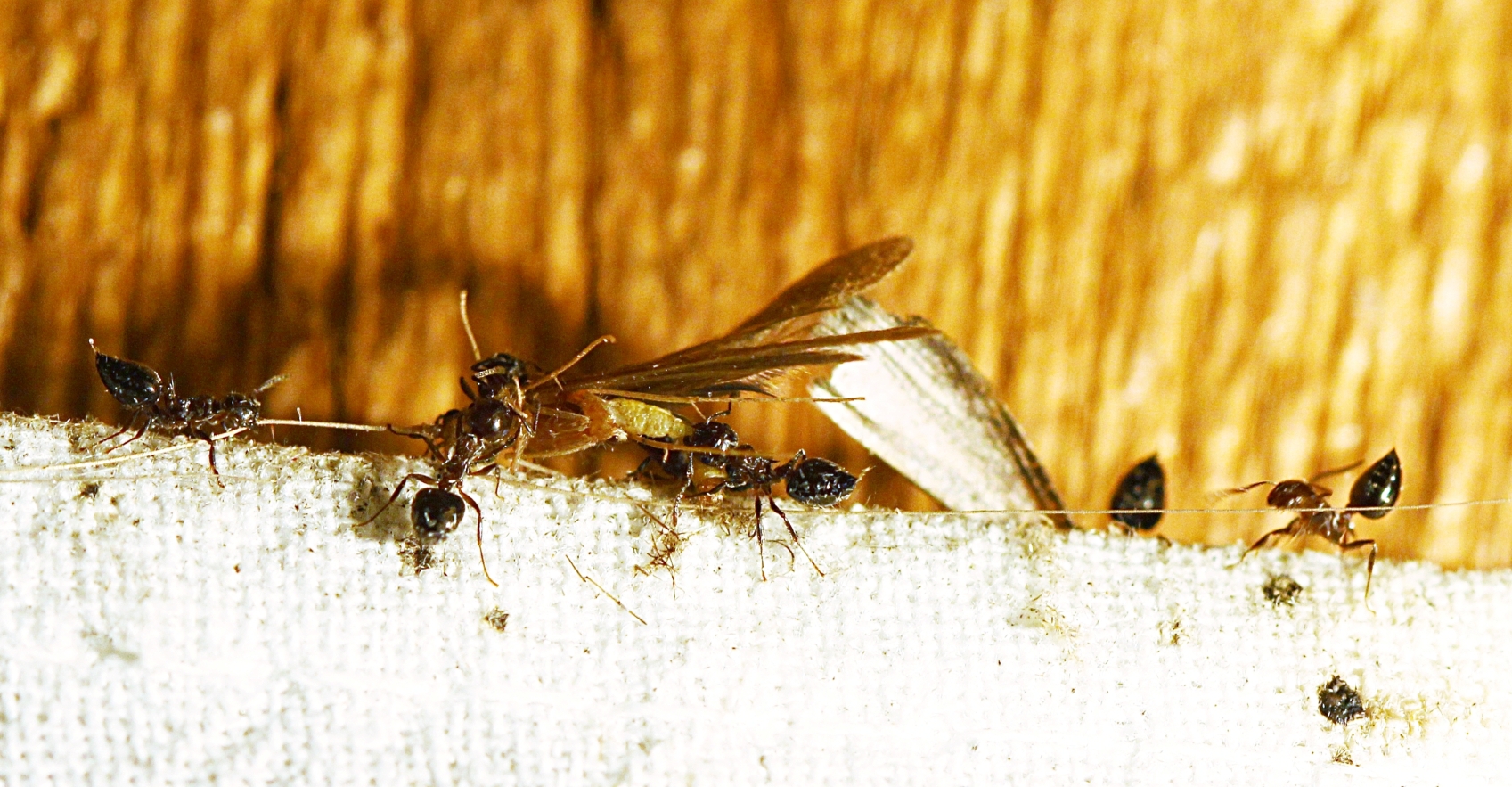
Crematogaster sp. (acrobat ants) have captured a small caddisfly.
Ants are active during the day and also at night. This is not surprising as they spend a good part of their lives in dark tunnels, finding their way using scent trails laid down by other ants. Above, a swarm of Crematogaster sp. (acrobat ants) has captured and is dismantling a tiny caddisfly that got tangled in spider web fragments.
Neuroptera: lacewings
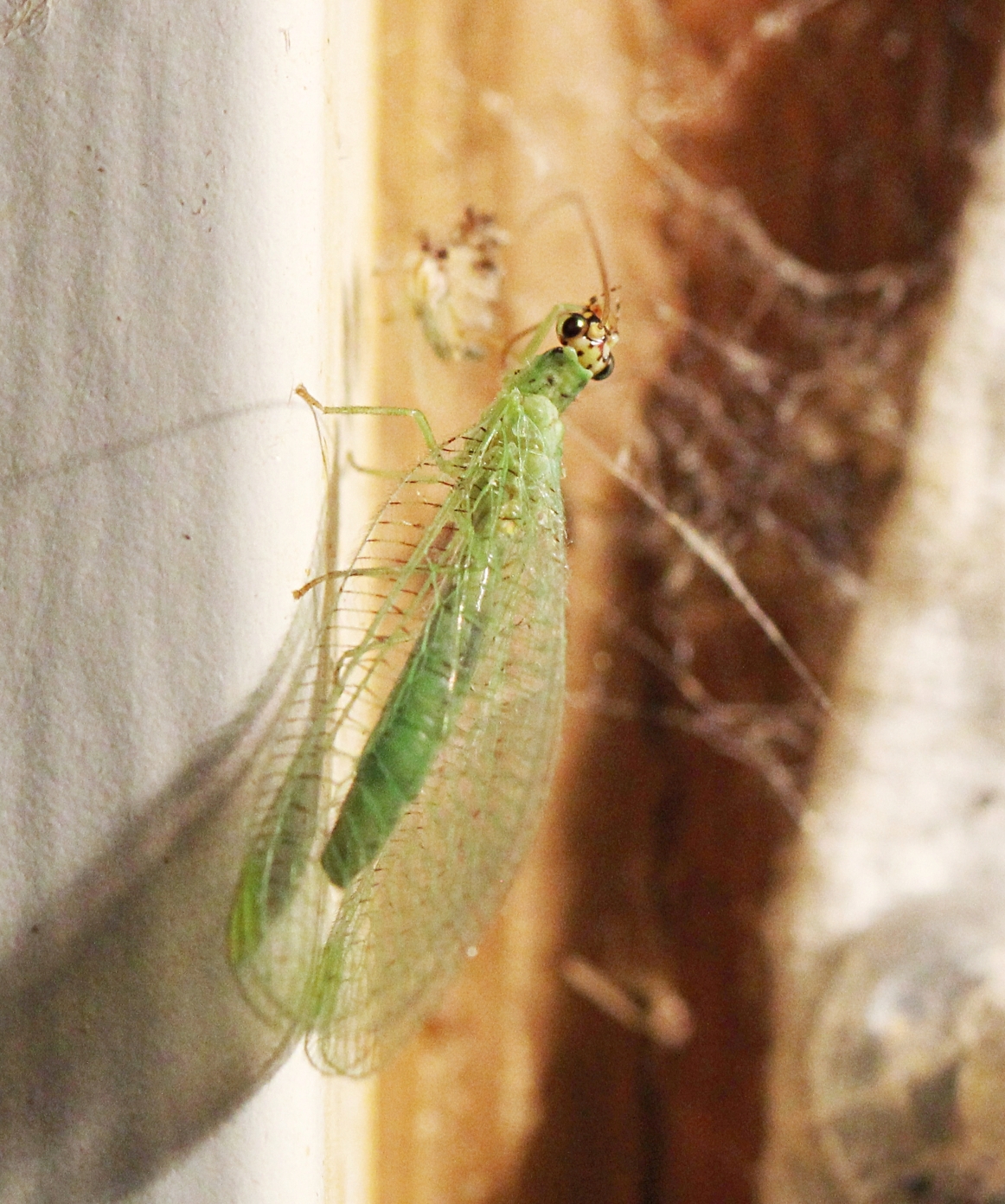
A green lacewing (Chrysoperla sp.) is searching in the debris of spider web fragments for prey.
Lacewings eat aphids and other small soft-bodied arthropod prey, including insect eggs. This lacewing (Chrysoperla sp.) was searching in spider web fragments where small leaf hoppers, like Chlorotettix spp. and psyllids, became entangled. When the lacewing found one, it ate it.
Amphibians: frogs
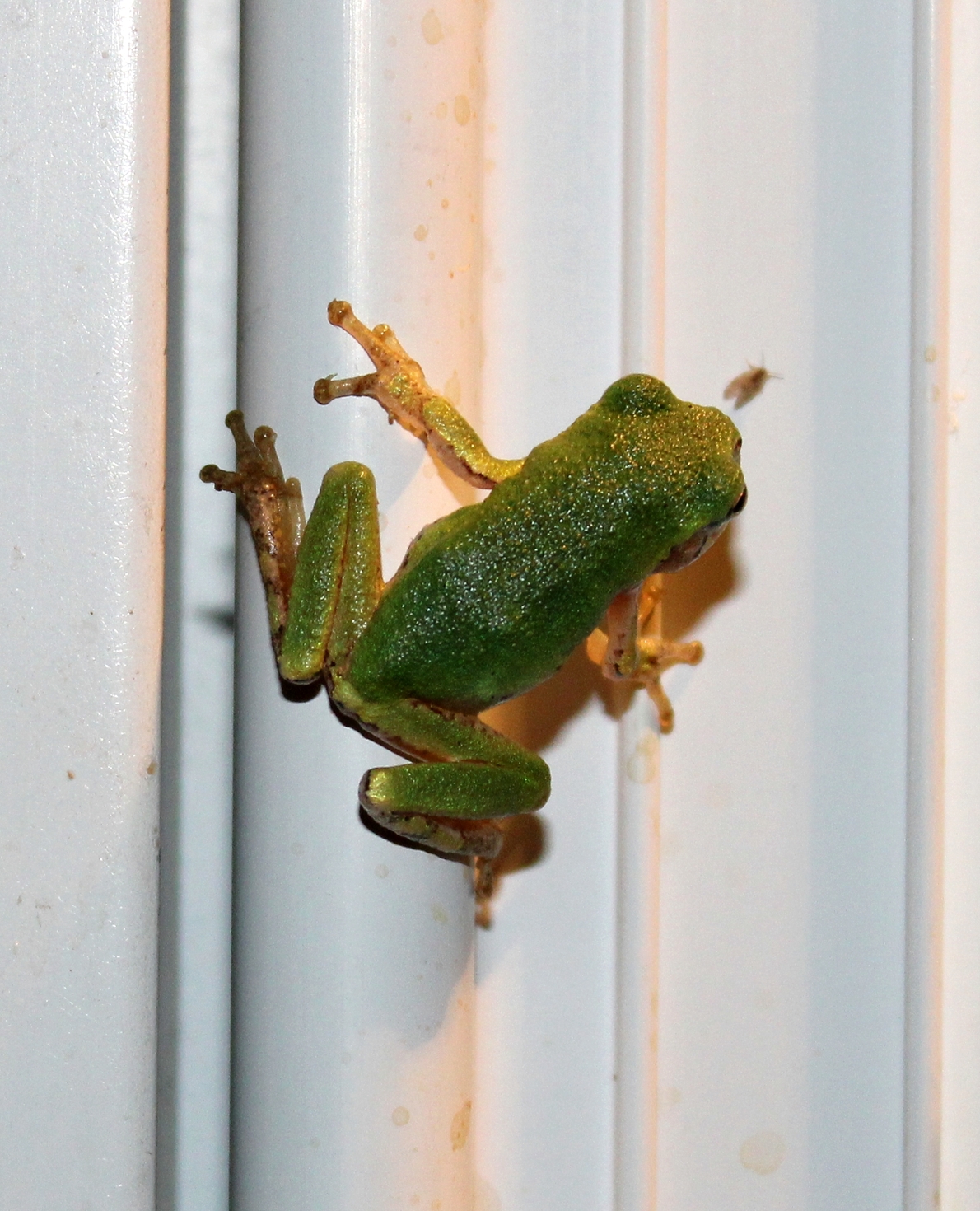
A gray tree frog (Hyla versicolor) is getting ready to strike at a psyllid, an aphid-like insect.
Finally, a gray (okay, this one is green) tree frog (Hyla versicolor) on the hunt, searching for minute insects like this psyllid drawn to the moth light. Gray tree frogs are frequent visitors to the moth light, searching for food. With their sticky foot pads, they can climb up the walls to hunt for prey. Most of the gray tree frogs are small young-of-the-year individuals, but sometimes larger adults show up.
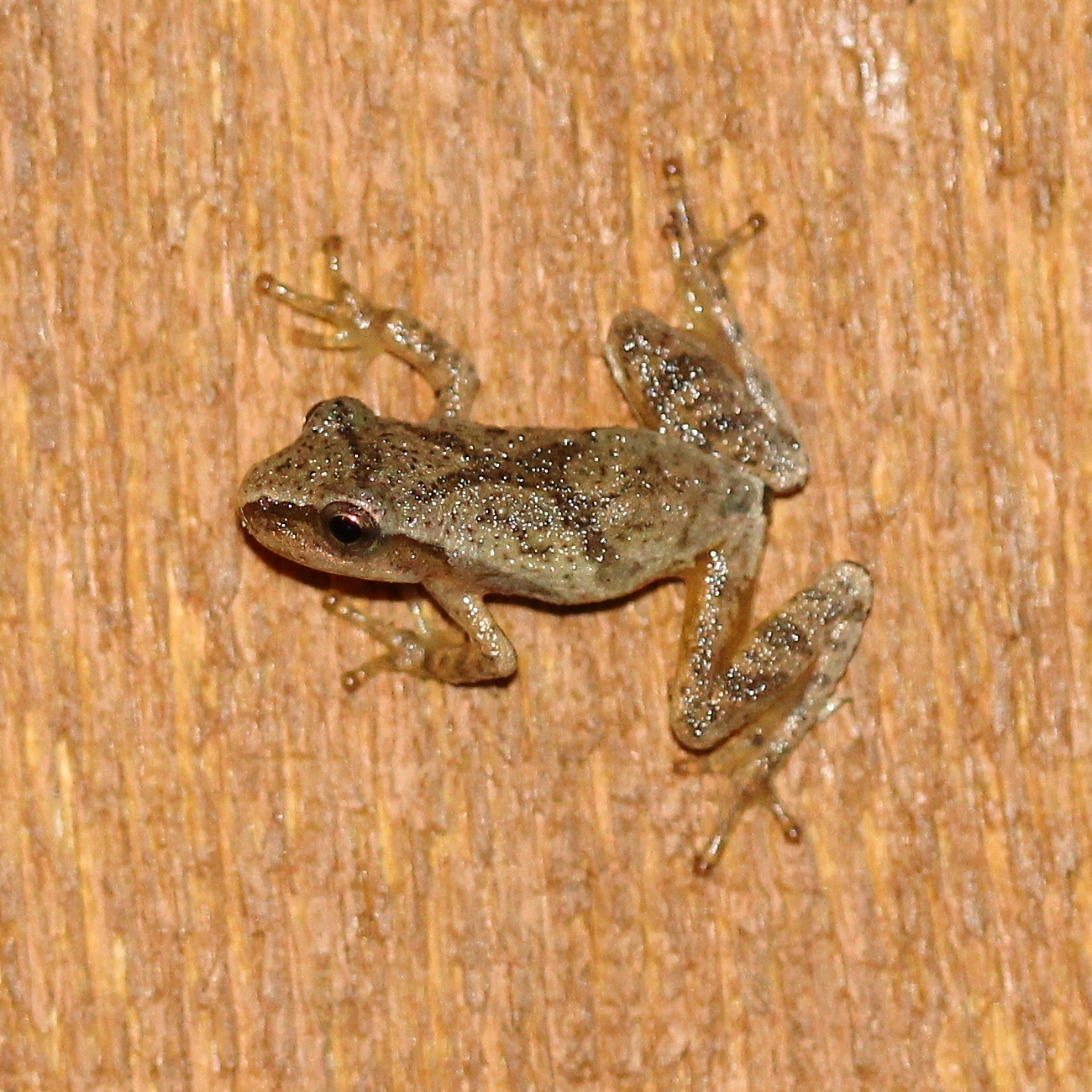
Spring peepers (Pseudacris crucifer) are common visitors. Like the gray tree frogs, many are young-of-the-year.
Pseudacris crucifer (Spring Peeper) froglet on the wall by my moth light, looking for small insects.
Down below on the ground, American toads (Anaxyrus americanus) search for fallen insects. Green frogs (Lithobates clamitans), mink frogs (Lithobates septentrionalis), and wood frogs (Lithobates sylvaticus) also look for insects that may be on the ground or under the porch. Some green frogs and mink frogs took up residence on the porch, living in pans where I was growing duckweed and other floating aquatics. Garter snakes (Thamnophis sirtalis) occasionally come by, too, and prey upon the terrestrial amphibians.
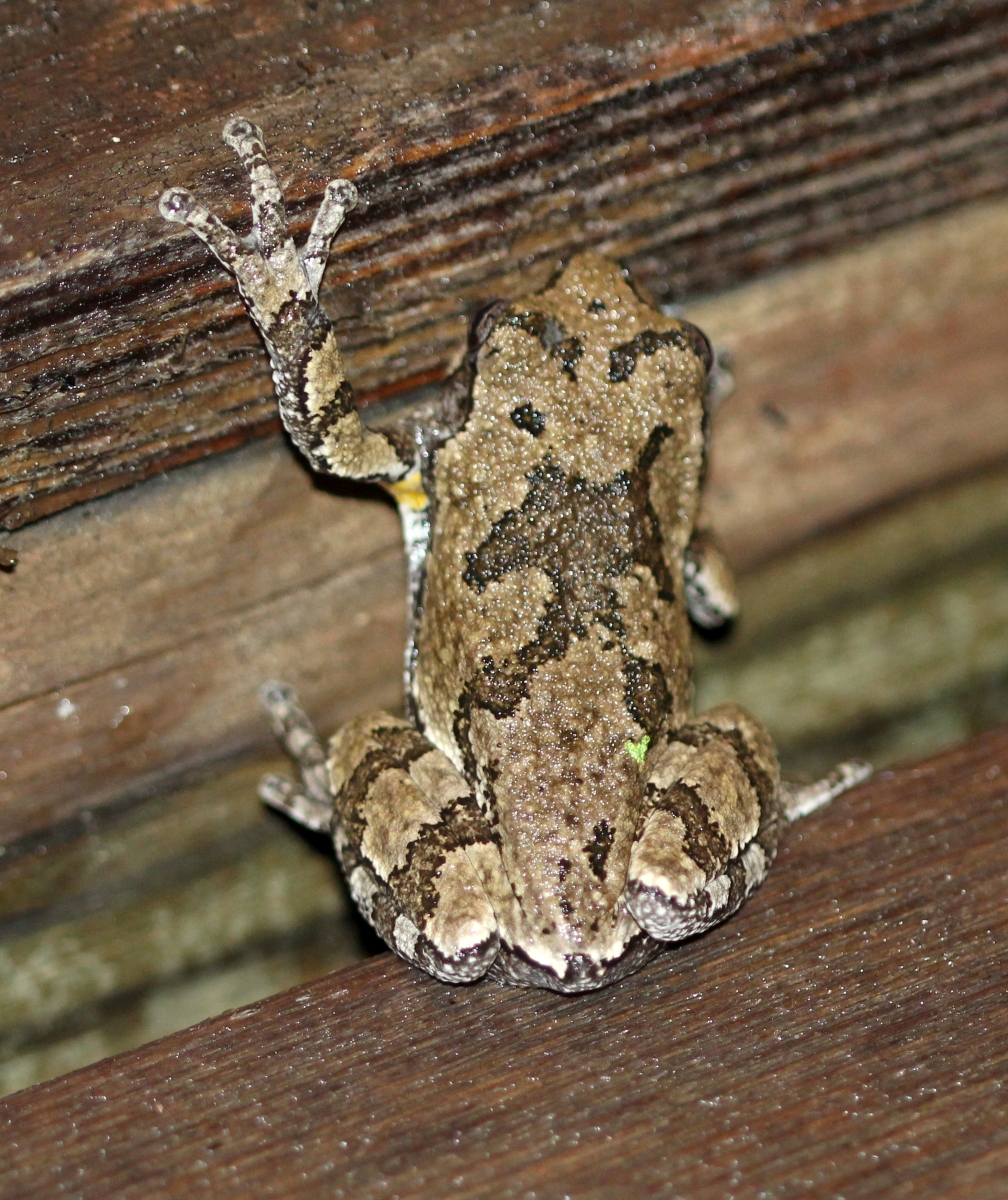
Another gray tree frog, this one boldly patterned, is preparing to climb up the wall in search of insects. This same frog would also climb up the glass of my office window at night to eat insects attracted to the light shining through the glass.
Some final thoughts
So, do you do mothing? And if you do, have you seen spiders or other predators coming by in search of food? What did you think about that? Should these predators be chased away?
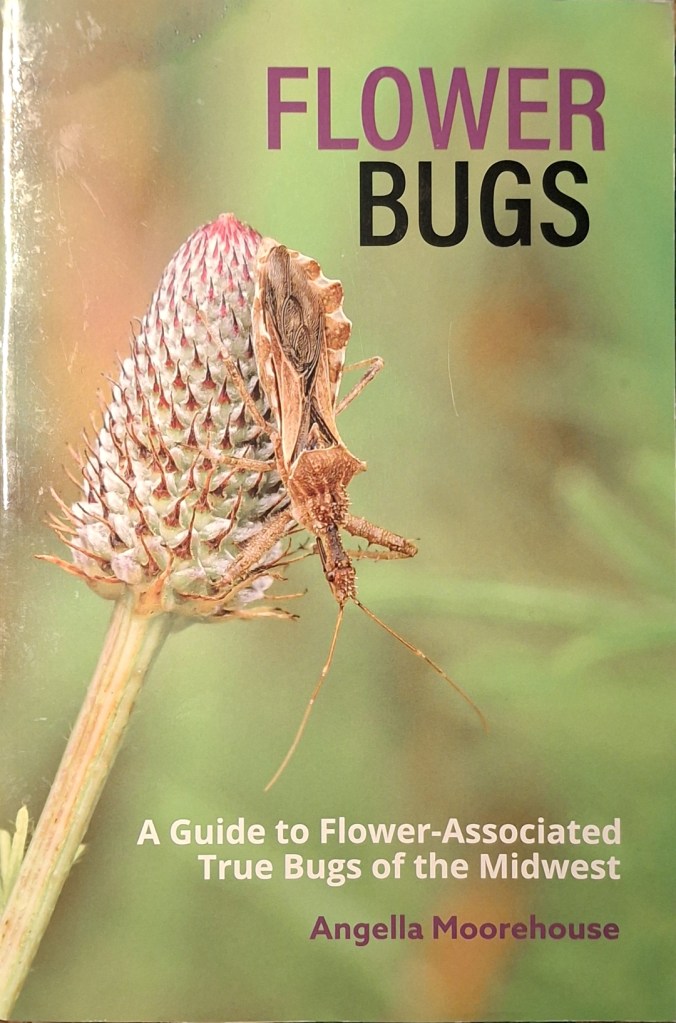
This just arrived today, and I know it will be so very useful as I venture further into the world of insects. Flower Bugs: A Field Guide to Flower-Associated True Bugs of the Midwest by Angella Moorehouse (2023) is published by Pollination Press LLC, Minnetonka, MN. The Pollination Press web address is www.pollinationpress.com.
This book has 360 pages, lavishly illustrated with beautiful full-color photographs of 160 species of terrestrial true bugs from 25 families and 52 genera. The area covered includes the states of Minnesota, Iowa, Missouri, Wisconsin, Illinois, Indiana, Ohio, and Michigan in the US and Southern Ontario in Canada.
The book includes taxonomic charts that will guide you to family and then to genus, detailed illustrations of bug morphology, their ecology, and a glossary of terms to help you learn and identify true bugs.
Species descriptions are not overly technical, thus making this book more accessible to non-specialists with some background in insect identification. Maps show the range of each species. There are notes on key identifying features, life history, ecology, feeding, and habitat. Descriptions of herbivorous species include lists of plants they consume. Carnivorous species are similarly treated. Not all species receive the same description treatments. Some are represented with photographs.
There seems to be a problem with the index, where some entries do not match the page numbers in the book. Not sure why.
I am loving this book already and will put it to good use identifying the many bug species I have photographed. My first project will be to go through the unidentified species in my files and to re-check previous identifications. After that, I’ll spend many an evening just browsing and waiting for spring and the bugs to return.



 Not Very Far Away