Moth Checklist Update


Its been a busy month and a half of mothing so far with many new species and as well as returning species seen last summer. As of May 31 the moth checklist for 2018 is now at 57 species with a combined checklist for 2017 and 2018 of 225 species. There are also many new ones in the “Unknown Moths” file. The latest checklist additions, all observed between May 26 and May 31, are Argyrotaenia marianaHelcystogramma melanocarpaAcronicta morulaElaphria versicolorEucosma awemeana, Petrophora subaequaria, Acronicta interrupta, Ancylis albacostanaLeuconycta diphteroides, Ectropis crepusculariaOrthofidonia flavivenata, Palpita magniferalisBibarrambla allenellaPlagodis pulverariaMonopis monachella, Pero morrisonariaApotomis funereaSemioscopis packardella, Tacparia desertata, Hydriomena renunciata, and Galgula partita. Returning species include Caloptilia stigmatella, Pseudeustrotia carneolaEuphyia intermediata, Tetracis crocallata, Gluphisia septentrionalis, Prochoerodes lineola, Metanema determinata, Metanema inatomaria, Plutella xylostella, Clostera albosigma, Acronicta lobeliae, and Idia americalis.


A sparkling shiny new moth


Another micro-moth identified. This one is a Tinted Moth or White-headed Monopis Moth (Monopis monachella, Family Tineidae). It showed up under my porch light a few nights ago. From a distance it looks like a grain of burned rice but close up it is very beautiful with a white furry head and thorax, and dark purplish wings that are decorated with iridescent blue scales, a pearly white patch, and fringes at the the upturned end of the wing.

The genus Monopsis has some very unusual feeding preferences. Monopis moth larvae feed on a variety of substances that we do not commonly associate with moth caterpillars which by and large eat leaves or other live plant parts. Instead, Monopsis larvae feed on feathers, fur, wool, dried skin and other less digestible parts of animal carcasses, owl pellets, bird droppings, and carnivore scat. In a Korean study feathers were used to bait traps to catch two species of Monopsis. A species of Monopsis has also been discovered that lives in bat caves feeding on guano and other debris.

Taxonomy
Class Insecta (Insects)
Order Lepidoptera (Butterflies and Moths)
Superfamily Tineoidea (Tubeworm, Bagworm, and Clothes Moths)
Family Tineidae (Clothes Moths, Fungus Moths)
Subfamily Tineinae
Genus/species Monopis monachella

Description
The following description is a summary after After Dietz (1905), Forbes (1923), Guo-Hua et al. (2011), and Bug Guide. Wings dark reddish brown (“purple black” in Guo-Hua et al. 2011) with ashy gray-brown spots, the costa trapezoidal, pearly white, extending from mid-wing to the tip, its edges diagonal. The diagonal edge of the costa encloses a translucent or vitreous circle which is typical of all Monopis. There are a few white scales are on the rounded wing tip. The head and thorax are white, antennae dark brown. Length approximately 5 mm.

Range
In the broad sense M. monachella has a near worldwide distribution. However, recent studies suggest that M. monachella is actually a collection of many morphologically similar looking species that can be reliably told apart only by DNA.

Larval Hosts
Larvae of M. monachella are reported to feed on animal remains that contain keratin (keratophagous) such as dried skin, feathers and other remains in bird nests, fur, wool and owl pellets which are the regurgitated bits of animals containing fur and bones an owl cannot digest. Some members of the genus are chitinophagous, that is, they can eat and digest fungi, the cell walls of which contain chitin, and the chitinous exoskeletons of arthropods. The larvae live in portable silken tubes.


SOURCES

Bong-Kyu Byun, Sat-Byul Shin, Yang-Seop Bae, Do Sung Kim, Yong Geun Choi. (2014). First discovery of a cave-dwelling Tineid moth (Lepidoptera, Tineidae) from East Asia. Journal of Forestry Research  25(3): 647-651.

Dietz, William G. (1905). Revision of the Genera and Species of the Tineid Subfamilies Amydrinae and Tineinae inhabiting North America. Transactions of the American Entomoligical Society, 31(1): 1-95 with six plates. Description of Monopis monachella on pages 30 to 33.

Dong-June Lee, Young-Don Ju, Ulziijargal Bayarsaikhan, Bo-Sun Park, Sol-Moon Na, Jae-Won Kim, Bong-Woo Lee, Yang-Seop Bae. (2016). First report on two species of genus Monopis (Lepidoptera, Tineidae) collected by feather trap in Korea. Journal of Asia-Pacific Biodiversity 9: 215-218

Forbes, William T. M. (1923). Cornell University Agricultural Experiment Station, 1923, Memoir #68: Lepidoptera of New York and Neighboring States. Description of Monopis monachella on page 132.

Guo-Hua Huang, Liu-Sheng Chen, Toshiya Hirowatari, Yoshitsugu Nasu, and Ming Wang. (2011). A revision of the Monopis monachella species complex (Lepidoptera: Tineidae) from China. Zoological Journal of the Linnean Society, 163: 1-14.

Genus Monopis at Bug Guide web site.

Monopis monachella at HOSTS web site.

Monopis monachella at NIC.FUNET.FI web site.

Monopsis monachella at Svenska fjärilar web site.

Species Monopis monachella – White-headed Monopis – Hodges#0418 at Bug Guide web site.


A Moth Among the Ferns

Northern Petrophora (Petrophora subaequaria)


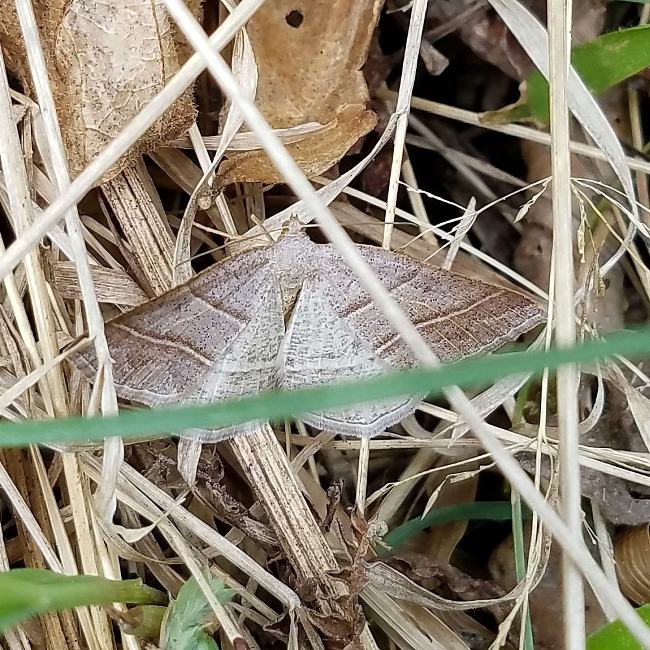
I was out taking a walk Sunday afternoon and saw many different small moths flying out from hiding in the grass and blueberry bushes. Most were too small and fast to get a good look at them. The one shown above flew and ducked under some grass blades just long enough for me to get a few snapshots before it took off. Later I went out again and saw dozens of them in a forest clearing full of bracken fern. The species is Northern Petrophora (Petrophora subaequaria, Family Geometridae) and its larvae feed only on ferns with bracken fern (Pteridium aquilinum) apparently the principle host plant. Photos at Bug Guide show the larvae on fronds of Osmunda fern.


Some brief information on Northern Petrophora (Petrophora subaequaria)

Taxonomy
Superfamily Geometroidea (Geometrid and Swallowtail Moths)
Family Geometridae (Geometrid Moths)
Subfamily Ennominae
Tribe Lithinini
Genus/species Petrophora subaequaria

Description
Wing span to 19 mm, speckled tan forewings with yellowish veins, antemedial and postmedial lines white edged and parallel. There is a small black dot in the center of the wings.

Life cycle
As with many moths not directly injurious to crops and forestry there is little information on the life history of Northern Petrophora. With so many adult moths appearing now in my bracken field it seems that mating and egg laying occur in the spring.

Range
Northern Petrophora occurs in North America from New Brunswick to Alberta, along the Great Lakes east to New England, and then south sporadically along the Appalachians to North Carolina.


SOURCES

Beadle, D. and Leckie, S. (2012). Peterson Field Guide to Moths of Northeastern North America. Houghton Mifflin Harcourt Publishing Company, Boston. 640 pages.

Voss, Edward G. (1991) “Moths of the Douglas Lake Region (Emmet and Cheboygan Counties), Michigan: IV. Geometridae (Lepidoptera),” The Great Lakes Entomologist: Vol. 24 : No. 3 , Article 11. Available at: http://scholar.valpo.edu/tgle/vol24/iss3/11

Species accounts at Bug Guide, Moth Photographers Group, HOSTS,


Two new species last night


I didn’t find five new species last night like I had hoped to but I did find two, Curved-toothed Geometer (Eutrapela clemataria) in the Family Geometridae (Geometrid Moths) and Gray Leafroller (Syndemis afflictana) in the Family Tortricidae (Tortricid Moths), which, like almost all the moths I’ve found to date, are new records for Carlton County. These two species bring the checklist to 197 species.

Curved-toothed Geometer is similar in appearance to Large Maple Spanworm (Prochoerodes lineola, Family Geometridae) but can be told apart by its scalloped wing margins, hooked wing tips, and the pale yellow postmedial line across the forewings. Color of the forewings varies from light brown to dark purplish brown to brownish gray and may be mottled with fine spots. The range of Curved-toothed Geometer is east of the Mississippi River and north into southern Canada. Larvae of Curved-toothed Geometer feed on many trees including ash (Fraxinus spp.), basswood (Tilia spp.), birch (Betula spp.), elm (Ulmus spp.), and poplar (Populus spp.).

Two moths seen in the last several days returned: Agonopterix pulvipennella (Family Depressariidae) and Black-dashed Hydriomena (Hydriomena divisaria, Family Geometridae (Geometrid Moths)).


And there were some moths first seen here last summer. Two of them, Pale Metanema (Metanema inatomaria) and Dark Metanema (Metanema determinata) are in the Family Geometridae (Geometrid Moths). The other, Apical Prominent (Clostera apicalis), is in the Family Notodontidae (Prominent Moths) and is one of two species of Clostera I have found the other being Sigmoid Prominent (C. albosigma). Apical Prominent differs from Sigmoid Prominent by the wavy postmedial line that borders a large rust colored apical patch and by the kinked oblique median line of the forewing as compared to the parallel lines of Sigmoid Prominent. The larvae of all four species feed on aspen (Populus spp.) and willows (Salix spp.). These moth species occur over most of the US and southern Canada.


Although I am feeling a bit tired I think I will put in a few hours tonight looking for moths again.

SOURCES

Beadle, D. and Leckie, S. (2012). Peterson Field Guide to Moths of Northeastern North America. Houghton Mifflin Harcourt Publishing Company, Boston. 640 pages.

Species accounts at Bug Guide and Moth Photographers Group.