
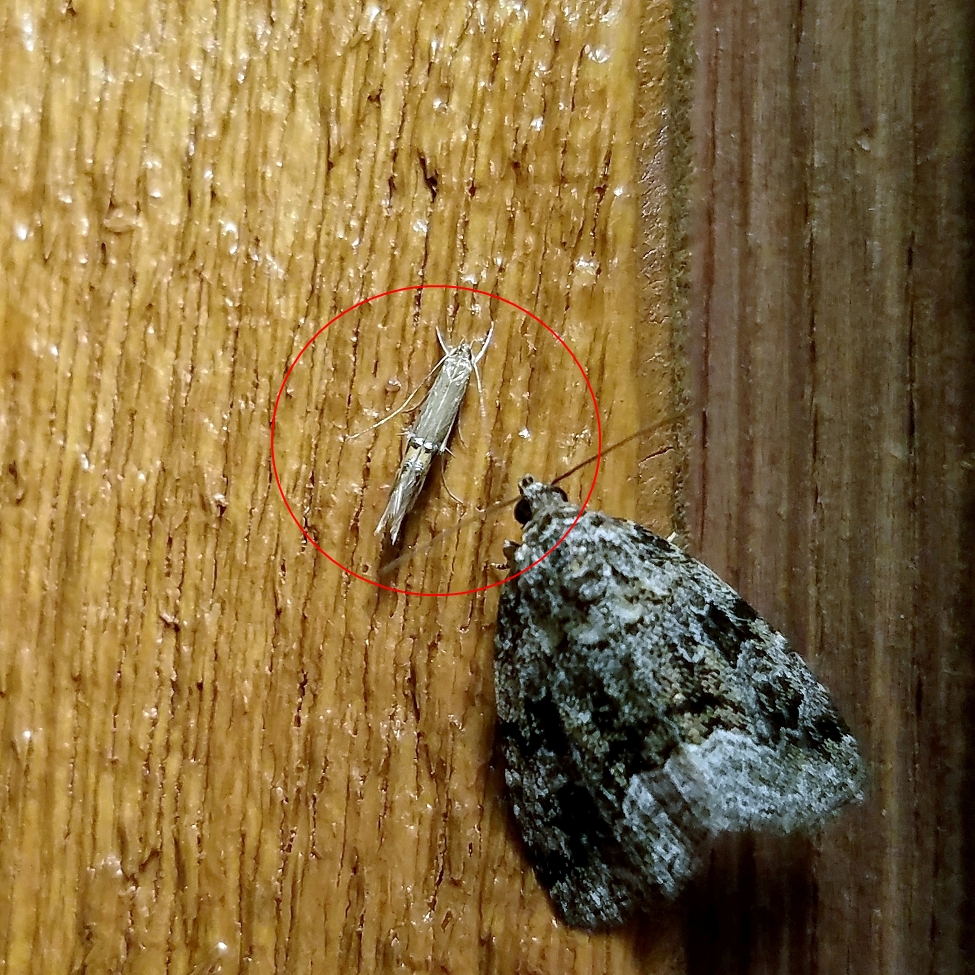
One looks like a positve id: Cosmopterix fernaldella (Fernald’s Cosmopterix Moth). Photos of the other three, Olethreutes glaciana (a leaf-roller moth), Olethreutes permundana (Raspberry Leaf-roller Moth), and Capis curvata (Curved Halter Moth), are little blurry but have sufficient detail I think to make a species determination. O. permundana is the only one I am not completely sure of but it seems to fall within the variation for that species.
A very detailed description of Cosmopterix fernaldella is in The genera Cosmopterix Hübner and Pebobs Hodges in the New World with special attention to the Neotropical fauna (Lepidoptera: Cosmopterigidae) on pages 330 to 332.
The larva of Cosmopterix fernaldella is a leaf miner (feeds on leaf tissue in between the upper and lower surface layers of the leaf) on Carex (sedges, Family Cyperaceae). The leaves of Carex lacustris are mentioned in Insects (Diptera , Coleoptera, Lepidoptera) Reared from Wetland Monocots (Cyperaceae, Poaceae, Typhaceae) in Southern Quebec as a larval host on page 305. The US range of Cosmopterix fernaldella is from Maine to the Lower Peninsula of Michigan south to New Jersey and Pennsylvania, and as far west as Wisconsin and Minnesota. In Canada it ranges from Quebec to Ontario and British Columbia. Range map at Moth Photographers Group.
Cosmopterix fernaldella is in the Superfamily Gelechioidea, Family Cosmopterigidae, Subfamily Cosmopteriginae.
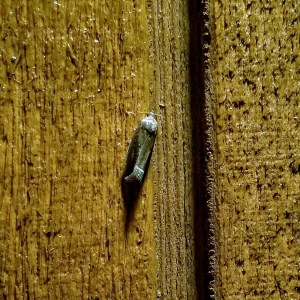
Olethreutes glaciana larvae feed on maple (Acer), birch (Betula), and cottonwood (Populus). Range map at Moth Photographers Group.
Olethreutes permundana larvae feed on a variety of plant species from many families including meadowsweet (Spiraea salicifolia), ninebark (Physocarpus opulifolius), staghorn sumac (Rhus typhina), hazel (Corylus), sweetgale (Myrica), and hickory (Carya). Range map at Moth Photographers Group.
Ancylis albacostana larvae feed on maple (Acer). Range map at Moth Photographers Group. EDIT (04-13-2018): And a correction. After finding more photos of this moth in my files and going through the Plate Series at the Moth Photographers Group I think it is really Capis curvata. Larvae of C. curvata probably feed on sedges. Well, there is always this summer to find Ancylis albacostana.
Olethreutes glaciana and O. permundana are in the Superfamily Tortricoidea, Family Tortricidae, Subfamily Olethreutinae, Tribe Olethreutini and C. curvata is in the Family Noctuidae, Subfamily Eustrotiinae.
Update on Eucosma (Pelochrista) dorsisgnatana and E. (Pelochrista) similiana: I found a few photos of the latter in my August files and have added its name back to the checklist which stands at 158 species now. I knew I’d seen E. (Pelochrista) similiana before. Both species are shown below.
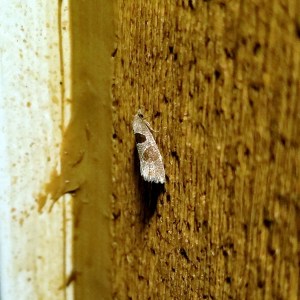
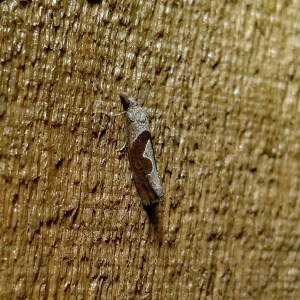
Both species are in the Superfamily Tortricoidea, Family Tortricidae, Subfamily Olethreutinae, Tribe Eucosmini. Recent taxonomic revisions now place many species once in Eucosma into Pelochrista. Larvae of both species feed on the roots of goldenrod (Solidago). Range maps for E. dorsisignatana and E. similiana can be found at the Moth Photographers Group.
SOURCES
D. Beadle and S. Leckie (2012). Peterson Field Guide to Moths of Northeastern North America. Houghton Mifflin Harcourt Publishing Company, Boston. 640 pages.
F. Beaulieu and T. A. Wheeler (2002). Insects (Diptera , Coleoptera, Lepidoptera) Reared from Wetland Monocots (Cyperaceae, Poaceae, Typhaceae) in Southern Quebec. Proceedings of the Entomological Society of Washington. Volume 104, No. 2, pages 300 to 308.
J. C. Koster (2010). The genera Cosmopterix Hübner and Pebobs Hodges in the New World with special attention to the Neotropical fauna (Lepidoptera: Cosmopterigidae). Zoologische Mededelingen, 84 (2010), pages 251 to 575.
Bug Guide website
Moth Photographers Group website


 Not Very Far Away