More Moths

This slideshow requires JavaScript.


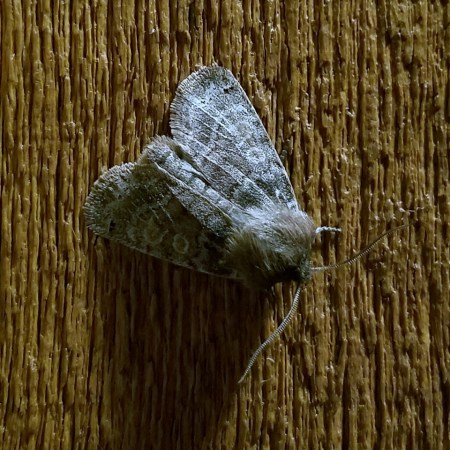
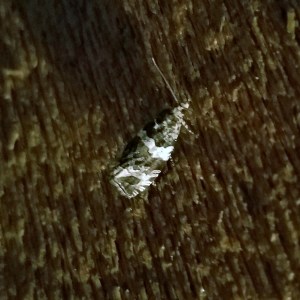
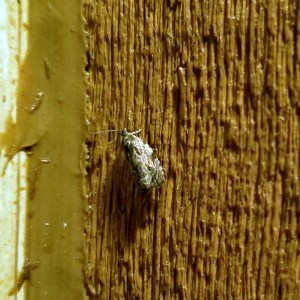
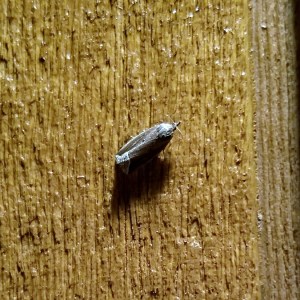
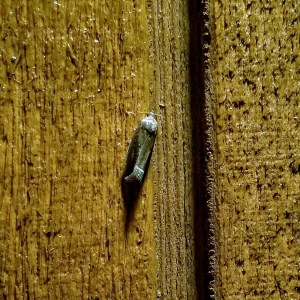
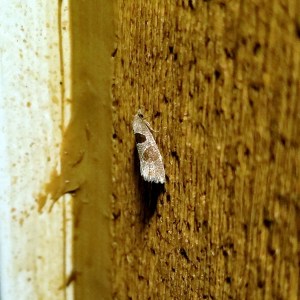
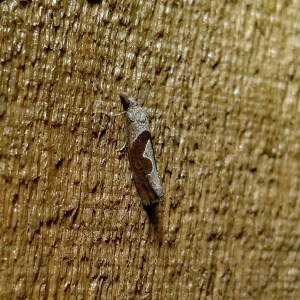
Eight more moths for the checklist: Mint Root Borer (Fumibotys fumalis), Deceptive Snout Moth (Hypena deceptalis), Bronzy Macrochilo (Macrochilo orciferalis), Forage Looper (Caenurgina erechtea), Purple-backed Cabbageworm (Evergestis pallidata), White-banded Toothed Carpet (Epirrhoe alternata), Labrador Carpet (Xanthorhoe labradorensis), and Dark Marbled Carpet (Dysstroma citrata) bringing it to 161 species identified. There were three repeated names, a genus name with no species epithet, and one name from a set of photos misidentified as Xanthorhoe ferrugata but really Euphyia intermediata (already on the list). Those last two are members of the “Carpets” which because of their intricate patterns can be a challenge to differentiate. When the dust settled the actual number of species on April 05 was not 158 but 153. Adding these eight species on April 10 makes the total for the checklist 161 species.

Some Brief Facts

Mint Root Borer (Fumibotys fumalis) – not well liked wherever mint (Mentha spp.) is grown as its larvae feed on mint leaves and then as they get older on the roots and rhizomes.

Deceptive Snout Moth (Hypena deceptalis) – this moth confused me at first and I misidentified it as Gray-edged Hypena (Hypena madefactalis) which was wishful thinking on my part. After going over many photos of each species at Moth Photographers Group and Bug Guide it became clear my initial identification was wrong. The larvae of Deceptive Snout Moth feed on leaves of American basswood (Tilia americana). Members of Hypena are specialized feeders.

Bronzy Macrochilo (Macrochilo orciferalis) – food preferences of this species larvae are grasses but many others in the subfamily (Herminiinae, Litter Moths) eat dead leaves and leaf litter.

Forage Looper (Caenurgina erechtea) – larvae feed on a variety of grasses and legumes grown for forage and hay including alfalfa and the weedy plant giant ragweed (Ambrosia trifida).

Purple-backed Cabbageworm (Evergestis pallidata) – possibly introduced to North America in the early 1800s the larvae of this moth feed on many members of the mustard family including bittercress (Cardamine spp.), cabbage, and horseradish.

White-banded Toothed Carpet (Epirrhoe alternata) – the larvae of this species feed on bedstraw (Galium spp.).

Labrador Carpet (Xanthorhoe labradorensis) – larvae feed on many species of woody and herbaceous plants

Dark Marbled Carpet (Dysstroma citrata) – larvae feed on blackberry, raspberry, and thimbleberry (Rubus spp.), alder (Alnus spp.),  willow (Salix spp.) and several other woody and herbaceous plant species.

The list keeps growing

Just before publishing this I added seven more species: Crambus leachellusAgriphila ruricolellusPalpita magniferalis, Monopis monachellaEpinotia lindana, and possibly Herpetogramma aeglealis and Dichomerus fistuca (these last two seem at least to be in the right genus) bringing the total to 168 species identified. The list keeps on growing as I sort through photos and to that list can be added 219 photos of yet to be identified species. Given that there are an estimated 1,500 to 2,200 moth species in Minnesota the possibility of 600 to 900 moth species in my county does not seem far-fetched. I hope to add another 100 species this summer as I explore new areas at night on my property (not just the porch) and search for moth larvae by day.

Corrections

In the April 05 post “Four new finds in the moth photo files and a rediscovery” I mentioned I had found Ancylis albacostana. It turns out I had not but instead had misidentified Capis curvata as that species. They are similar especially if the white band on the ends of the forewing is wide on C. curvata. A. albacostana is somewhat rare in northern Minnesota where I live so chances of finding it are small (but not impossible).

What I had previously thought was Toothed Brown Carpet (Xanthorhoe lacustrata) in an earlier version of this post is White-banded Toothed Carpet (Epirrhoe alternata).


SOURCES AND MORE INFORMATION

D. Beadle and S. Leckie (2012). Peterson Field Guide to Moths of Northeastern North America. Houghton Mifflin Harcourt Publishing Company, Boston. 640 pages.

R. E. Berry and L. B. Coop (2000). Mint Root Borer Lepidoptera: Pyralidae Fumibotys fumalis. Publication No. IPPC E.01-01-1. Oregon State University, Department of Entomology and Integrated Plant Protection Center, Corvallis, Oregon. October 24, 2000.

E. M. Quinn and R. Danielson (2009). A Survey of Lepidoptera in Three Priority Areas of the Minnesota State Parks System Final Report. Minnesota Department of Natural Resources – Division of Parks and Trails. 49 pages.

Robinson, G. S., P. R. Ackery, I. J. Kitching, G. W. Beccaloni and L. M. Hernández (2010). HOSTS – A Database of the World’s Lepidopteran Hostplants. Natural History Museum, London. http://www.nhm.ac.uk/hosts.

J. Sogaard (2009). Moths and Caterpillars of the North Woods. Kollath+Stensaas Publishing. Duluth, MN. 276 pages.

D. Schweitzer, J. R. Garris, A. E. McBride, and J. A. M. (2014). The current status of forest Macrolepidoptera in northern New Jersey: evidence for the decline of understory specialists. Appendix D. Journal of Insect Conservation. Vol. 18, Issue 4, pages 561–571.

Species accounts at the Bug Guide website

Moth Photographers Group website (check out their Plate Series)

University of Alberta E.H. Strickland Entomological Museum website


Are you stuck?

Laurel Sphinx Moth (Sphinx kalmiae)


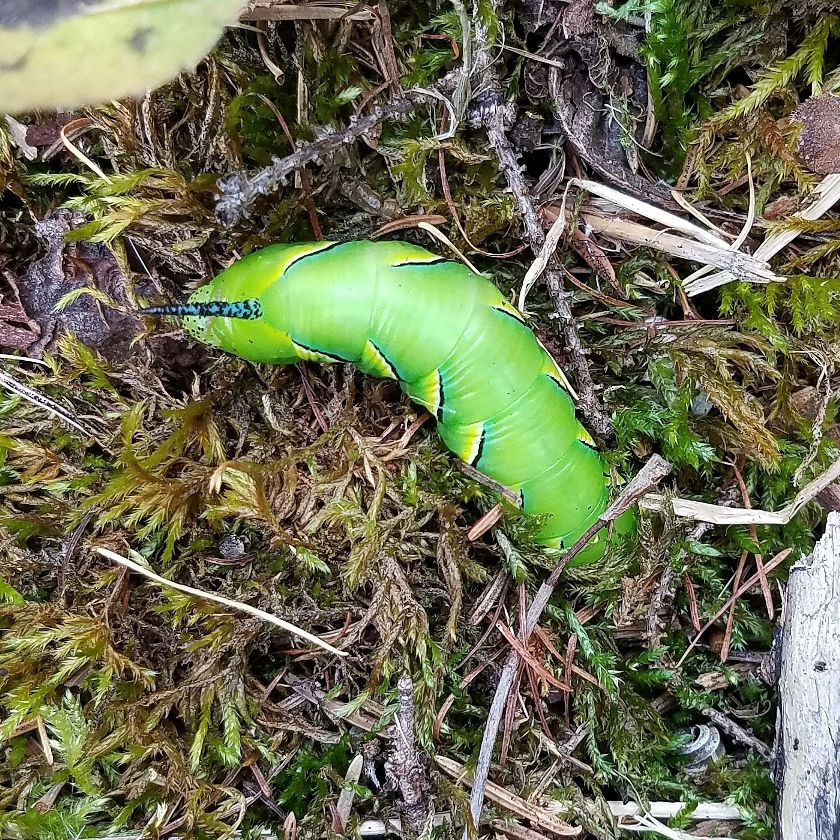
Wandering in the woods is a favorite activity of mine and one of the ways I find new insect and other species on my land. One afternoon in mid-October while out walking along the edge of a tamarack swamp and upland deciduous-coniferous forest I saw this beautiful caterpillar with its head buried in the forest duff. Its brilliant glowing green color caught my eye immediately.  Looking more closely I saw oblique pale blue, dark blue, white, and yellow stripes on each segment. And then there was the blue horn at the tail with small black dots. Its behavior was also puzzling. Why was its head partly buried in the duff?

Caterpillars with tail horns are typically some species of the sphinx moth family (Sphingidae) although not all larvae in this family have tail horns. This made my work a bit easier than say finding some small yellow and brown striped caterpillar (a future post). The first step in finding out the species was to search for images using the phrase “green sphinx caterpillar blue stripes”. This led to an abundance of photos some of which looked like my caterpillar. One was the Tobacco Hornworm (Manduca sexta) but it lacks the yellow stripes, has blue lines in a series of dots, and the horn can be white, reddish, or yellow. A closer fit was the Wild Cherry Sphinx Moth (Sphinx drupiferarum) but it also lacks yellow stripes, has pale blue stripes, and a reddish-brown horn. As its name suggests the Wild Cherry Sphinx Moth feeds on cherry (Prunus) a few scraggly shrubs of which were in growing in the area.

None of the Sphinx Moth larva images were like this caterpillar except for the Laurel Sphinx Moth (Sphinx kalmiae).  It was off to BugGuide and the Moth Photographer’s Group where the description and photos seemed to confirm this.

Continuing my research I found another website, Sphingidae of the Americas linked from the Moth Photographers Group page on Sphinx kalmiae, that is very helpful in identifying Sphinx Moth caterpillars. Sphingidae of the Americas is dedicated to all Sphinx Moths in North, Central, and South America, and the Caribbean and includes photos of larval, pupal, and adult stages with information on distribution, flight times, and larval host plants (when known).

Description, Range, Life History of the Laurel Sphinx Moth

Principle larval host plants are in the Oleacea (Olive Family) and include species of ash (Fraxinus), fringe tree (Chionanthus virginicus), common lilac (Syringa vulgaris), and privet (Ligustrum). Laurel Sphinx Moth larva have also been reported feeding on hackberry (Celtis occidentalis, Ulmaceae), mountain laurel (Kalmia latifolia, Ericaceae), yellow bush honeysuckle (Diervilla lonicera, Caprifoliaceae), and mountain holly (Nemopanthus mucronata, Aquifoliaceae). Growing at the location where I found this caterpillar are black ash trees and yellow bush honeysuckle. There is also winterberry (Ilex verticillata) which is in the same family as mountain holly. It would be interesting to know whether the Laurel Sphinx larvae eat this also. Whether they eat mountain laurel (Kalmia latifolia) or not is questionable as the species epithet “kalmiae” is probably from the name of the 18th century naturalist Pehr Kalm and not from laurel plants (also named after him). Adult moths nectar at flowers usually at night but can be attracted to baits of fermented fruit mixed with sugar and beer.

The Laurel Sphinx Moth is a medium-sized moth with a wingspan of 7.5 to 10 cm. The forewings are yellow-brown with some fine dark brown lines along the wing veins. The reniform spot (a kidney-shaped marking found on the forewings of many moth species) is black. The underwings are also yellow-brown but with broad dark brown antemedial and postmedial bands.

Laurel Sphinx Moth occurs in the eastern half of the United States from Maine to North Carolina and west to Texas, Oklahoma, and Nebraska, and north to Newfoundland, Quebec, Ontario, Manitoba, and Saskatchewan in Canada.

Taxonomy

Class Insecta – Insects
Order Lepidoptera – (Butterflies, Skippers, and Moths)
Superfamily – Bombycoidea (Silkworm, Sphinx, and Royal Moths)
Family – Sphingidae (Sphinx Moths)
Subfamily – Sphinginae
Tribe – Sphingini
Genus and species – Sphinx kalmiae (Laurel Sphinx Moth)

So, was this caterpillar stuck in the duff or in any sort of trouble? No, as it turns out there are many moth species in Sphingidae whose larvae burrow into loose soil just before pupating which is what this one was doing. If all goes well this winter then come late May or early June an adult Laurel Sphinx Moth will emerge and begin the cycle all over again. Maybe I’ll see the adult Laurel Sphinx Moth this coming summer sipping on overripe banana mush and beer.


SOURCES AND MORE INFORMATION

H. M. Bower (1961). Food Plants of Sphingidae in Wisconsin. Journal of the Lepidopterists’ Society. Vol.15 , No. 1:64.

H. M. Bower (1963). Additional Note on Food Plant of Sphinx kalmiae. Journal of the Lepidopterists’ Society. Vol. 1, No. 17:36.

R. W Hodges (1971). The Moths of America North of Mexico. Fasicle 21. Sphingoidae. Hawkmoths. London, E. W. Classey: 158 pages.

C. Messenger (1997). The Sphinx Moths (Lepidoptera: Sphingidae) of Nebraska. Transactions of the Nebraska Academy of Sciences, 24: 89-141.

A. P. Platt (1969). A light weight collapsible bait trap for Lepidoptera. Vol. 23, No. :97-101.

Bug Guide website

Moth Photographers Group website

Butterflies and Moths of North America website

Sphingidae of the Americas website

Four new finds in the moth photo files and a rediscovery

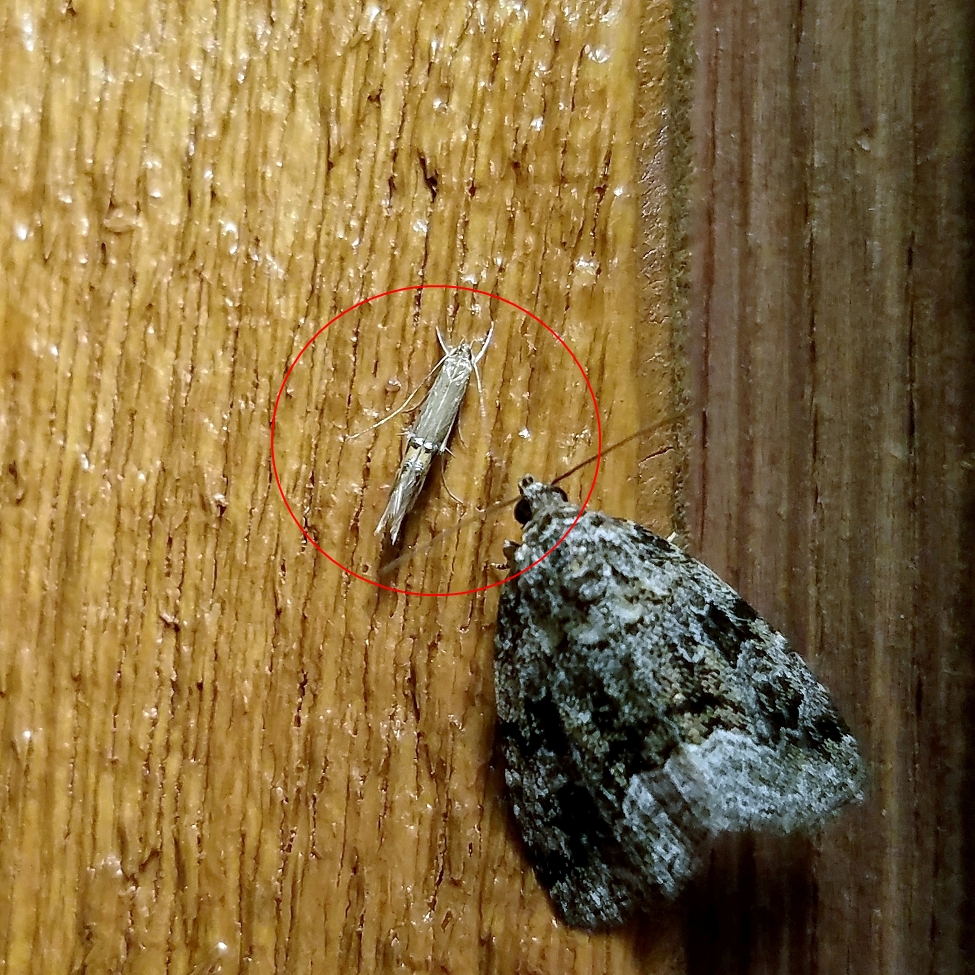
Cosmopterix fernaldella (in red circle). C. fernaldella measures about 5 to 6 mm long. The larger moth is unidentified for now.


One looks like a positve id: Cosmopterix fernaldella (Fernald’s Cosmopterix Moth). Photos of the other three, Olethreutes glaciana (a leaf-roller moth), Olethreutes permundana (Raspberry Leaf-roller Moth), and Capis curvata (Curved Halter Moth), are little blurry but have sufficient detail I think to make a species determination. O. permundana is the only one I am not completely sure of but it seems to fall within the variation for that species.

A very detailed description of Cosmopterix fernaldella is in The genera Cosmopterix Hübner and Pebobs Hodges in the New World with special attention to the Neotropical fauna (Lepidoptera: Cosmopterigidae) on pages 330 to 332.

The larva of Cosmopterix fernaldella is a leaf miner (feeds on leaf tissue in between the upper and lower surface layers of the leaf) on Carex (sedges, Family Cyperaceae). The leaves of Carex lacustris are mentioned in Insects (Diptera , Coleoptera, Lepidoptera) Reared from Wetland Monocots (Cyperaceae, Poaceae, Typhaceae) in Southern Quebec as a larval host on page 305. The US range of Cosmopterix fernaldella is from Maine to the Lower Peninsula of Michigan south to New Jersey and Pennsylvania, and as far west as Wisconsin and Minnesota. In Canada it ranges from Quebec to Ontario and British Columbia. Range map at Moth Photographers Group.

Cosmopterix fernaldella is in the Superfamily Gelechioidea, Family Cosmopterigidae,  Subfamily Cosmopteriginae.


Olethreutes glaciana larvae feed on maple (Acer), birch (Betula), and cottonwood (Populus). Range map at Moth Photographers Group.

Olethreutes permundana larvae feed on a variety of plant species from many families including meadowsweet (Spiraea salicifolia), ninebark (Physocarpus opulifolius), staghorn sumac (Rhus typhina), hazel (Corylus), sweetgale (Myrica), and hickory (Carya). Range map at Moth Photographers Group.

Ancylis albacostana larvae feed on maple (Acer). Range map at Moth Photographers Group. EDIT (04-13-2018): And a correction. After finding more photos of this moth in my files and going through the Plate Series at the Moth Photographers Group I think it is really Capis curvata. Larvae of C. curvata probably feed on sedges. Well, there is always this summer to find Ancylis albacostana.

Olethreutes glaciana and O. permundana are in the Superfamily Tortricoidea, Family Tortricidae, Subfamily Olethreutinae, Tribe Olethreutini and C. curvata is in the  Family Noctuidae, Subfamily Eustrotiinae.


Update on Eucosma (Pelochrista) dorsisgnatana and E. (Pelochrista) similiana: I found a few photos of the latter in my August files and have added its name back to the checklist which stands at 158 species now. I knew I’d seen  E. (Pelochrista) similiana before. Both species are shown below.


Both species are in the Superfamily Tortricoidea, Family Tortricidae, Subfamily Olethreutinae, Tribe Eucosmini. Recent taxonomic revisions now place many species once in Eucosma into Pelochrista. Larvae of both species feed on the roots of goldenrod (Solidago). Range maps for E. dorsisignatana and E. similiana can be found at the Moth Photographers Group.


SOURCES

D. Beadle and S. Leckie (2012). Peterson Field Guide to Moths of Northeastern North America. Houghton Mifflin Harcourt Publishing Company, Boston. 640 pages.

F. Beaulieu and T. A. Wheeler (2002). Insects (Diptera , Coleoptera, Lepidoptera) Reared from Wetland Monocots (Cyperaceae, Poaceae, Typhaceae) in Southern Quebec. Proceedings of the Entomological Society of Washington. Volume 104, No. 2, pages 300 to 308.

J. C. Koster (2010). The genera Cosmopterix Hübner and Pebobs Hodges in the New World with special attention to the Neotropical fauna (Lepidoptera: Cosmopterigidae). Zoologische Mededelingen, 84 (2010), pages 251 to 575.

Bug Guide website

Moth Photographers Group website

A Winter of Mothing


I’ve been going through my photos of moths from last summer and fall while the snow here slowly melts, comes back again, and then melts some more. As I go through my files of moth photos I am beginning to realize that there may be several hundred moth species in my township. At last count (March 30) I have 147 identified to species and another 175 unidentified species for a total of 322 species. That is a little bit over my original estimate of 300 species in my township. I am going to have to revise that number upwards a bit. The current estimate of moth species in the state of Minnesota where I live is placed at 1,503 so there may be another 300 or more species on top of what I have found.

Digital photos of the unidentified moths are kept in folders named Crambids (23 subfolders, some shown above), Micro-moths (35 subfolders, some shown above), Darts and Prominents (50 subfolders), Tussock Moths (6 subfolders), and many as just “Moth” (55 subfolders) for those in the Geometridae or moths I can’t place in any group. I think I may break that one up into “Geometrids” and “Others”.

There are still many more photos to sort through and the next group to be separated are the Plume Moths (Pterophoridae). This is an interesting group of moths that look like some sort of fixed-wing aircraft. There are three Plume Moths species subfolders (see below) but more might be added later. Moth caterpillars and cocoons also have their own folder called “Unknown Caterpillars” with just three species left until I find more this summer.


Now that I have some of the moths separated and each in its own folder I can begin tackling identification in a more systematic way. Of course no single field guide or website will have all the species possibly present in a geographic region but by getting these photo specimens identified to family or better yet to genus I can narrow my search efforts and maybe hit upon the answer. Right now I am working on the Crambidae or Crambid Moths commonly known as Grass Veneers and Snout Moths. A few days ago the unidentified Crambid files had 29 unknowns. Now it is down to 23 unknowns after confirming three species (Crambus bidens, C. agitatellus, and Chrysoteuchia topiarius) and tentatively identifying three more (Crambus pascuella, C. perlella, and Microcrambus elegans). It is progress.

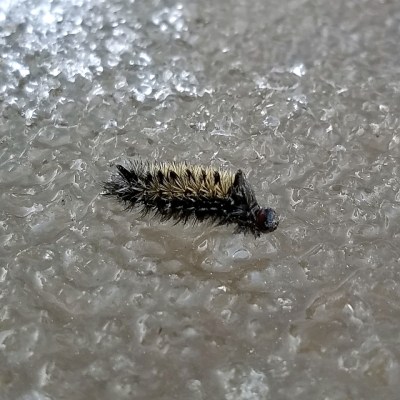
More progress below with two moth larvae tentatively identified (Acronicta impressa, Melanchra assimilis) and three with more confidence (Trichordestra legitima, Erannis tiliariaPyrrhia experimens). To that I should add that I have found two errors in my checklist but these are now corrected. One was in the right genus (Eucosma) but wrong species (E. dorsisgnatana not E. similiana both very similar) and the other was a species in a look-alike genus (Macrochilo litophora not Zanclognatha pedipilalis).


Warm weather is still in the future it seems but when it does get here and the ice and snow start to melt I will be out in the woods and fields looking for moths and other things that are waking up after a long and sometimes cold winter.