Well, I’ve been away for quite some time now. A lot has been happening here where I live and my life has gone through some changes. The biggest change is that I have officially retired. This happened right around the time of the COVID lockdown. Great timing, right?
This past July I finally got to take that vacation I was going to do in 2020 car camping and hiking in the Superior National Forest. That is one of the places where I used to work but this time the pace was relaxed and it didn’t matter if everything on the agenda was completed or not.
A micro-moth I found on the Superior Hiking trail in Lake County, Minnesota. It might be Landryia impositella or maybe a species of Scythris. Whatever species it is this moth is nectaring on big leaf aster in a sugar maple/paper birch forest.
I’ve also been doing a lot of exploring where I live and have found many more species of moths, one of my latest obsessions, as well as lichens, fungi, plants, and other living things. Back when I stopped posting the moth checklist was at about 470 species. Now, it is at 763 species and will probably go even higher before the winter weather arrives in late October.
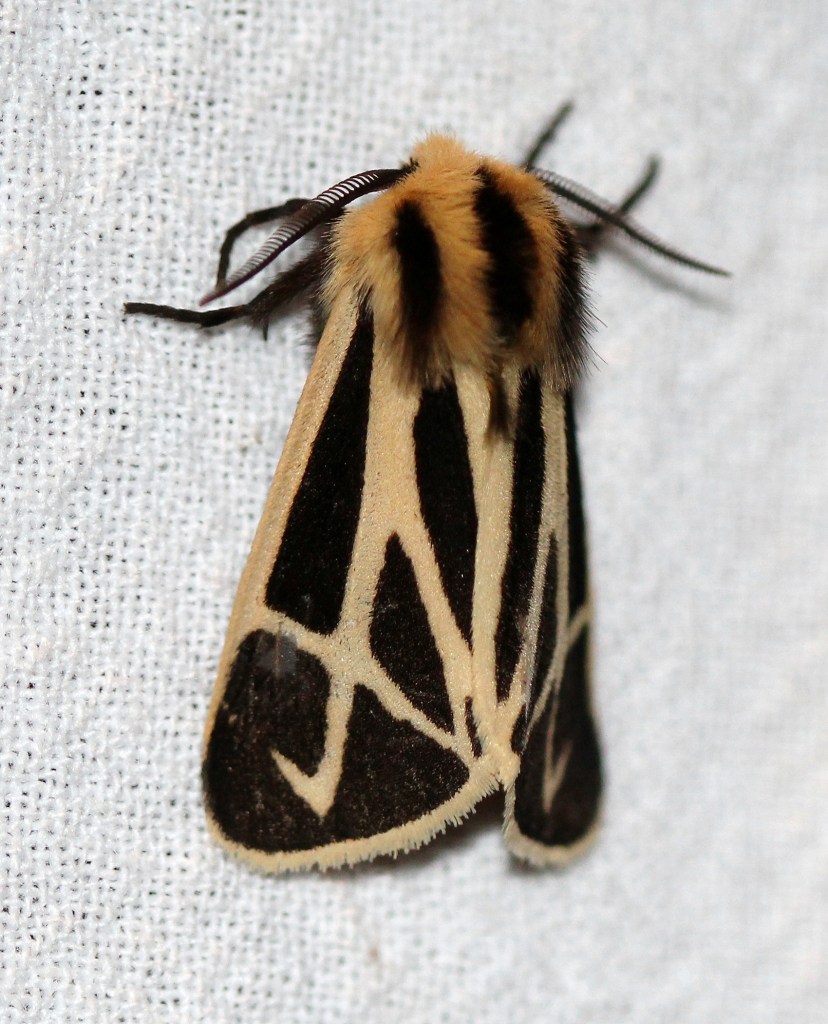
Apantesis phalerata (harnessed tiger moth) one of the new moth species discovered this year at my porch light. Its presence marks a significant range extension north.
I’m building up the checklists on other insect species, too. While not as large (yet) as the moth lists they have been steadily growing. My focus is on bugs, beetles, wasps, and bees which is enough for now. Down below is one example of the new beetles on the checklist, Chlaenius tricolor (ground beetle), which under certain light conditions has a metallic iridescence. More will be coming soon.
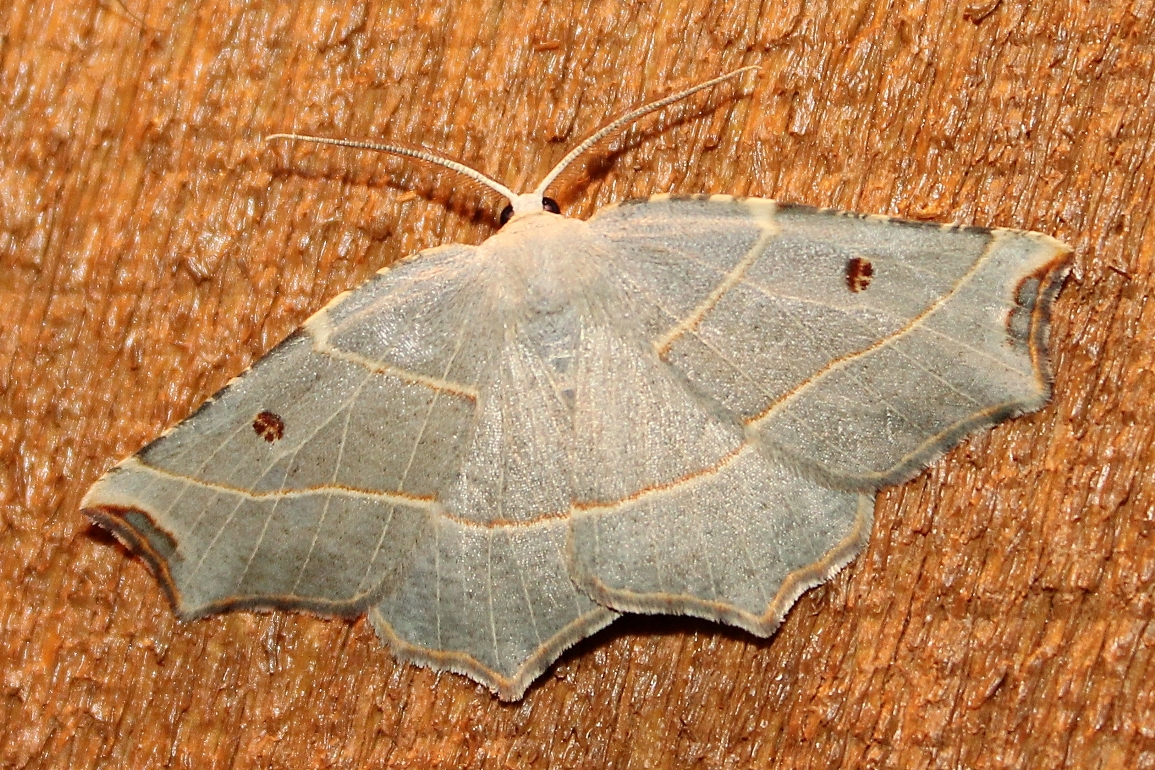
Metanema inatomaria a species seen last summer on warm humid nights.
…during much of July and so will be posting a little less frequently. But summer has arrived and brings with it a new group of moths that love the hot and humid weather. Here are five of the seventeen new moths plus one returning visitor that showed up at my porch light over the weekend. I’ll be writing about these species later in August. There are already a few in the works on the moths Habrosyne scripta (almost done!), Oreta rosea, Phlogophora iris, Campaea perlata, and Monopis spilotella seen this year and last year.
Odontosia elegans
Schizura badia
Drepana arcuata
Autographa ampla
Xanthotype sp, one of three species found here and nearly impossible to tell apart from a photo alone.
Hypena palparia (Family Erebidae), possible new record for the state. Seen on June 16, 2018.
Agonopterix atrodorsella (Family Depressariidae), possible new record for the state. Seen on May 24, 2018.
Argyrotaenia mariana (Family Tortricidae), possible new record for the state. Seen on May 26. 2018.
Calledapteryx dryopterata (Family Uraniidae), possible new record for the state. Seen on June 16, 2018
One thing that often happens when doing an inventory of plants and animals in a particular region such as in the county where I live is the discovery of species not previously known from there. This has been my experience with plants in Carlton County beginning in 1992. Back then there was only Ownbey’s and Morley’s Vascular Plants of Minnesota: A Checklist and Atlas for plant species occurrences by county for Minnesota. The internet has greatly expanded the available information on species distributions and this holds for plants, lichens, and many kinds of animals such as moths. Many museums and universities have searchable databases listing taxa by region or even county level often on maps showing where these species have been found. Some even provide historical data such as when a particular species was seen and/or collected.
Unfortunately, finding a volume like Ownbey and Morley for moths even for a state seems pretty much out of the question. There are other sources of data on moth species occurrences although their reports may not be complete. The first two sources I rely on are the maps at the Moth Photographers Group (MPG) and Butterflies and Moths of North America (BAMONA). Maps at MPG are based on archived specimens and are accurate to the county level. BAMONA is based on citizen-scientist contributions and these are accurate to township level. The weakness in both of these sources is the human factor. For both MPG and BAMONA there seem to be more records near larger population centers where colleges and universities, and hence entomologists and/or interested amateurs, are located compared to areas of the country with smaller populations and distant from colleges.
The third source I look to for Minnesota moths is a Minnesota DNR report (A Survey of Lepidoptera in Three Priority Areas of the Minnesota State Parks System) published in 2009. This report lists all the moth (768) and butterfly (72) species found in thirteen Minnesota state parks between southeastern and northeastern Minnesota over a two-year period. Jay Cooke State Park, which is in Carlton County in northeastern Minnesota, was not included in the survey. The purpose of the survey was to determine what other lepidopteran species might be affected if a Bt spraying program were initiated to control the introduced Gypsy Moth (Lymantria dispar dispar), a potential pest insect in the state. Thankfully, Bt was not used and a mating disrupting pheromone was instead.
I have not done a complete list of new species records for Carlton County because it does not matter as almost every moth I find is a new record for the county. However, as I add more species to the checklist I have noticed that some appear to be new records for the state. Four of these are shown in the photo gallery above. These are not the only ones just some of the most recent. Looking at the maps at MPG and BAMONA it quickly becomes clear that there is a deficit in the record of the lepidopteran fauna of Carlton County (not too unlike the record of the county’s flora). One could get the impression that there is little moth biodiversity here but that would be a mistake. As of June 15, I have photographed and identified almost 270 species of moths. Of these, 100 were photographed and identified this year over a two month period. Even more importantly all were taken on my property. What other species might be found in the oak-maple-basswood forests? Or the bogs? Or the cedar swamps?
SOURCES CITED
Ownbey, G. B., and T. Morley. (1991). Vascular plants of Minnesota: a checklist and atlas. University of Minnesota Press, Minneapolis, Minnesota. 320 pages.
A giant really with a wingspan of 115 mm (~4.5 inches). This is one of the giant silkworm moths known as Antheraea polyphemus. It arrived at my porch light at about 12:30 AM on June 13. So I took a lot of photos then went inside and turned out the light. At dawn it was still there but had fallen from the screen door so I set it on a tarp covered box and placed a small footstool over it for safety. By early afternoon the moth had flown away. I seldom see these large moths, including their larvae, although they are said to be widespread and common. I’m wondering what tonight will bring since I plan on staying up late again.
Antheraea polyphemus showing wing undersides.
Description A. polyphemus is a distinctive moth species. Apart from its large size the most obvious features are the four eyespots on the wings. There are two small spots on the forewings and two larger ones on the hindwings. The spots on the hindwings are the largest and most brightly colored with a deep black outline surrounding a deep blue interior dusted with many small white specks. at the bottom of the eyespot is an almond-shaped yellow spot with a translucent center. The eyepsots on the upper wings are very much like these yellow spots but with a thin black line enclosing them. The background color of the wings varies individually but is generally a pinkish cinnamon color often dusted with small black specks. Wing margins are separated from the rest of the wing by dark and light-colored bands. The scales on the body, legs, and near the points where the wings attach are long and look like hairs. The moth shown has feathery antennae (used to detect female pheromones) which means it is a male. Females have thinner antennae.
Range A. polyphemus occurs over most of north America from southern Canada (except Newfoundland) to Mexico and coast to coast in the US.
Larval Hosts
The larvae of A. polyphemus feed on the leaves a variety of deciduous trees and shrubs including oak (Quercus spp.), hickory (Carya spp.), ash (Fraxinus spp.), grape (Vitis spp.), maple (Acer spp.), birch (Betula spp.), pine (Pinus spp.), and willow (Salix spp.).
Taxonomy
Class Insecta (Insects)
Order Lepidoptera (Butterflies and Moths)
Superfamily Bombycoidea (Silkworm, Sphinx, and Royal Moths)
Family Saturniidae (Giant Silkworm and Royal Moths)
Subfamily Saturniinae (Silkmoths)
Tribe Saturniini
Genus/species Antheraea polyphemus
SOURCES
Beadle, D. and Leckie, S. (2012). Peterson Field Guide to Moths of Northeastern North America. Houghton Mifflin Harcourt Publishing Company, Boston. 640 pages.





 Not Very Far Away