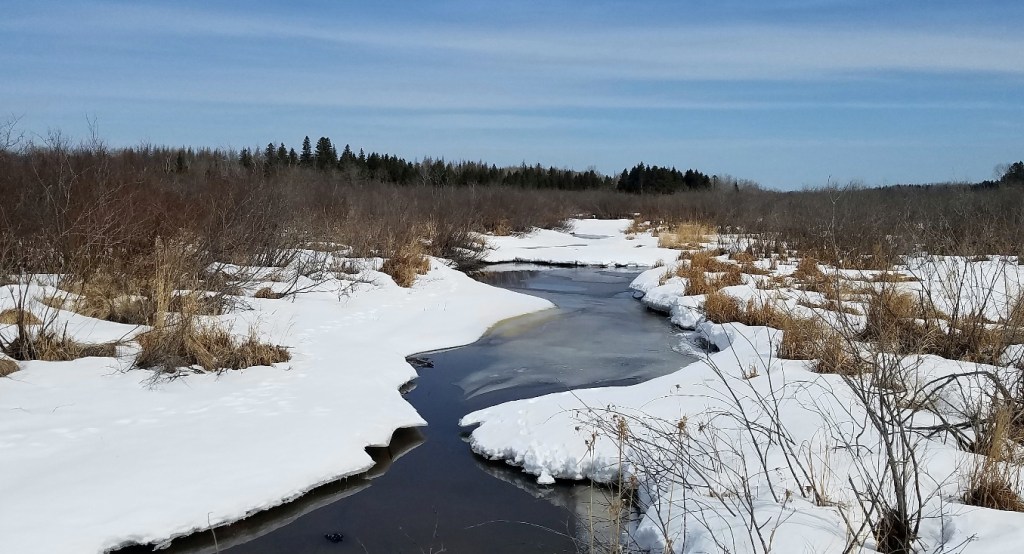
Here it is already April 12, and there is still two feet of snow on the ground and more in the forecast. Temperatures have been hovering around freezing with occasional warm days in the mid-40s, followed by nights near zero. Ice is still on the lakes in Minnesota when, at this time of year, it should be breaking up.
In just over two weeks, it will be May, and I am wondering what that month will be like. During most years in May, I’d be getting my garden ready, planting onions and potatoes, and putting off mowing the lawn. At this rate, all of that may have to wait until June. Instead, I need to get more gas for the snow blower just in case we get the half-foot of snow predicted. And get some more oranges and grapefruit. And mushrooms for pizza.
Below is a serenade by spring peepers and wood frogs at 3 in the afternoon on April 14th last year (hit play and the video straightens out). The high for the day was 68º F. This year, it is predicted to be 29º F. Looks like the frogs will be sleeping for a few more weeks.
Its hard to believe when I walk in the woods now but last year by the second week of April almost all of the snow had melted, plants were beginning to grow in sunny patches under the trees, frogs were laying eggs, and insects from bees to bugs were active. But this year everywhere I look there is deep snow and cold temperatures. In the spruce and tamarack woods there is only the occasional call of the chickadees and nuthatches. Spring flowers are a long way off.
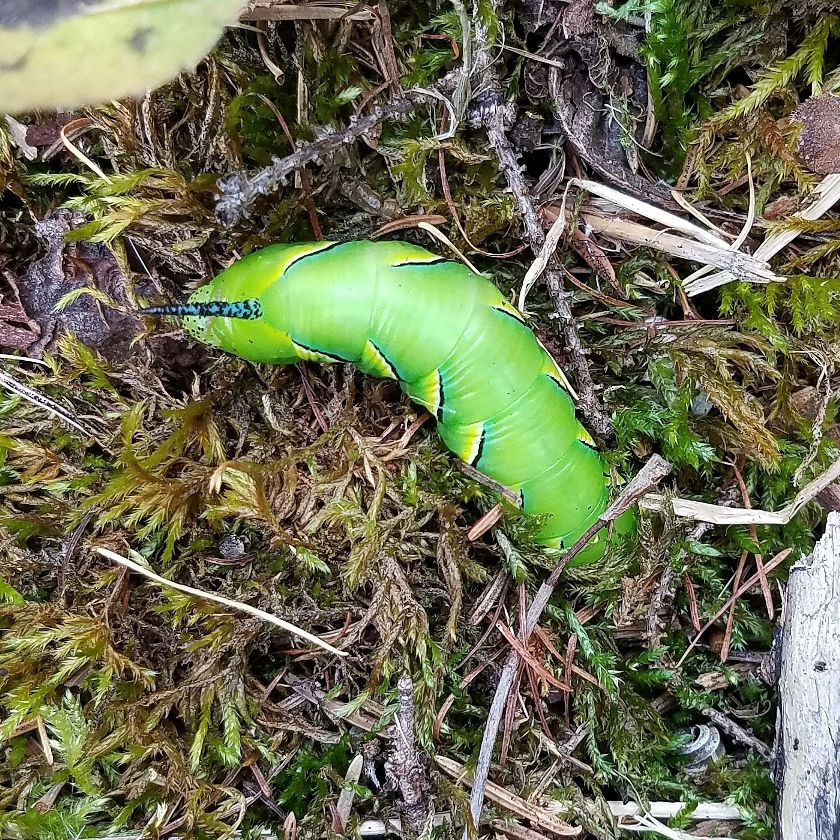
Wandering in the woods is a favorite activity of mine and one of the ways I find new insect and other species on my land. One afternoon in mid-October while out walking along the edge of a tamarack swamp and upland deciduous-coniferous forest I saw this beautiful caterpillar with its head buried in the forest duff. Its brilliant glowing green color caught my eye immediately. Looking more closely I saw oblique pale blue, dark blue, white, and yellow stripes on each segment. And then there was the blue horn at the tail with small black dots. Its behavior was also puzzling. Why was its head partly buried in the duff?
Caterpillars with tail horns are typically some species of the sphinx moth family (Sphingidae) although not all larvae in this family have tail horns. This made my work a bit easier than say finding some small yellow and brown striped caterpillar (a future post). The first step in finding out the species was to search for images using the phrase “green sphinx caterpillar blue stripes”. This led to an abundance of photos some of which looked like my caterpillar. One was the Tobacco Hornworm (Manduca sexta) but it lacks the yellow stripes, has blue lines in a series of dots, and the horn can be white, reddish, or yellow. A closer fit was the Wild Cherry Sphinx Moth (Sphinx drupiferarum) but it also lacks yellow stripes, has pale blue stripes, and a reddish-brown horn. As its name suggests the Wild Cherry Sphinx Moth feeds on cherry (Prunus) a few scraggly shrubs of which were in growing in the area.
None of the Sphinx Moth larva images were like this caterpillar except for the Laurel Sphinx Moth (Sphinx kalmiae). It was off to BugGuide and the Moth Photographer’s Group where the description and photos seemed to confirm this.
Continuing my research I found another website, Sphingidae of the Americas linked from the Moth Photographers Group page on Sphinx kalmiae, that is very helpful in identifying Sphinx Moth caterpillars. Sphingidae of the Americas is dedicated to all Sphinx Moths in North, Central, and South America, and the Caribbean and includes photos of larval, pupal, and adult stages with information on distribution, flight times, and larval host plants (when known).
Description, Range, Life History of the Laurel Sphinx Moth
Principle larval host plants are in the Oleacea (Olive Family) and include species of ash (Fraxinus), fringe tree (Chionanthus virginicus), common lilac (Syringa vulgaris), and privet (Ligustrum). Laurel Sphinx Moth larva have also been reported feeding on hackberry (Celtis occidentalis, Ulmaceae), mountain laurel (Kalmia latifolia, Ericaceae), yellow bush honeysuckle (Diervilla lonicera, Caprifoliaceae), and mountain holly (Nemopanthus mucronata, Aquifoliaceae). Growing at the location where I found this caterpillar are black ash trees and yellow bush honeysuckle. There is also winterberry (Ilex verticillata) which is in the same family as mountain holly. It would be interesting to know whether the Laurel Sphinx larvae eat this also. Whether they eat mountain laurel (Kalmia latifolia) or not is questionable as the species epithet “kalmiae” is probably from the name of the 18th century naturalist Pehr Kalm and not from laurel plants (also named after him). Adult moths nectar at flowers usually at night but can be attracted to baits of fermented fruit mixed with sugar and beer.
The Laurel Sphinx Moth is a medium-sized moth with a wingspan of 7.5 to 10 cm. The forewings are yellow-brown with some fine dark brown lines along the wing veins. The reniform spot (a kidney-shaped marking found on the forewings of many moth species) is black. The underwings are also yellow-brown but with broad dark brown antemedial and postmedial bands.
Laurel Sphinx Moth occurs in the eastern half of the United States from Maine to North Carolina and west to Texas, Oklahoma, and Nebraska, and north to Newfoundland, Quebec, Ontario, Manitoba, and Saskatchewan in Canada.
Taxonomy
Class Insecta – Insects
Order Lepidoptera – (Butterflies, Skippers, and Moths)
Superfamily – Bombycoidea (Silkworm, Sphinx, and Royal Moths)
Family – Sphingidae (Sphinx Moths)
Subfamily – Sphinginae
Tribe – Sphingini
Genus and species – Sphinx kalmiae (Laurel Sphinx Moth)
So, was this caterpillar stuck in the duff or in any sort of trouble? No, as it turns out there are many moth species in Sphingidae whose larvae burrow into loose soil just before pupating which is what this one was doing. If all goes well this winter then come late May or early June an adult Laurel Sphinx Moth will emerge and begin the cycle all over again. Maybe I’ll see the adult Laurel Sphinx Moth this coming summer sipping on overripe banana mush and beer.
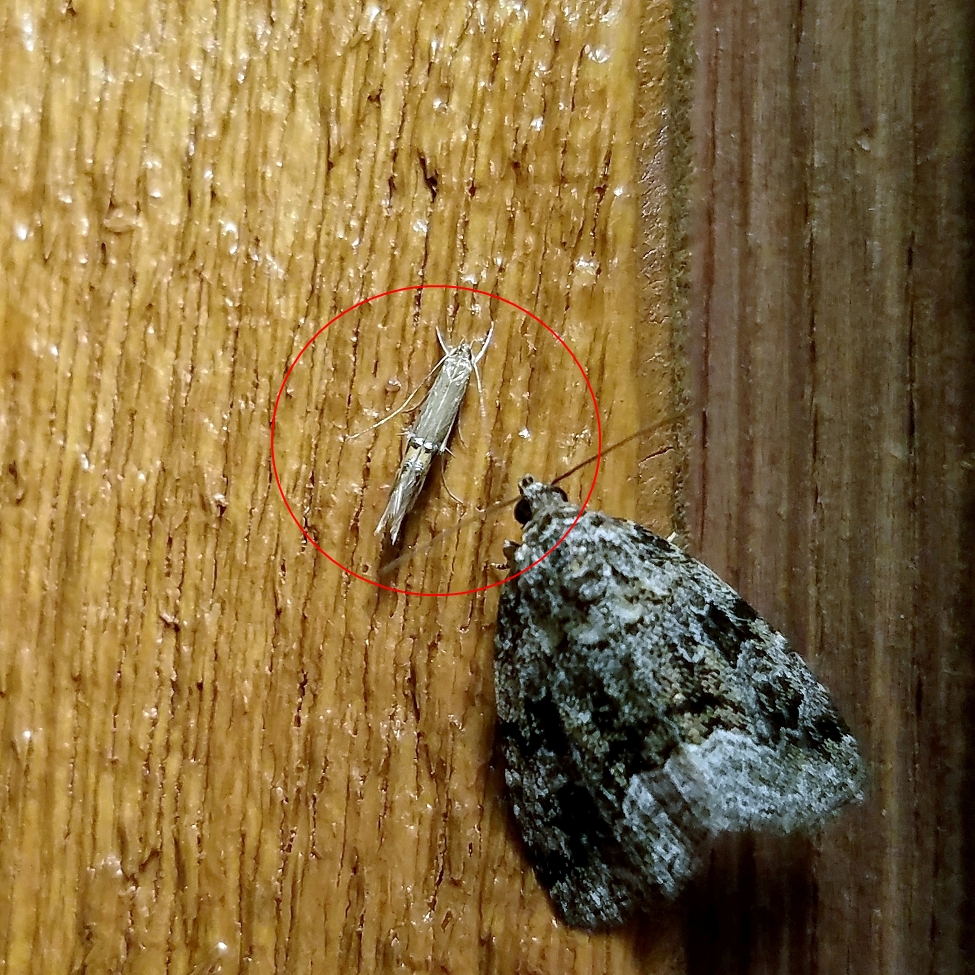
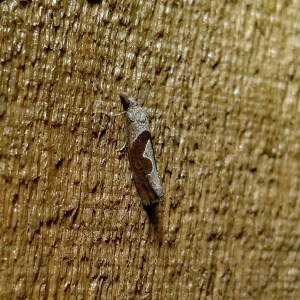
Cosmopterix fernaldella (in red circle). C. fernaldella measures about 5 to 6 mm long. The larger moth is unidentified for now.
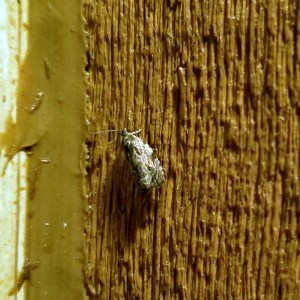
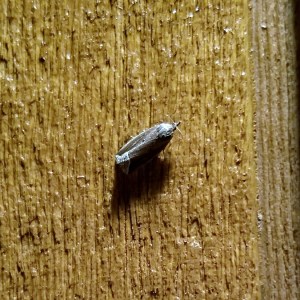
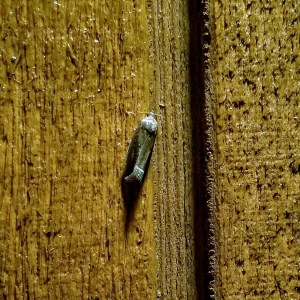
One looks like a positve id: Cosmopterix fernaldella (Fernald’s Cosmopterix Moth). Photos of the other three, Olethreutes glaciana (a leaf-roller moth), Olethreutes permundana (Raspberry Leaf-roller Moth), and Capis curvata (Curved Halter Moth), are little blurry but have sufficient detail I think to make a species determination. O. permundana is the only one I am not completely sure of but it seems to fall within the variation for that species.
Olethreutes permundanalarvae feed on a variety of plant species from many families including meadowsweet (Spiraea salicifolia), ninebark (Physocarpus opulifolius), staghorn sumac (Rhus typhina), hazel (Corylus), sweetgale (Myrica), and hickory (Carya). Range map at Moth Photographers Group.
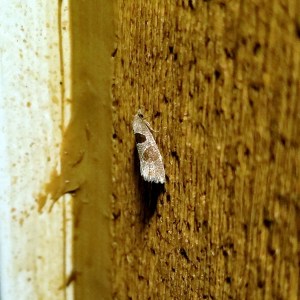
Update on Eucosma (Pelochrista) dorsisgnatana and E. (Pelochrista) similiana: I found a few photos of the latter in my August files and have added its name back to the checklist which stands at 158 species now. I knew I’d seen E. (Pelochrista)similiana before. Both species are shown below.
D. Beadle and S. Leckie (2012). Peterson Field Guide to Moths of Northeastern North America. Houghton Mifflin Harcourt Publishing Company, Boston. 640 pages.

 Not Very Far Away