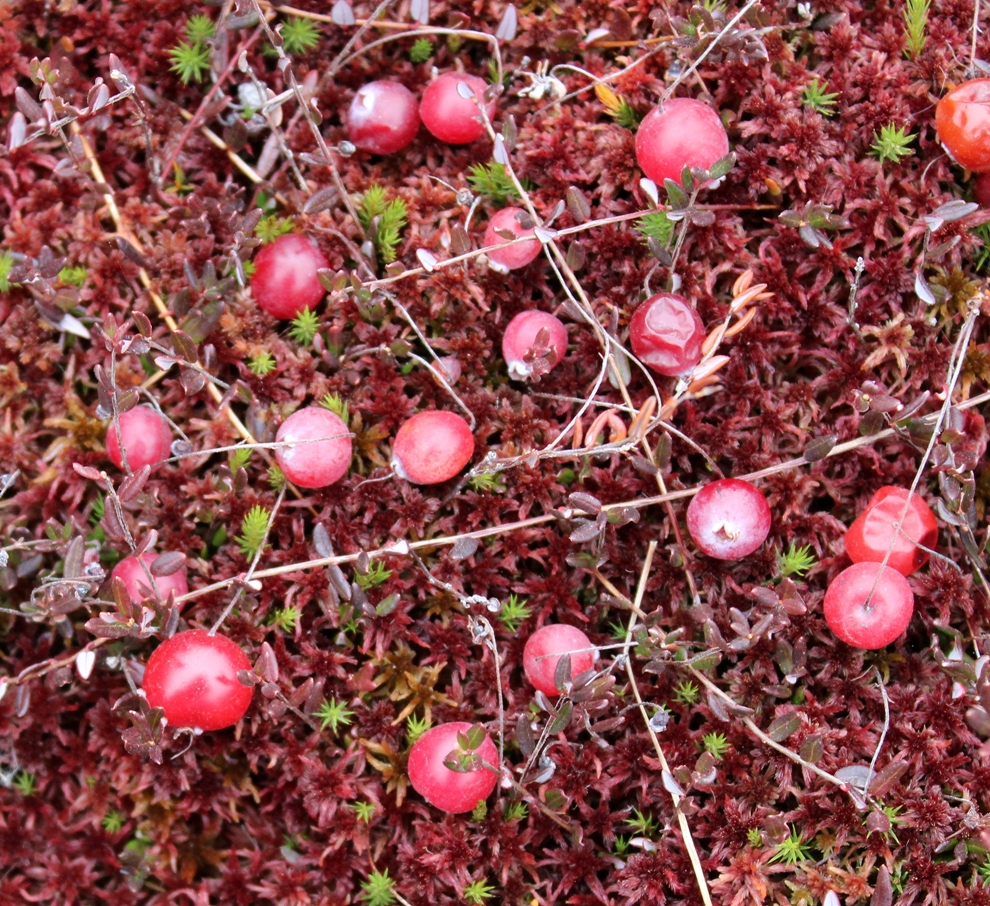
Just the thought of these tart red berries makes my mouth water. These are fruits of small cranberry (Vacciniumoxycoccos) and not to be confused with the ones in the grocery stores, which are cultivars of large cranberry (Vaccinium macrocarpon). Both species grow in wet habitats with deep peat soils. Vaccinium macrocarpon is only native to North America, but Vacciniumoxycoccos has a circumboreal distribution. Outside of North America, Vacciniumoxycoccos is cultivated to some extent.
I’ve found small cranberry in intermediate fens, poor fens, and raised bogs. They seem to fruit best in full sun. Sometimes they will make a few berries under the shade of tamaracks and black spruce. This group is growing in an open poor fen with lots of peat moss and cottongrass and no trees. There were thousands of berries to pick, but they were a little past their prime after a recent hard frost. I don’t know what wild animals and birds might feed on them. Perhaps ruffed grouse or bears do. I saw bear tracks in the fen and ruffed grouse along its edge in the low-growing shrubs, but no sign that the berries had been eaten.
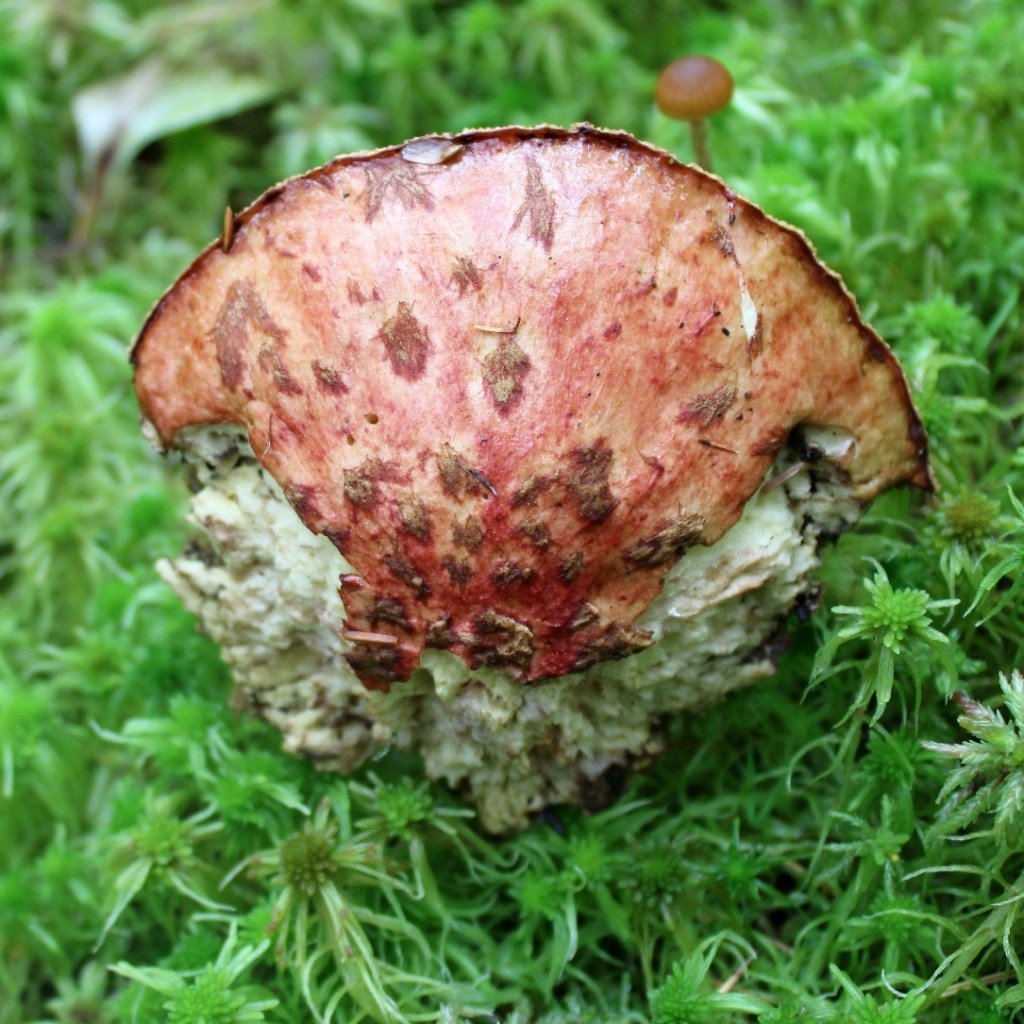
Suillus spectabilis (larch bolete)and a bit worn from hungry mice.
It’s fully autumn now and despite frosty nights and sometimes cooler days, this is a good time to hunt for mushrooms. At this time of the year, there are many interesting species popping up from the duff, through the moss, the sides of rotting logs, and even from fallen pine needles.
Boletes, a broad term for genera of pore fungi, have been sprouting in the woods these last few weeks. One afternoon in early October I came upon Suillus spectabilis, the larch bolete. It wasn’t a very handsome specimen, as some animal, perhaps a mouse or red squirrel, had taken some big chunks out of the cap. This reddish mushroom grows in conifer swamps where tamarack or larch (coniferous trees in the genus Larix) occur forming an ectomycorrhizal association. Two other Suillus (Suillus cavipes, Suillus grevillei) that also form ectomycorrhizal associations with Larix were noted in the area.
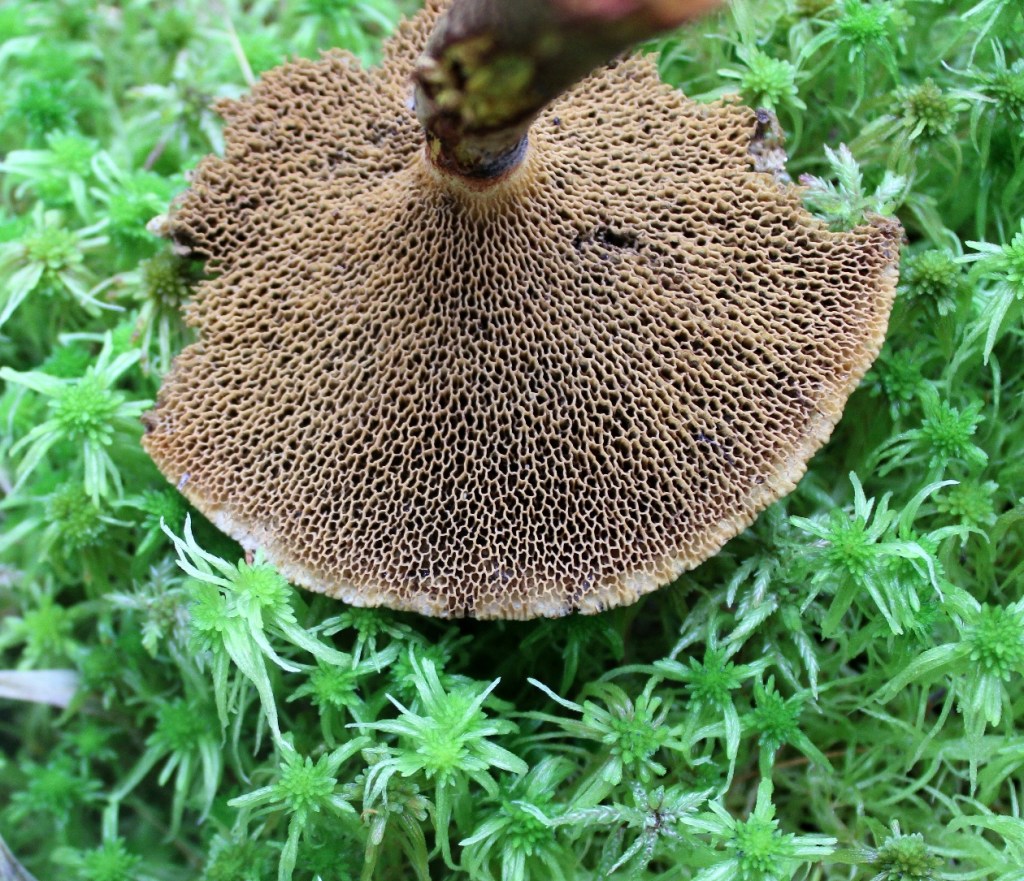
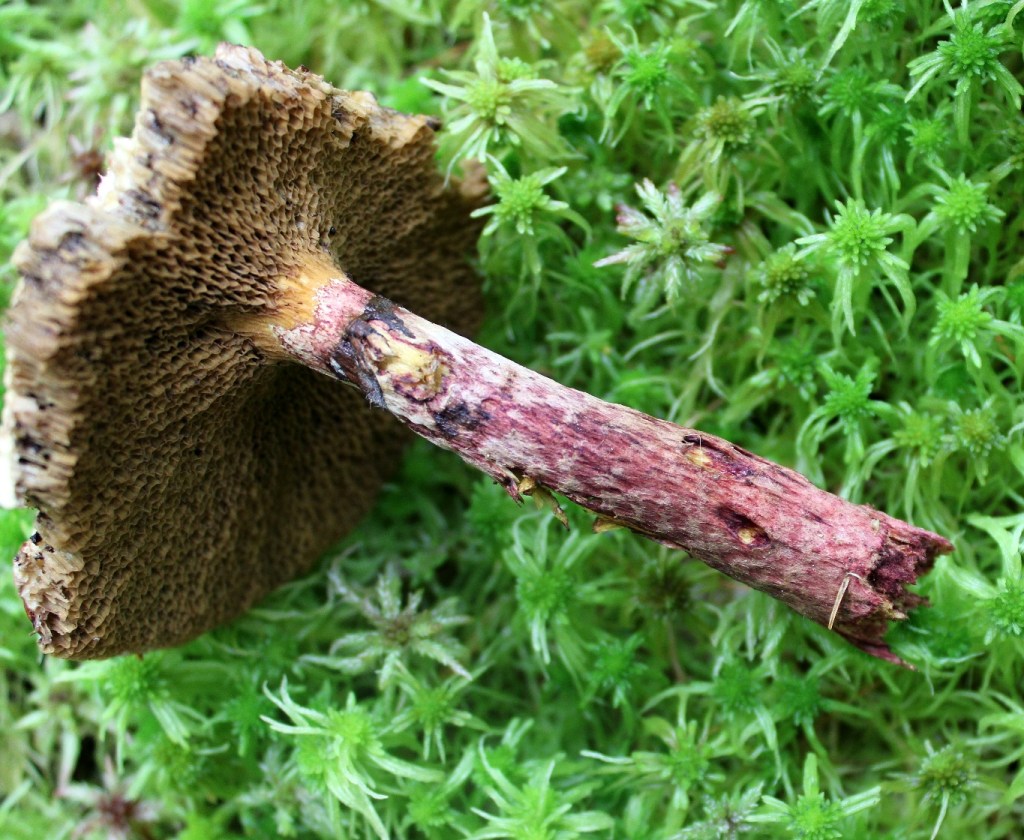
Suillus spectabilis poresSuillus spectabilis stem showing patchy red pigmentation.
Finding Suillus spectabilis helped to solve another Suillus identification problem. This other Suillus species was growing on some high ground near the edge of the tamarack swamp but also just a few yards away from a white pine the ectomycorrhizal associate another bolete: Suillus spraguei (syn. Suillus pictus). Given the close proximity to two possible symbionts, I wasn’t sure whether this mushroom was growing in association with pine roots or tamarack roots. Now that I had a new red Suillus for comparison, the differences were immediately obvious. I could now add the pine bolete or Suillus spraguei to the fungi checklist.
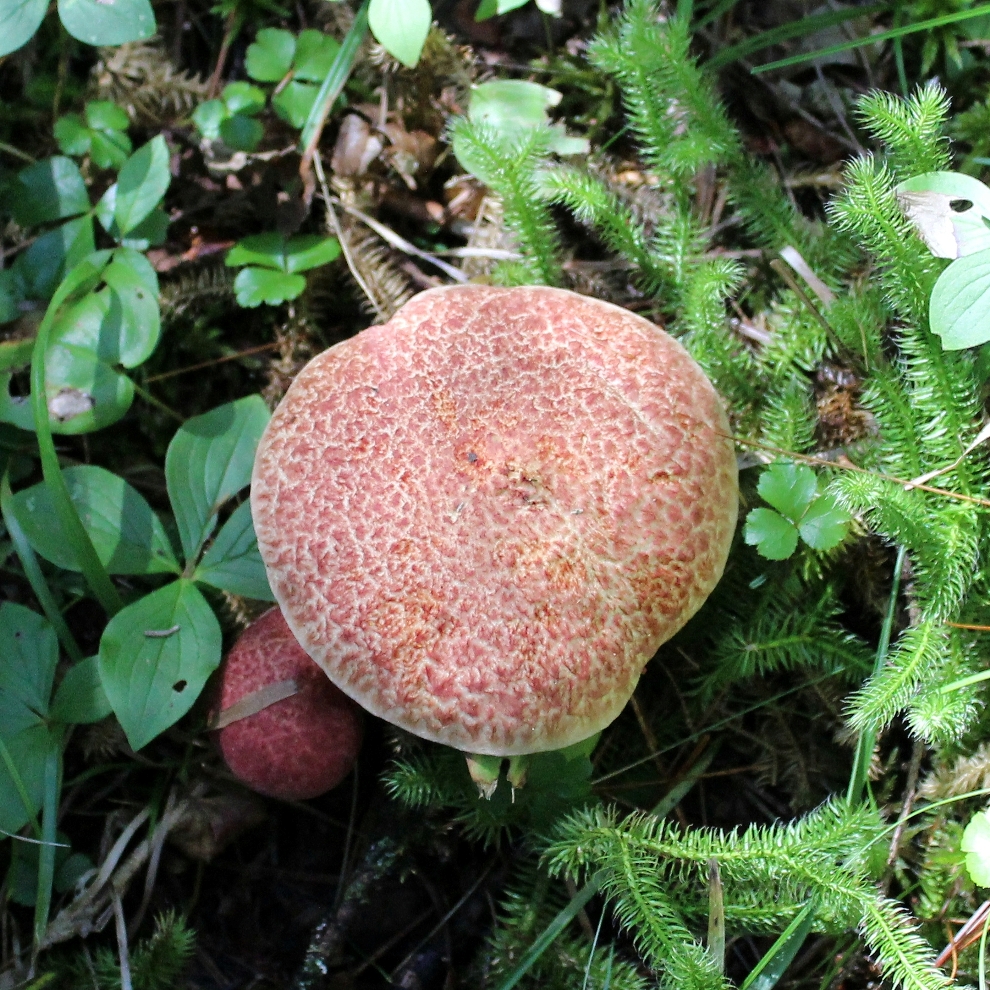
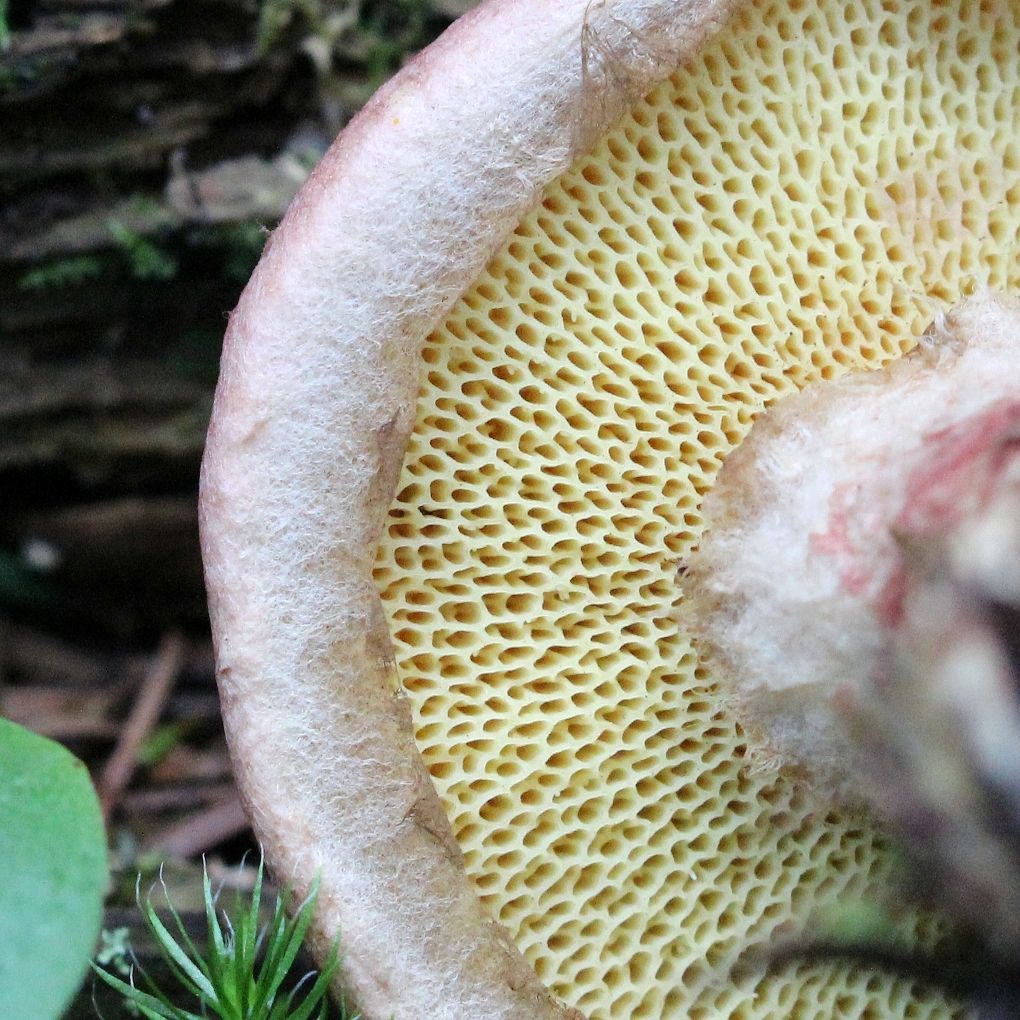
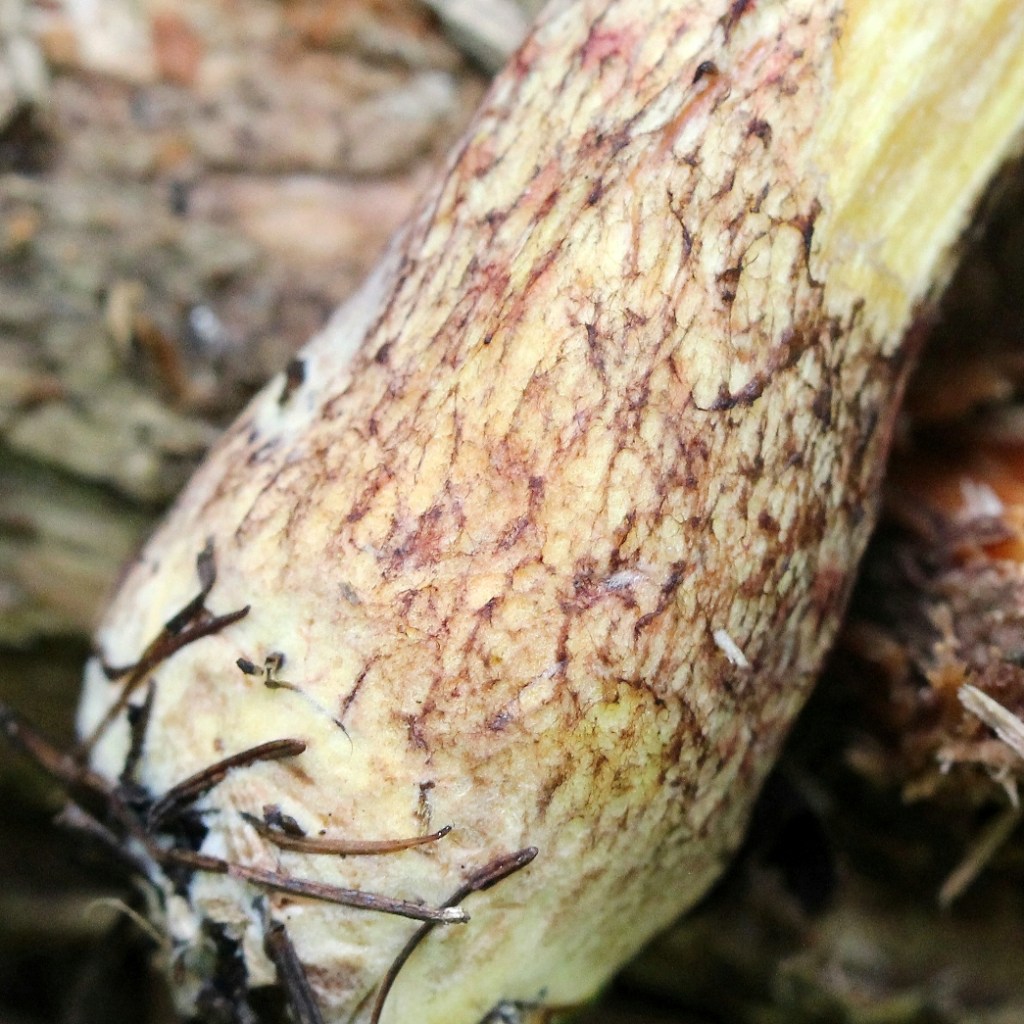
Suillus spraguei capSuillus spraguei poresSuillus spraguei base of stem
The differences between the two species, aside from the conifers they associate with, are seen in the cap, pores, and stem. For Suillus spectabilis (see here, here, and here), the cap is reddish with large pink scales; the pore surface is at first yellow, later turning brown; the margin of the cap’s underside is thin and the edge is not inrolled, and the stem is more or less equal in width from top to bottom, fibrillous and reddish.
Suillus spraguei (see here, here, and here) has a cap covered in red-brown scales; the underside is yellowish, later fading to brown; the cap margin is inrolled when young, and the stem may be a little wider at the base than at the top.
Boletes such as Suillus have undergone taxonomic revisions in recent decades clarifying genus and species delineations using molecular phylogeny. The genus is divided into three subgroups: Granulatus, Tomentosus, and Spectabilis. Subgroup Spectabilis includes Suillus spectabilis while subgroup Granulatus includes Suillus spraguei. Members of subgroup Spectabilis form ectomycorrhizal associations with Larix (larch, tamarack) and Pseudotusga (Douglas fir). Those in subgroup Granulatus form ectomycorrhizal associations with Pinus (pines) and one species is ectomycorrhizal with pines and Quercus (oaks). Ectomycorrhizal associations with Pinus in the subgroup Granulatus are further partitioned between two-needle and five-needle pines.
I’m working on a few posts related to fungi and insects. One should be ready next weekend and will feature an unusual beetle that eats bracket fungi and sprays poison on its enemies. And a beautiful beetle, too, will be discussed. The fungi posts will be about some important species found across the northern boreal forests. There are still literature searches going on that lead me down many wandering paths, as well as coalescing all of this information into writing before these are ready to post.
Eupithecia miserulata (common pug) caterpillar feeding on flowers of sawtooth sunflower (Helianthus grosseratus). This species also feeds on coneflowers in the genus Rudbeckia.
Pug moths (Eupithecia) are a large genus (about 1,400 species) of tiny moths in the Family Geometridae (geometer moths or inchworms). There are hundreds of described species from all continents except Antarctica. Some even live on Pacific islands like the islands of Hawai’i with species whose larvae are carnivorous and catch and eat other insects. North America north of Mexico hosts at least 160 species. There are probably many more species yet to be described.
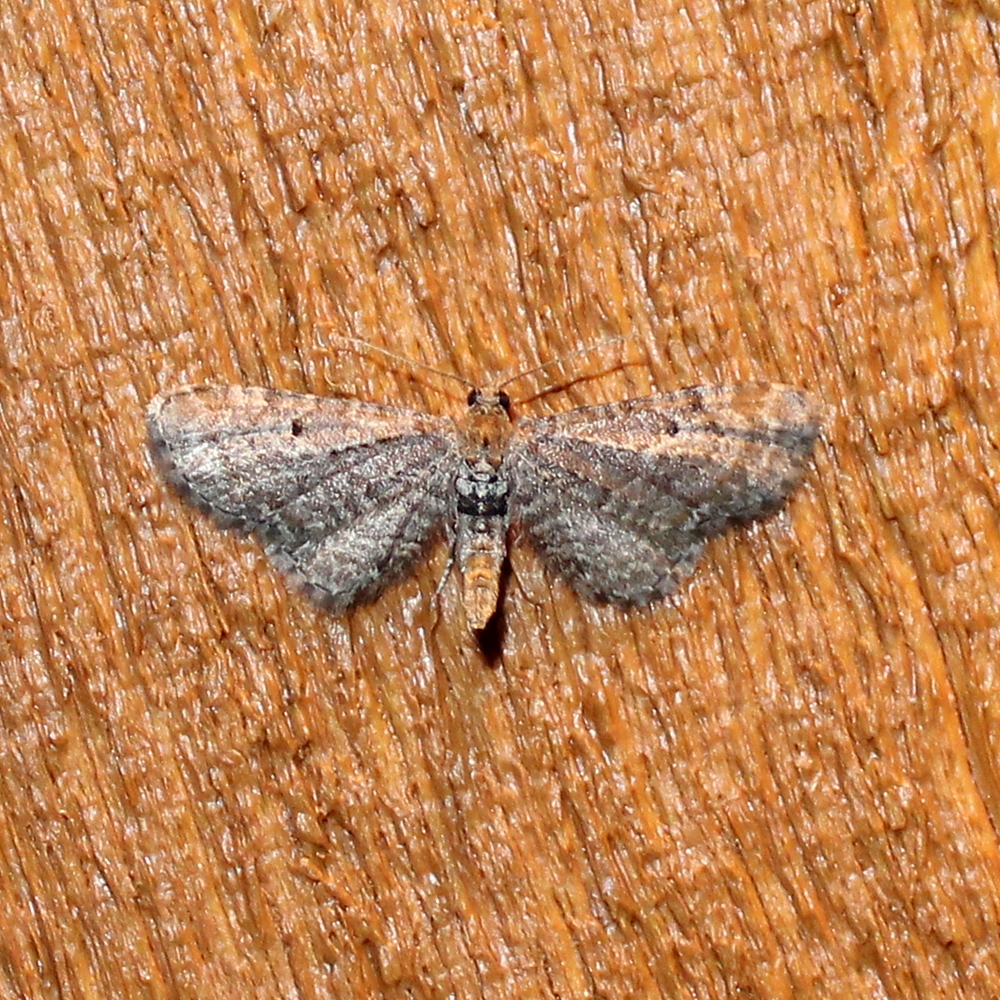
Eighteen Eupithecia species have been recorded from Minnesota. Some are known from five or fewer sightings in the state. I haven’t found all eighteen yet but have gotten to one-third of that number and that includes some of the rarities. The most common one is Eupithecia miserulata, a small grayish species with a dark dot on each of its forewings, faint scalloped lines on the wings, and often two or three dark dots along the costa. This moth can be variable and it is easy to confuse it with other species. I often find the yellowish larvae in July and August feeding on the anthers of black-eyed susan (Rudbeckia hirta) flowers, cut-leaf coneflower (R. laciniata), and sunflower (Helianthus grosseserratus). The larvae of E. miserulata are also reported to feed on oak, willow, and juniper.
Larval host preferences are not known for the other Eupithecia I’ve found except for E. strattonata (alder and spiraea), E. absinthiata (mugwort, wormwood, yarrow), and E. ravocostaliata (willow, cherry, birch and other woody plants).
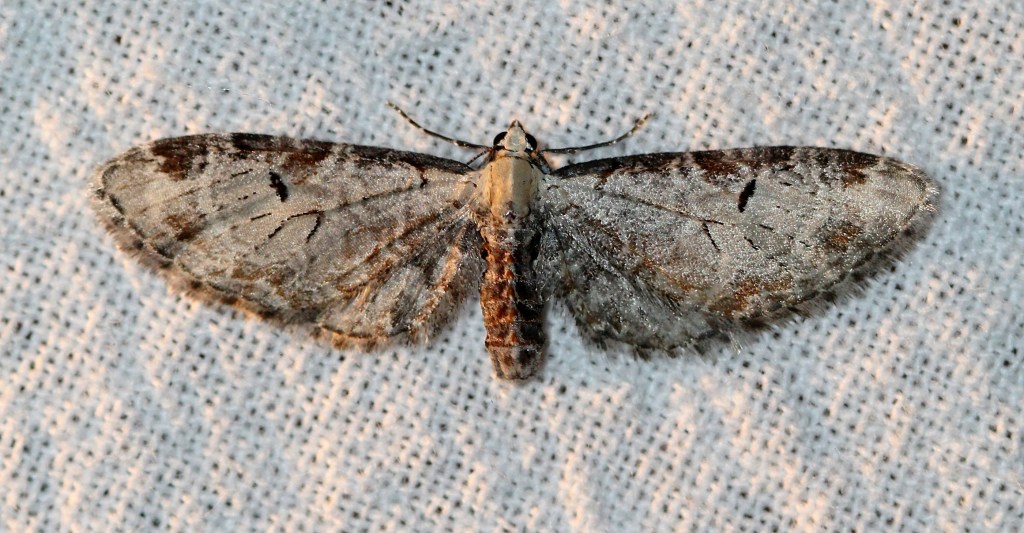
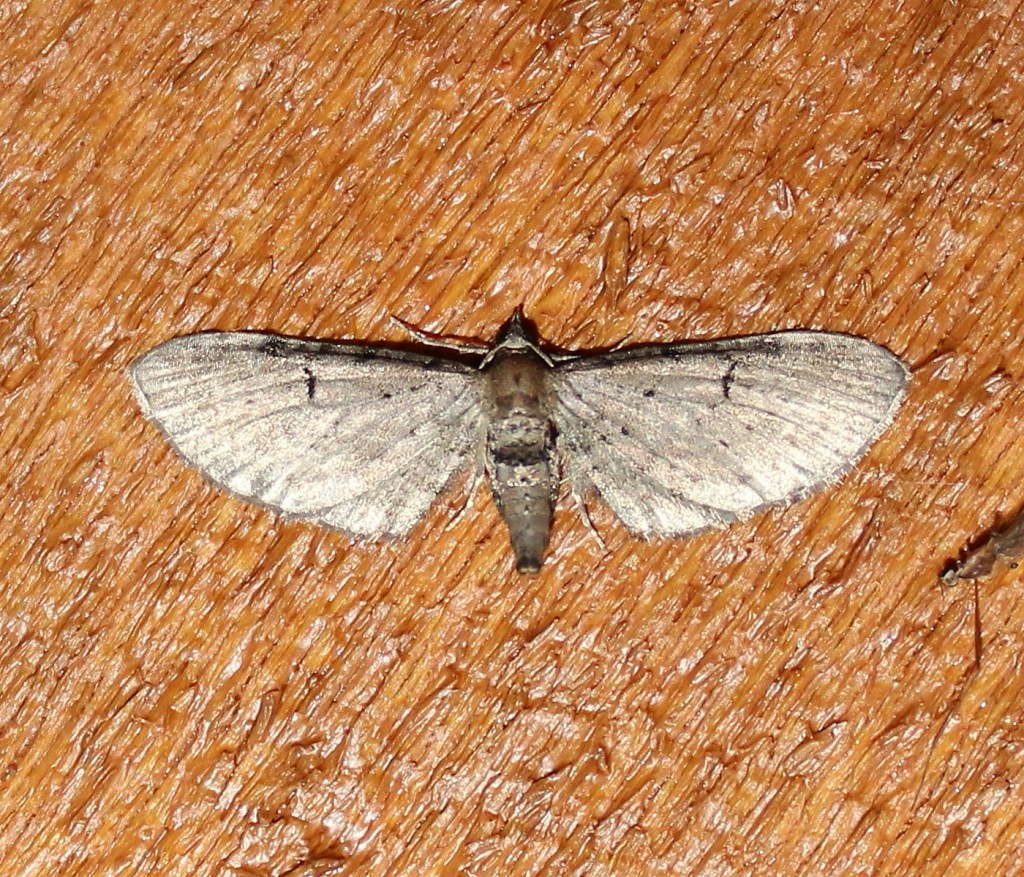
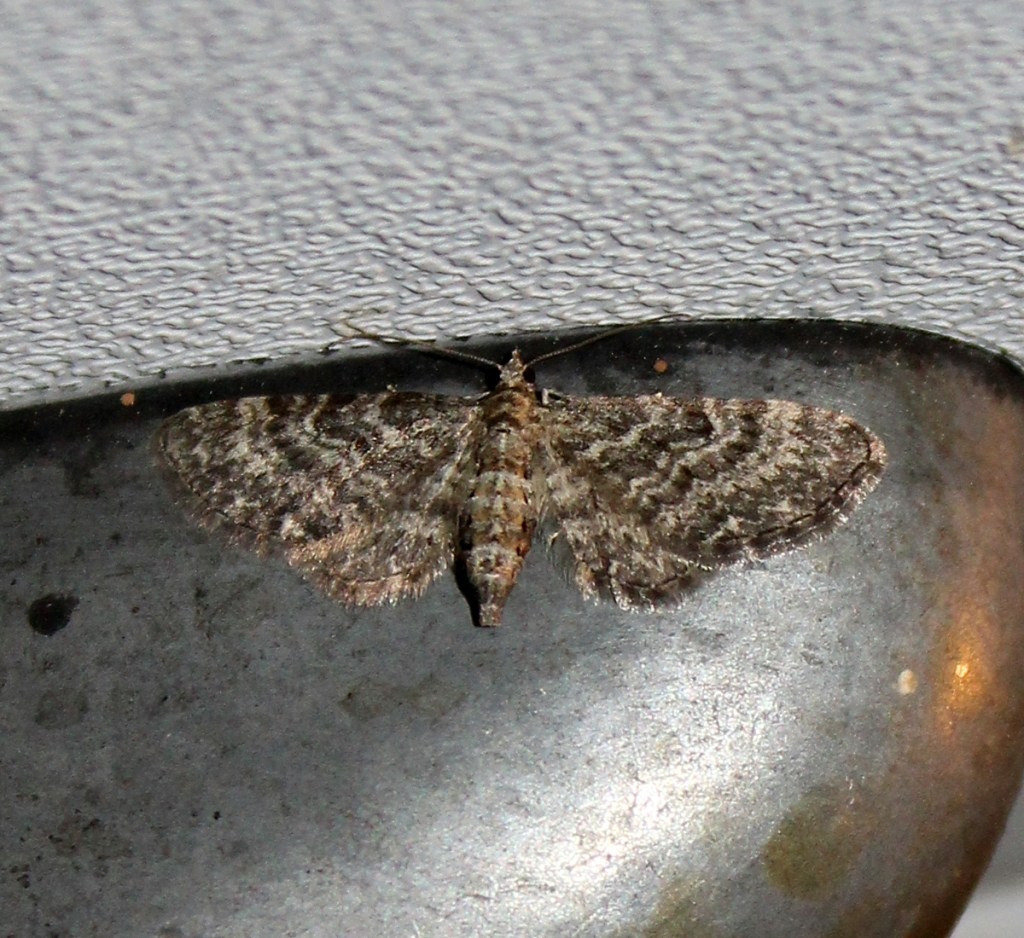
Below are the six species I’ve found and been able to identify.




 Not Very Far Away