
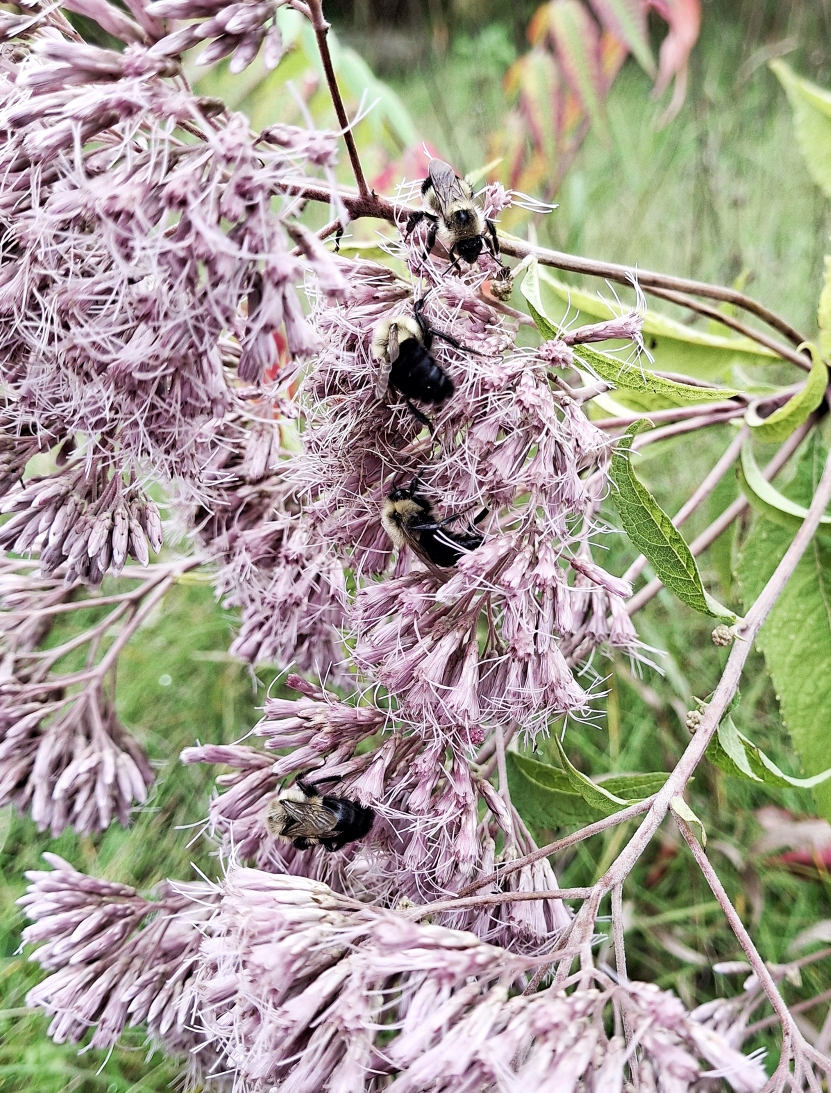
On my way to the mailbox today

Our township was without electricity for almost 24 hours. Not a record here. One of the longest was three days in December 2022. That event occurred during a massive winter storm called the Blue Blizzard. It buried huge swathes of the state and our neighboring states with two feet or more of snow mixed with freezing rain. I am working on a post about that, discussing the ecological consequences resulting from massive forest destruction brought by the storm.
The recent power outage was attributed to a rodent, but no explanation was given as to how it did that. Did it get inside a transformer? Short out exposed wires by falling on them? Whatever it did caused a fire in the substation, destroying transformers.
There have been problems with that substation all summer. In the last two weeks, before this blackout, there had been three other power surges followed by short power interruptions. Power surges and brief interruptions have been happening all summer. I haven’t heard why any of those happened. They weren’t big enough to get anyone’s attention, I guess.
So for now we have electricity.
My computer came back to life, too. Why? I don’t know. But it did. It seems to have suffered no ill effects, and all files look good. I’ll get it checked anyway. In the meantime, I can get back to writing and editing new posts and reading yours comfortably on a large screen.


It is April and spring is should to be well underway with flowers in the woods, trees putting out leaves, bees flying about, and frogs calling from the woodland ponds. But here in northern Minnesota you wouldn’t know it with the cold weather, occasional snow, and bleak landscape with only the conifers for greenery. There is still snow in the woods where the trees are thick and block the sun. The ground remains frozen except in the sunniest of sites and so none of the forest wildflowers have come out of dormancy. Even so, trees and shrubs are beginning to awaken albeit about 30 days late. The earliest of these are tag alder (Alnus incana ssp. rugosa), American hazel (Corylus americana), beaked hazel (C. cornuta), and tea-leaf willow (Salix planifolia). Following closely is the quaking aspen (Populus tremuloides) but only some groves (clones really) are flowering. Red maple (Acer rubrum) flower buds are swelling and I expect they will be in full bloom in a week. So far none of these shrubs or trees have produced any leaves. That will come later when flowering is over and temperatures are warmer at night.
Trees that flower in the early spring are mostly wind-pollinated a good strategy since insects may still be in hibernation or slow to move about. Tea-leaf willow is an exception and produces abundant pollen and nectar which attracts small wasps, solitary bees, beetles, and flies. These insects pick up pollen from the staminate flowers and transfer it to the pistillate flowers. Tea-leaf willow plants are either staminate or pistillate so the insects need to go from one to the other in the right order to effect pollination. The flowers of tea-leaf willow are fragrant and so lure the insects to them. But if insects are scarce like they are this year tea-leaf willow can still pollinate some of its flowers by wind pollination. Red maple is insect pollinated and has thick nectar-secreting glands in its bright red flowers to attract bees and other nectar feeders of many kinds. For a few days there will be a red glow in the forest canopy while the red maple is bloom.
Rain is forecast for early next week but the chances for a good downpour are very low. This is not a desirable situation as the low humidity, dry grass, and constant winds make fires more likely. A couple of rainy days and nights would certainly reduce the chances of a fire. Sunny weather isn’t all it’s cracked up to be.
So far I have heard no frogs in the woodland ponds and am wondering where they are. In past years wood frogs have begun calling in mid-April even when there was a bit of ice on the ponds. There ought to be some by now with the warm weather. I hope this isn’t an indication of a problem.
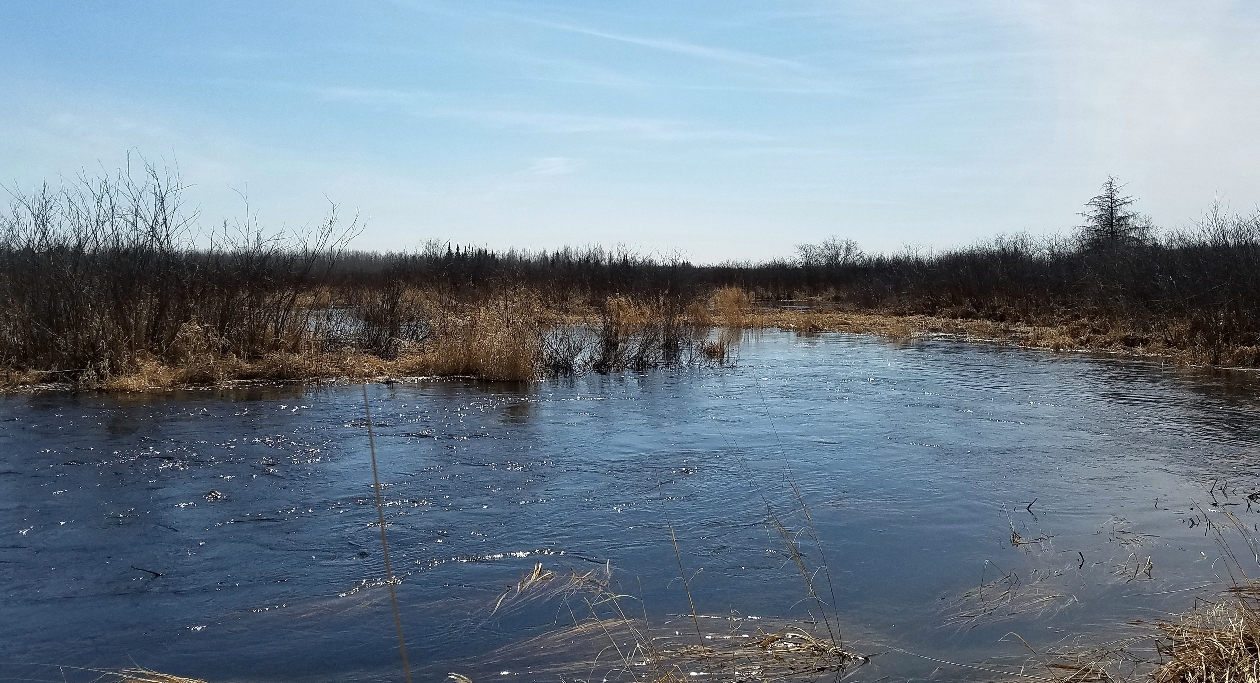
Temperatures rose rapidly over the weekend melting three feet of snow in our watershed. The result is a huge flood and the little stream (West Fork of the Moose Horn River) that flows through my property has gone from 16 feet wide to almost 1,600 feet wide. Water depths have increased from 3 feet to about 6 or 7 feet depending on where you measure. And the speed of the stream’s flow has also increased although I have no measurements for that other than sore muscles from trying to paddle upstream so as not become part of the flotsam.
The rising and spreading waters clean out the stream and refresh it. They also flatten out the grasses and sedges in the shrub carr/sedge meadow making them less prone to fire. And for me they make it easier to visit the western sections of my property as I can canoe within 100 feet of the uplands. When the stream is at normal levels the walk is 1,300 feet through willow thickets and sedge tussocks.

The flood waters are stirring up many small aquatic animals which can be collected in simple traps like minnow traps. It is encouraging to find larvae of damselflies and caddisflies in the traps as most species from these insect orders require oxygen-rich waters to survive. Their presence and abundance indicates a good level of stream health. But not everything in my traps is an indicator of oxygen-rich water. Mudminnows (Umbra limi), Brook Sticklebacks (Culaea inconstans), and isopods (most seem to be Caecidotea) are tolerant of oxygen-poor water. When rainfall is abundant and regular the stream is full and the water fresh. But if rainfall is scarce or sporadic the stream’s water levels drop and the flow slows down. During drought years the stream will nearly dry up. This can be especially problematic in the winter when what little water there is freezes solidly to the stream bed. These conditions put a lot of stress on aquatic life and species that can tolerate that stress have a better chance of surviving. In recent years rainfall has been more consistent. The arrival of beavers, which had been gone for two decades, is also helping to keep water levels higher and creating new aquatic habitats where other animals and plants can live.


While the water is high many migratory waterfowl have arrived. Trumpeter Swans (Cygnus buccinator) and Hooded Mergansers (Lophodytes cucullatus) are two species that arrived this week. They will rest here for a short while and continue northward to their preferred nesting habitats. A pair of Canada Geese (Branta canadensis) and Sandhill Cranes (Antigone canadensis) have come back as have several pairs of Mallard Ducks (Anas platyrhynchos). These birds will stay here all summer tending their young. Redwing Blackbirds are back, too, fussing at intruders into their territory like me. Other songbirds, mainly warblers and sparrows, will being showing up soon to build nests in the willows and sedge. The flood will continue for several more days and eventually the shrub carr/sedge meadow will drain a little. Then the willows, grasses and sedges will start leafing out transforming the scene from one of bare twigs and brown thatch to green dotted with patches of aster and goldenrod flowers.
 Not Very Far Away