Dwarf Mistletoe: A Parasitic Plant on Black Spruce

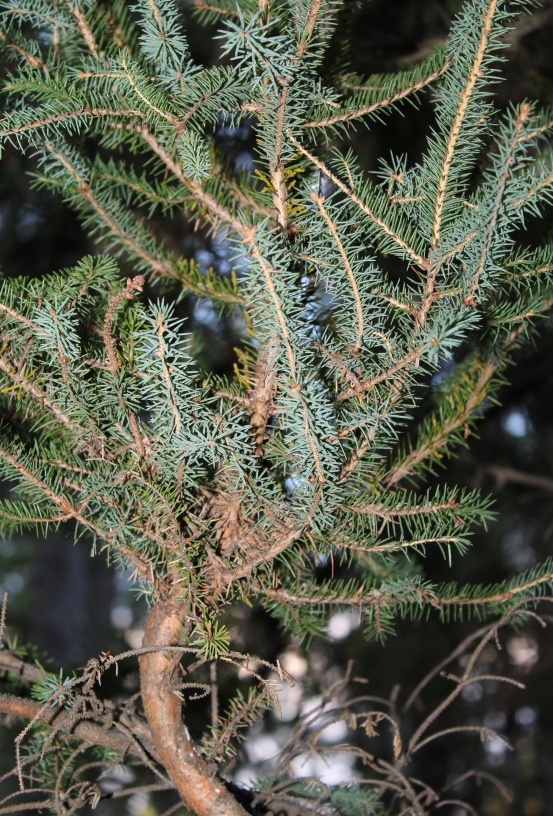
Arceuthobium pusillum fruiting shoots on a black spruce branch. Some smaller shoots are on the left side and down below. These will be next year’s flowering shoots. This dwarf mistletoe was found in a Northern Poor Conifer Swamp, a type of Poor Fen, near Marble Lake in Lake County, Minnesota.

This peculiar growth on a tree branch in the above photo is Arceuthobium pusillum (dwarf mistletoe), a parasitic plant that grows on black spruce (Picea mariana) trees. It is a flowering plant and a member of the same family (Viscaceae) as the familiar Christmas mistletoes, Phoradendron leucarpum and Viscum album. But at 2 to 3 mm in size, it is much smaller and unlikely to feature in any Christmas decorations.

Description

Arceuthobium pusillum is a minute perennial shrublet parasitic on the branches of bog conifers, primarily back spruce. Although photosynthetic to a limited extent, all of its other nutritional needs are derived from the host plant.

The stems of the Arceuthobium pusillum are green, orange, red, maroon, or brown, 2 to 3 cm long, and covered in small oppositely arranged, scale-like leaves.

The staminate (male) flowers are represented by three or four sepals, each with a sessile anther sac. There may be a prominent nectary in the center of the flower.

Pistillate (female) flowers have reduced sepals fused to the outside of the bicarpellate gynoecium. Mature pistillate flowers exude a pollination droplet that draws in the pollen grain.

Reproduction

Flower buds are formed in the fall. Flowering occurs in the spring. The minute flowers are either pistillate or staminate and borne on separate plants. Pollination is accomplished by insects and by wind.

The most frequent pollinating insects are flies (Syrphidae, Tachinidae), beetles (Lampyridae), and wasps (Aphidiidae, Ichneumonidae, Tenthredinidae, Vespidae). In studies where insects were excluded from access to the flowers, the seed set was lower.

The 2 to 3 mm long greenish or brownish fruits contain one seed. At maturity, pressure builds up in the fruit, causing the seed to be ejected up to 12 or more meters. The seeds are sticky, which helps them adhere to a potential growth site. If they land on a young live spruce twig and germinate, root-like growths (haustoria) push through the bark and into the cambium. It may take two or more years of growth under the bark of the host tree before the first mistletoe shoots appear.

The sticky seeds may also adhere to the feathers of birds, thus aiding in long-distance dispersal to new bogs with black spruce. After the seed is ejected, the mistletoe branch dies.

Witches’ brooms

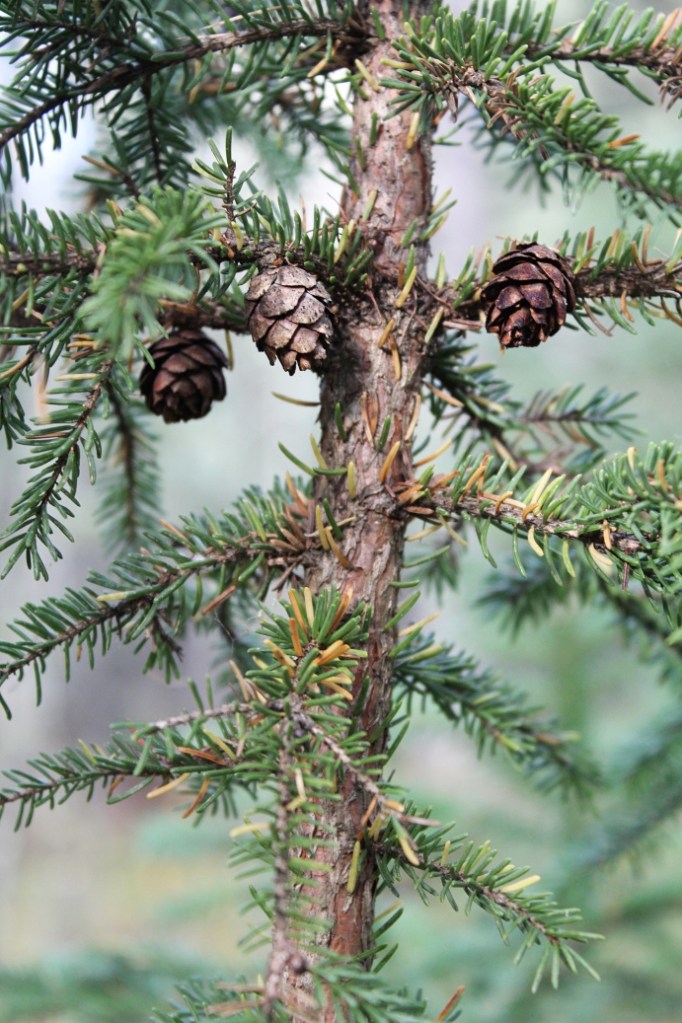
The mistletoe alters the growth of the trees’ twigs by causing a loss of apical dominance. As a result, clusters of branchlets form, called “witches’ broom”. This alteration may also affect the growth form of larger side branches that develop from the witches’ broom. These branches are twisted and flattened into an oval shape.

Abundant growth of Arceuthobium pusillum on spruce can eventually kill the tree. But the witches’ brooms, whether living or dead, are shelter for many insects, spiders, birds, and small mammals.

Habitat

Arceuthobium pusillum is a parasitic plant that grows on black spruce trees in poor fens, intermediate fens, and coniferous forested peatlands. It is occasionally found on white spruce (Picea glauca) and red spruce (Picea rubens). It rarely occurs on tamarack (Larix laricina), white pine (Pinus strobus), jack pine (Pinus banksiana), red pine (Pinus resinosa), and balsam fir (Abies balsamea).

Arceuthobium pusillum has parasites, too

Caliciopsis arceuthobii is a fungus that infects the flowers of spring-flowering Arceuthobium species, including Arceuthobium pusillum. Its spores are spread by wind and by insects visiting the flowers. The fungal hyphae destroy the developing fruit.

Discovery of the species

Thoreau first described the brooms formed by Arceuthobium pusillum in 1858, although he did not know the cause of them. In his journal entry, he wrote,

“About the Ledum pond hole there is an abundance of that abnormal growth of the spruce–Instead of a regular free & open growth–you have a multitude putting out from the summit or side of the stem of slender branches crowded together & shooting up nearly perpendicularly–with dense fine wiry branchlets & pine needles which have an impoverished look–all together forming a broom-like mass–very much like a heath.”

Arceuthobium pusillum was not formally described until 1872 by C. H. Peck after he received correspondence about the plant and specimens from botanist Lucy B. Millington of Warrensburg, New York, in 1871. Her correspondence about her discovery of a tiny mistletoe on Abies nigra (an older name for Picea mariana) was published in the Bulletin of the Torrey Botanical Club. She wrote,

“I believe it to be a mistletoe. I found the first specimen in a small tree in the edge of a cold peat bog in Warrensburg, Warren Co., N.Y. In a few days I found more in a similar situation in Elizabethtown, Essex Co., N.Y. Later I found it halfway up the side of a small mountain. In every case the limbs of the trees infested were very much distorted. Every twig bristled with the little parasite…”

Range

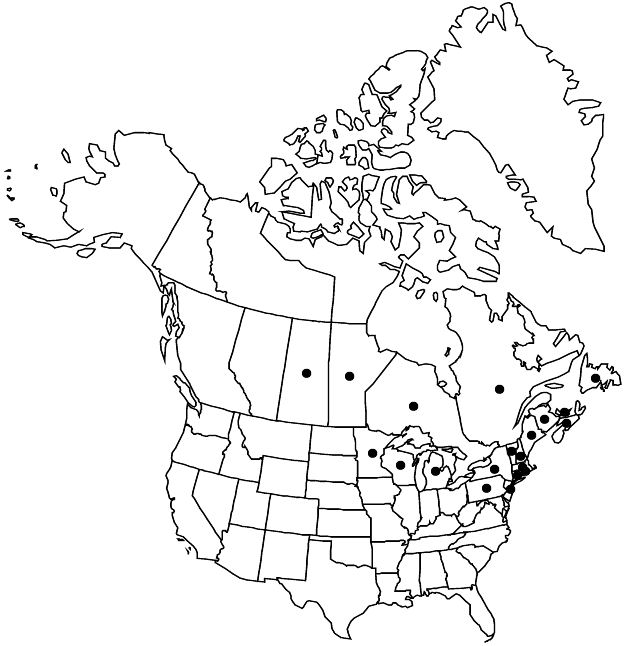
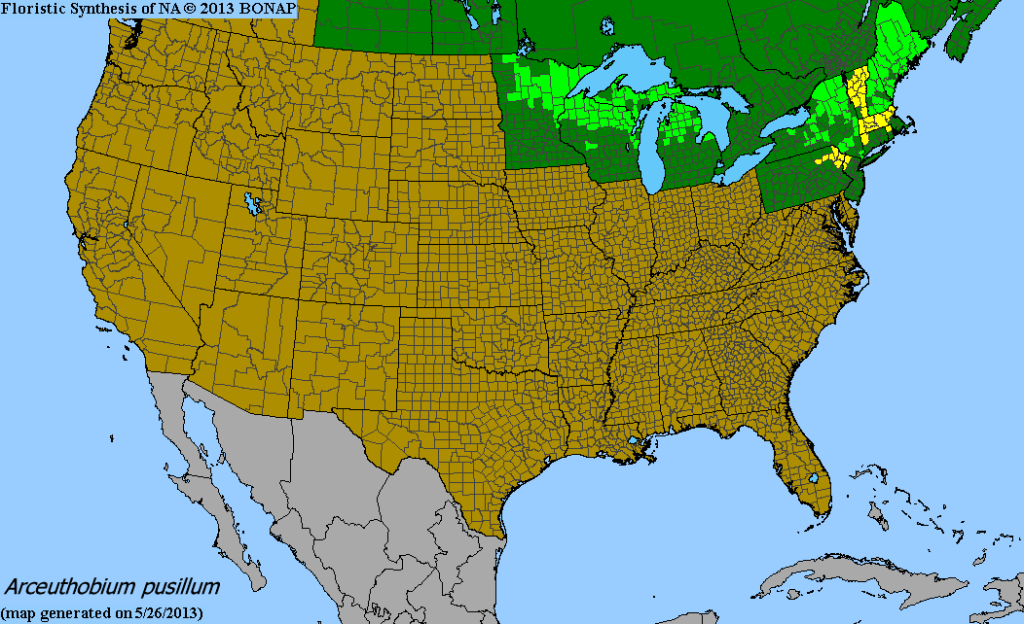
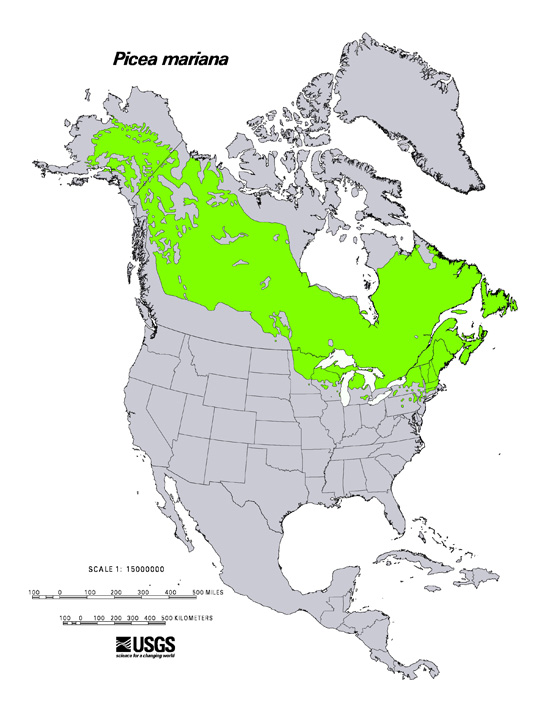
The range of Arceuthobium pusillum is from Newfoundland to Saskatchewan and south into New Jersey, Pennsylvania, and the Great Lakes states, closely following the range of its primary host, black spruce.

Sources

The Role of Beavers in an Aquatic Ecosystem

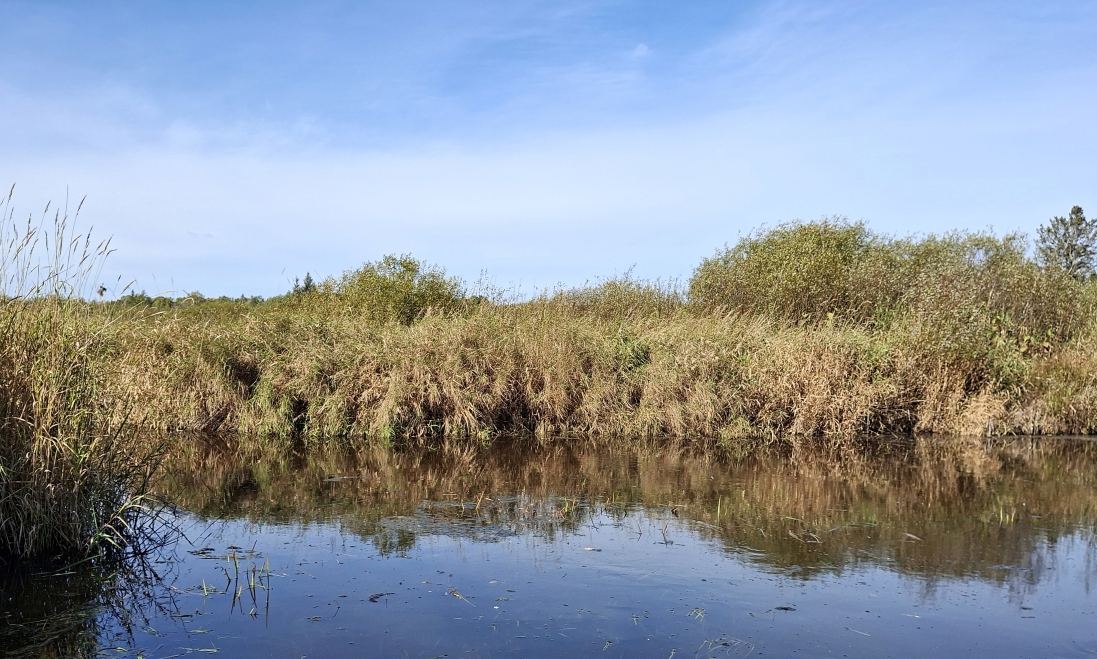
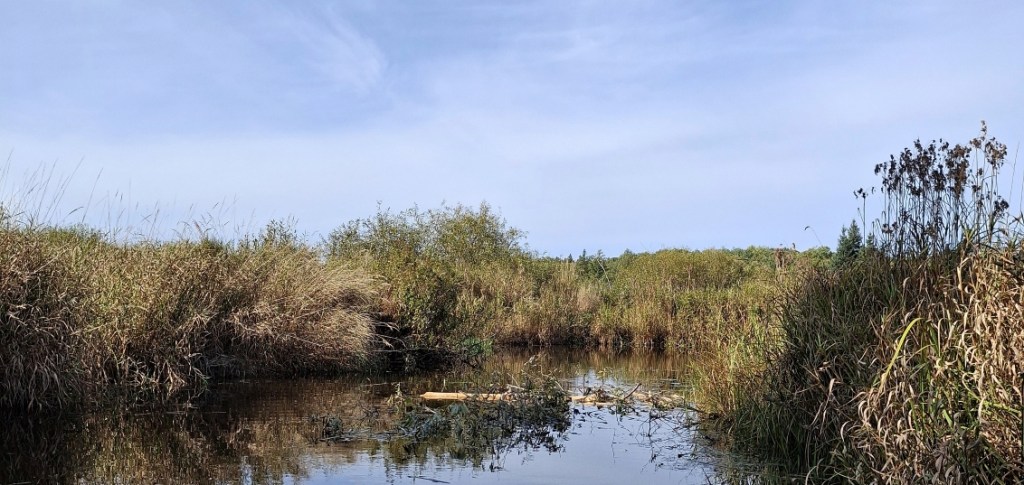
An exposed mudflat in my river on August 26, 2025, with a thick growth of Sparganium emersum (bur-reed).

A few days ago, I was out on one of my meandering walks. Eventually, I made my way down to the little river that flows through my property. My first stop was at an old beaver lodge to see what might be growing on it.

Looking for plants

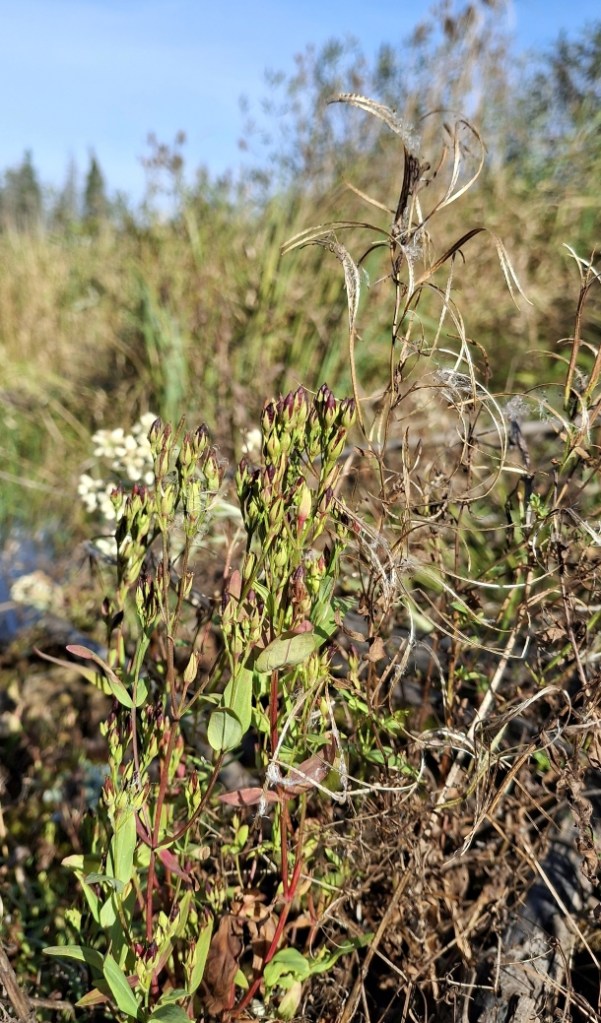
On the beaver lodge, I found some weedy species: Erechtites hieraciifolius, Hypericum majus, Epilobium leptophyllum, and Pseudognaphalium obtusifolium. Erechtites hieraciifolius is an annual and Hypericum majus, Epilobium leptophyllum, and Pseudognaphalium obtusifolium are short-lived perennials that would never survive in the thick marsh grasses. I’ve never seen them anywhere near the river except on other old beaver lodges and dams. How many years (decades?) had their seeds lain dormant in the muck before the beavers brought them to the surface?

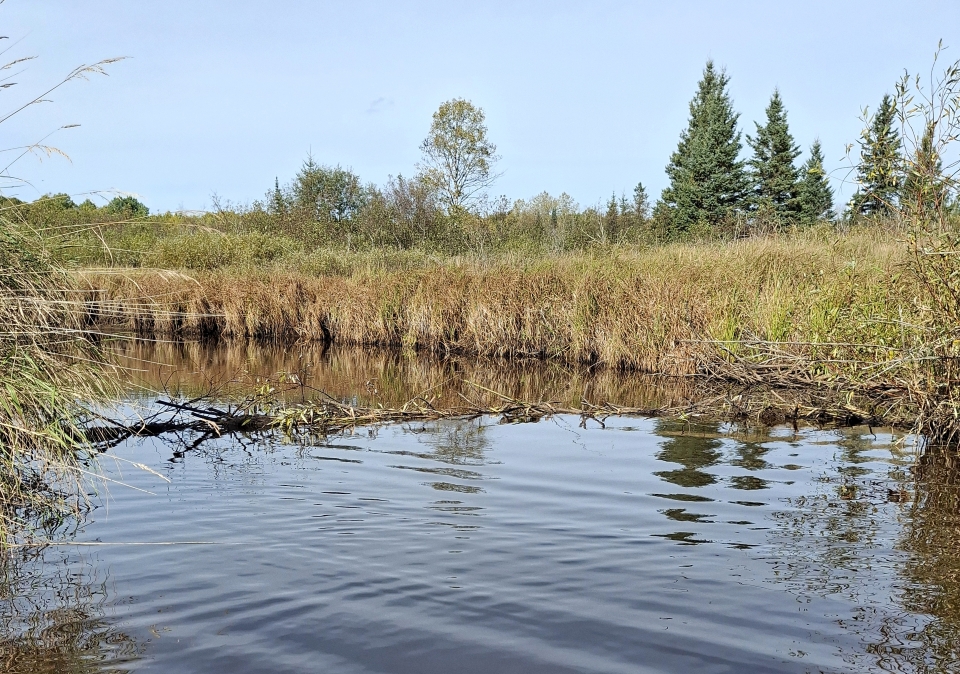
Same location as the top photo, but now the water is much deeper. October 06, 2025.

No rain but the river is rising

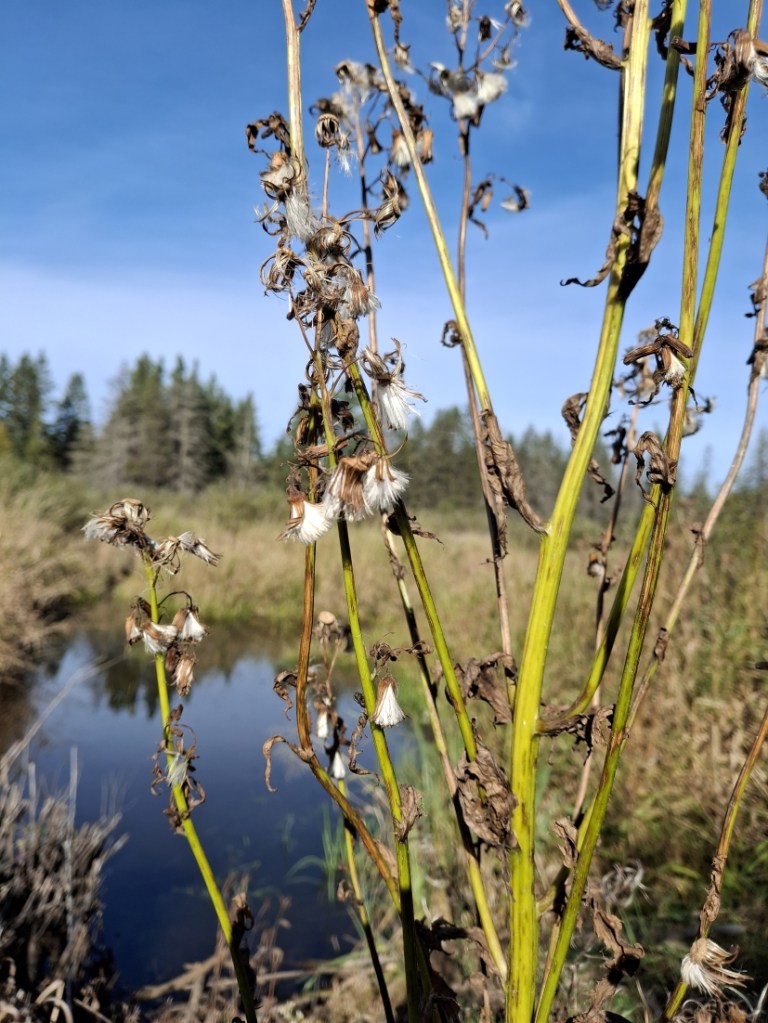
I kept walking along the riverbank, fighting my way through the tall and densely tangled grass. When I got to the place where I keep my canoe in the summer, I noticed the water had risen.

We haven’t had any substantial rain all season. When it does rain, the water soaks right into the ground and doesn’t change the river’s water level at all. So what could have happened to raise the water level in just a few days? I suspected the beavers had returned.

The beavers are back

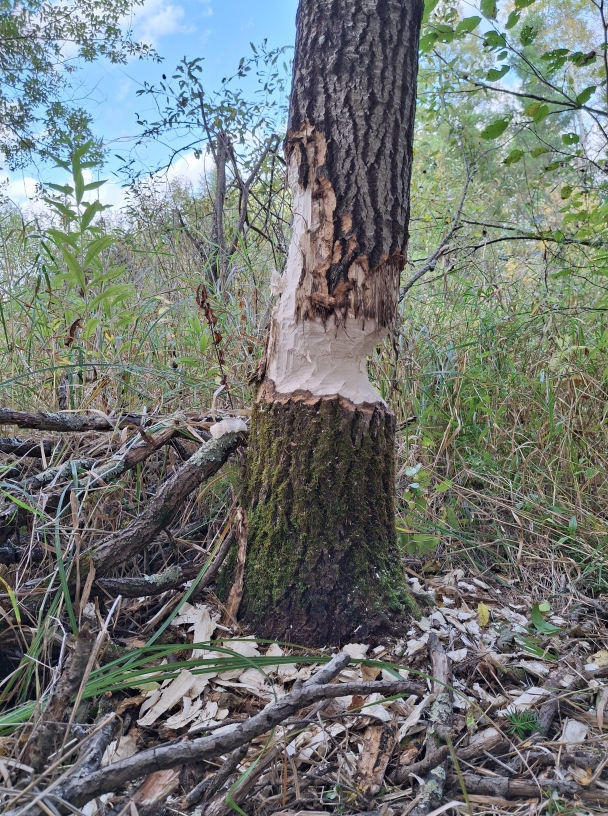
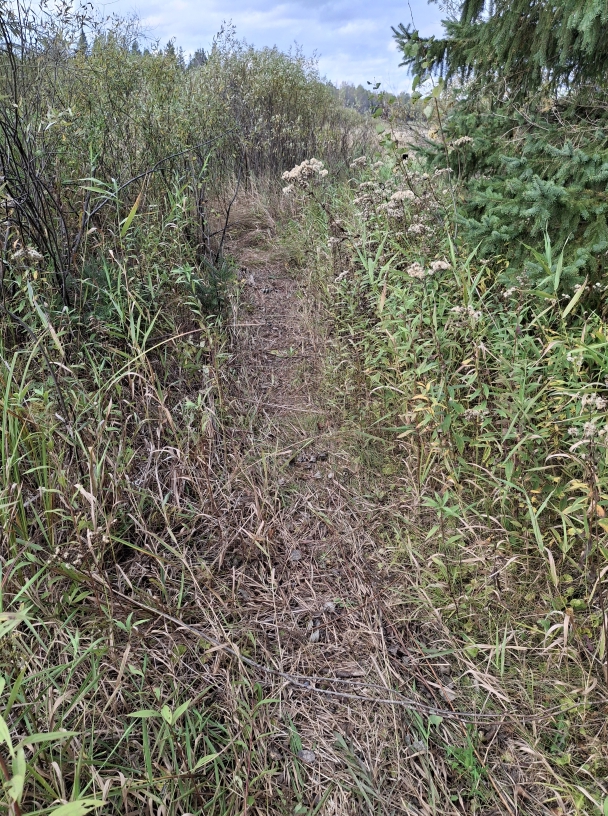
I continued walking until I came to a small, partially forested island in the marsh. Here I saw chewed tree stumps and drag marks through the grass. Beavers had been working here, pulling aspen branches and logs to an old canal connected to the river. This had all happened over a period of three days because the last time I was here was on October 2nd, and there was only a little beaver activity noted then.

An old dam and a renewed dam

About two years ago, the river had worked its way around an old beaver dam built in 2005 but abandoned by 2009. The new river course reopened a channel cut off in the 1960s. But this isn’t where the beavers were working. The new dam was further downstream, about 300 feet as the crow flies, and it was being built on the remains of an older dam (called Dam 3 on my maps) from 2010. I was impressed by how quickly they had built this new dam and how far it had backed up the water behind it.

Beavers are ecosystem engineers

By building dams and excavating canals into the surrounding marsh, the beavers maintain the river’s hydrology. Their dams hold back water that is slowly released downstream through the leaky dams, keeping the stream flowing all year. Water flowing over the dams mixes with air and becomes oxygenated, thus preventing anoxic stagnant conditions.

The impounded water also recharges and raises the water table, further maintaining the stream’s flow. The ponds and the higher water help keep the surrounding marsh wet.

A complex hydrology

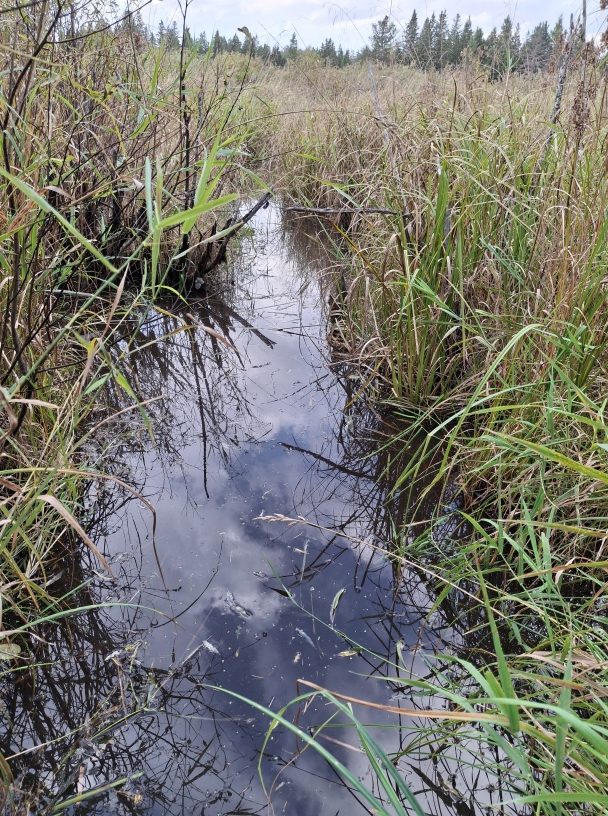
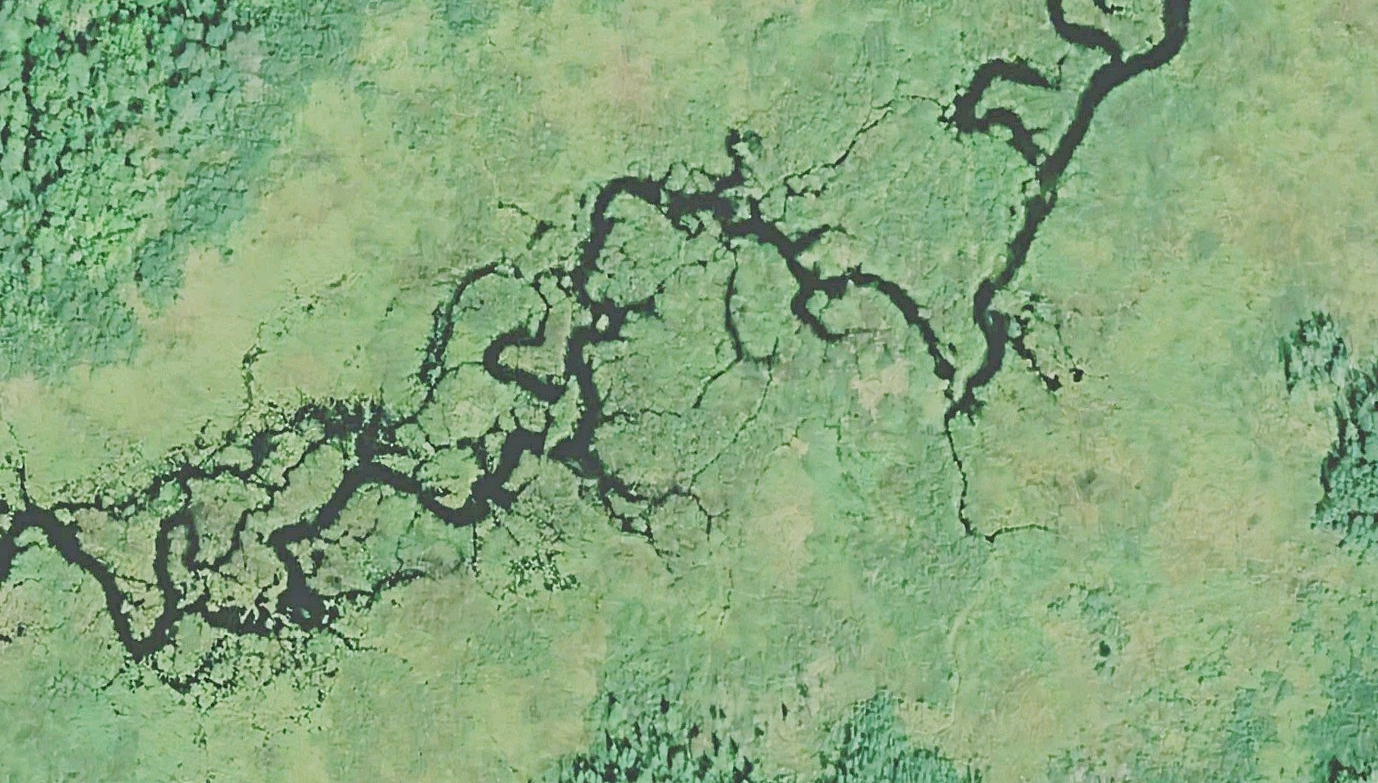
Because the river channel is meandering, and the terrain is flat and wide, the dams the beavers build do not need to be high or long. The dams are just high enough to hold back the water, which then backs up and spills into old river channels, oxbows, and beaver canals, creating a huge network of interconnected waterways.

This satellite image (above) of the river shows its main channel and the complex system of interconnected smaller streams, backwaters, oxbows, and canals created by centuries of beaver activity.

The area in the image is 30 acres (about 12 hectares). Most of the land in the image is a sedge meadow/shrub carr wetland. There is also a large alder thicket, and a conifer/hardwood swamp is reclaiming its former territory.

If you look closely, you can see tiny finger-like projections extending from the riverbank into the channel. Aerial photos from the 1940s also show these stubs as well as most of the smaller streams and backwaters.

The stubs are the remains of old dams, possibly more than a hundred years old. Trapping eliminated beavers from Minnesota by the 1890s, but they were reintroduced in the 1900s. Those dam fragments may date to that time or a little later.

The straight part of the channel was caused by something, but I have not been able to learn who or what did it. If it was ditched (but why?), there are no traces of ditch spoils to confirm it. Anyway, it’s a good fishing spot.

Four active dams are visible in the image, but only one (lower left) has a rounded pond behind it. The other three ponds are more linear in shape. The oxbow in the upper right has a small dam blocking it, but that dam keeps water from the main channel from entering it. A thin stream channel flows from the oxbow through the marsh and shrubs and back into the main channel.

An abundance of shallow water habitat

The water behind the dams and in the older abandoned channels hosts a larger variety of wildlife and plant life than the river would without them. These areas of shallow water, from 1 to 6 feet deep, support submerged, floating, and emergent plants.

These weedy waters are an ideal habitat for many species of small fish, crustaceans, amphibians, aquatic insects, and mollusks. They also provide habitat and food for waterfowl such as mallards, blue herons, night herons, geese, sandhill cranes, bitterns, and kingfishers, and mammals like water shrews and star-nosed moles.

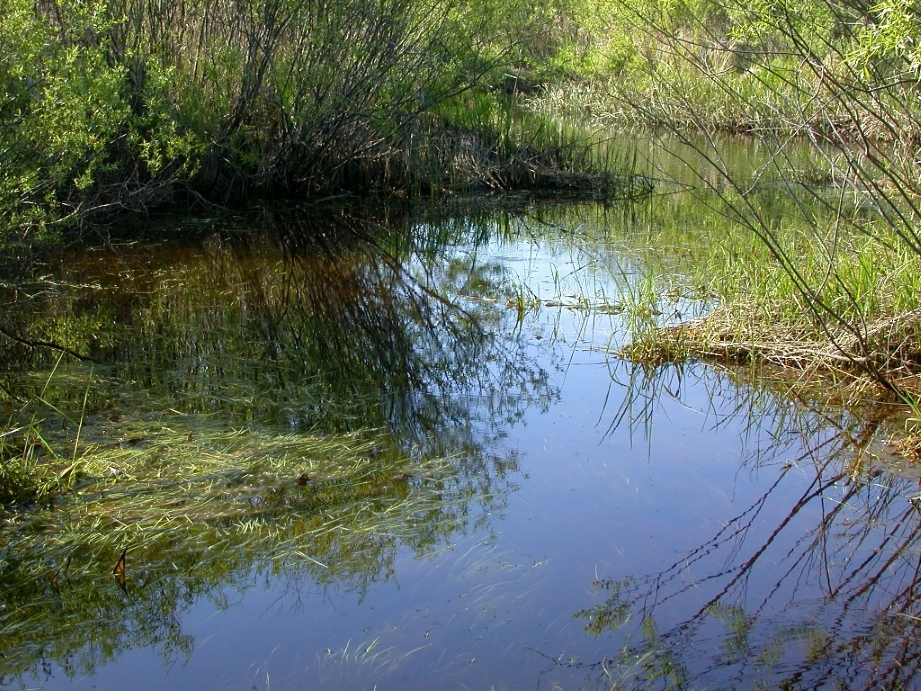
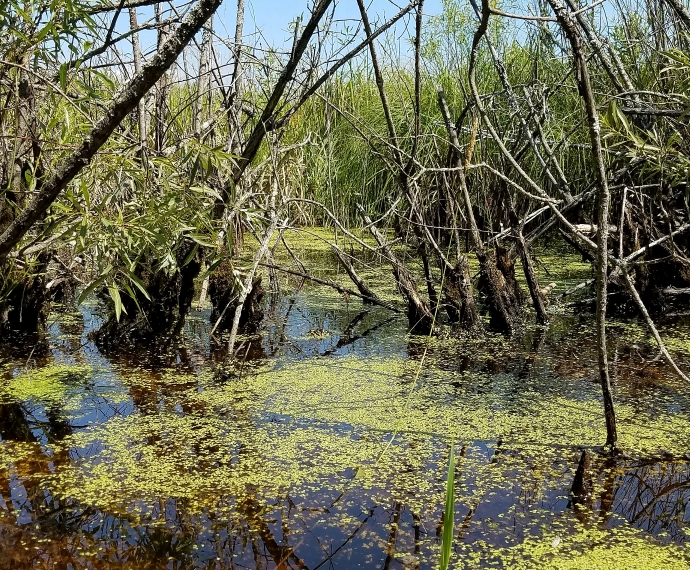
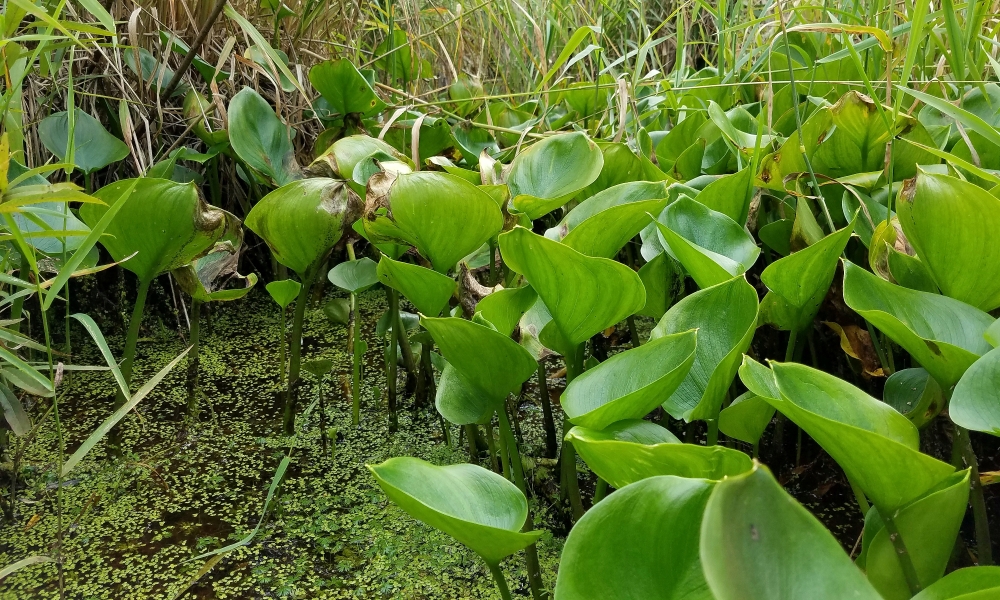
Submerged, floating, and emergent wetland vegetation grow in this backwater. Species in the photo are water calla (Calla palustris), lake sedge (Carex lacustris), water crowfoot (Ranunculus gmelinii), and duckweed (Lemna minor).

In future posts, I will be writing more about this wetland complex, exploring its connections to conifer swamps, hardwood swamps, and the adjacent upland hardwood/conifer forests.

Summer is over

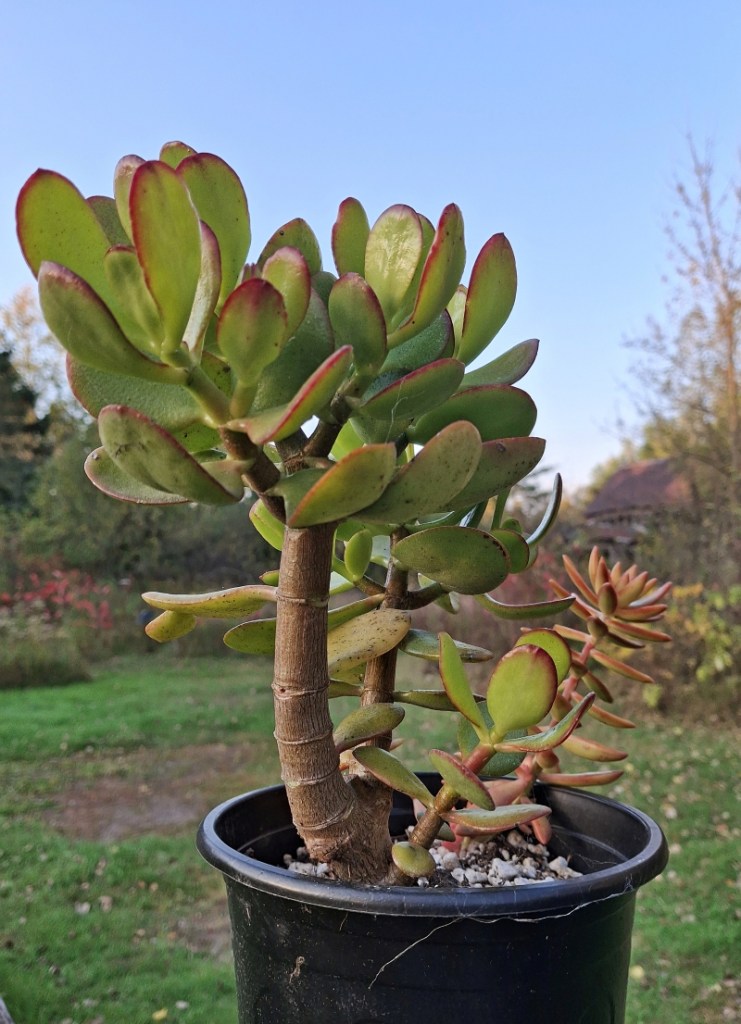
A jade plant I started from a cutting two years ago. In the winter, it lives under grow lights, but in the summer, it enjoys the fresh air and the rays of the sun. Tomorrow, it will have to come back indoors along with the Echevarria, Sansevieria, Tradescantia, and the epiphytic Zygocactus, Hatiora, and Rhipsalidopsis cactus.

We’ve had exceptionally warm weather for the last week, and even before that, the temperatures were just plain nice. But Sunday is the last day of temperatures in the 70s and 80’s. Yesterday it was 90 degrees in the shade. Tomorrow it will cool down to the 60s, and there is a chance of frost for three nights in a row.

After Monday, I will probably have to cut them down and store the tubers for the winter. The same is true for the tuberous begonias and the gladiolus. And all the houseplants I set out for their summer vacation will need to be brought back in.

A stalled high-pressure system is bringing the warm weather. Winds are from the south and gusting to 30 mph. The warm weather, while enjoyable and welcome so late in the year, is bringing problems to the already dry forests and fields. Even the wetlands are dry. Very dry.

Macrochilo Bivittata: A Rare Wetland Moth

Macrochilo bivittata

Macrochilo bivittata is one of those moths I look forward to seeing every year. It isn’t a showy species, just a small triangular-shaped moth with four dark stripes against a buff to brown background, some prominent wing venation, and two pairs of dots. It is in the Herminiinae or litter moths, named because the larvae of many species feed on fallen or dead leaves and fallen fruit.

The reason I get excited about seeing it again is that where I live is one of the few known places in North America where it occurs. Across its range, Macrochilo bivittata is uncommon to rare. Minnesota and Wisconsin appear to have the largest number of observations. The rarity of Macrochilo bivittata may be a lack of verified observations and not rarity based on specialized habits or food requirements, loss of habitat, or replacement by a non-native species. More searches in appropriate habitat could help to resolve this.

A few Macrochilo bivittata moths come to my moth light every year in July. But it is in a nearby old marsh grass hayfield, now reverting to sedge meadow-shrub carr wetland, where I see many more. As I walk through the tall grasses, sedges, and willow shrubs, dozens of these little moths fly ahead of me to escape the disturbance.

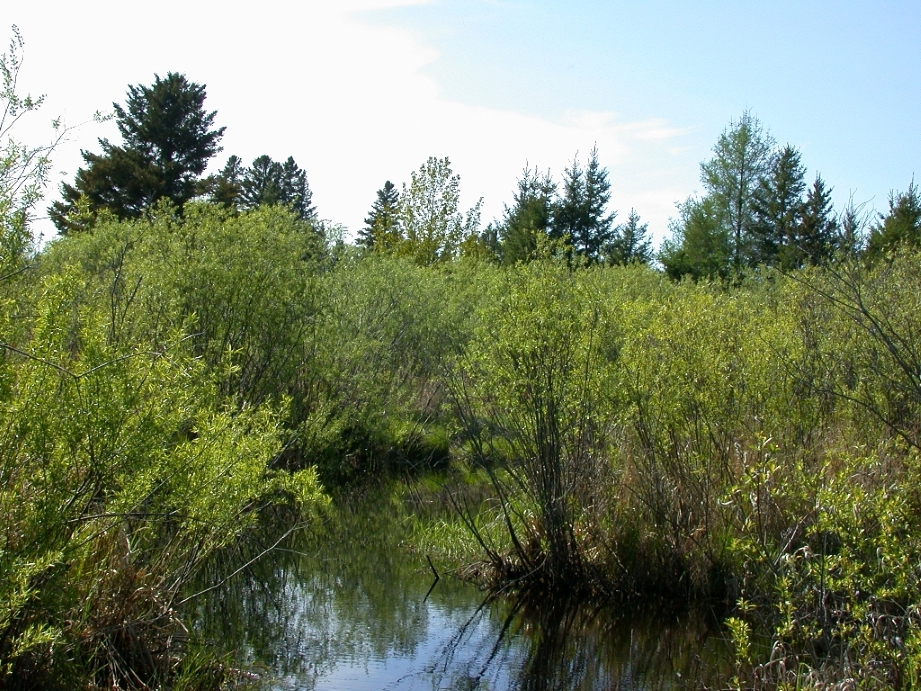
The sedge meadow-shrub carr wetland where Macrochilo bivittata lives. Except for a few patches of canary grass, most of the plant species here are native.

The food preferences of Macrochilo bivittata are not known. It is thought their larvae feed on leaf litter like other members of the Herminiinae. There is certainly an abundance of leaf litter out there under the grasses and willows in the old hayfield. Macrochilo bivittata seems to be doing very well with that.