

Wordless Wednesday
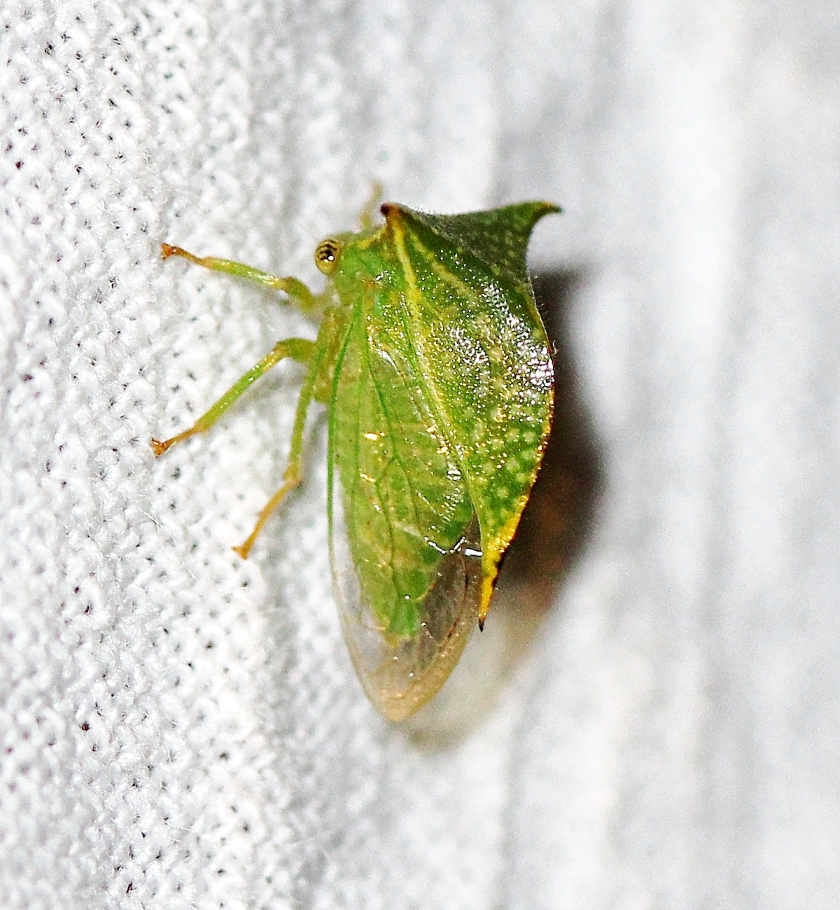
Stictocephala taurina (buffalo treehopper, family Membracidae, in the order Hemiptera, the true bugs) is a green colored species of treehopper notable for its prominent, sharp horns. The horns on treehoppers have functions that include mimicking the thorns of plants and electroreception. According to the article in PNAS, treehoppers and their predators produce electrical fields, and the extreme morphologies of treehoppers aid in the detection of these fields.
Stictocephala taurina is a green species of treehopper, one of 17 species of Stictocephala in North America north of Mexico. It measures about 7.5 mm long. The pronotum is adorned with two prominent horns on the front, numerous pale spots, and ends in a long spine. The horns are not very large and may have a dark edge. The legs are green (reddish in the similar-looking Tortistilus abnorma) and end with yellow tarsi (feet).
Stictocephala taurina lives in forests and forested areas. The nymphs feed on softer herbaceous vegetation, piercing the plants to get sap. Adults move to woody vegetation.
In a previous post, I wrote about syrphid flies that mimic bees and wasps. But are there other insects with this mimicry superpower? The answer is yes. Other types of flies, beetles, and moths all have species that mimic stinging insects. The moth Superfamily Cossoidea (Carpenter and Clearwing Moths) is notable for the many species that mimic stinging wasps.
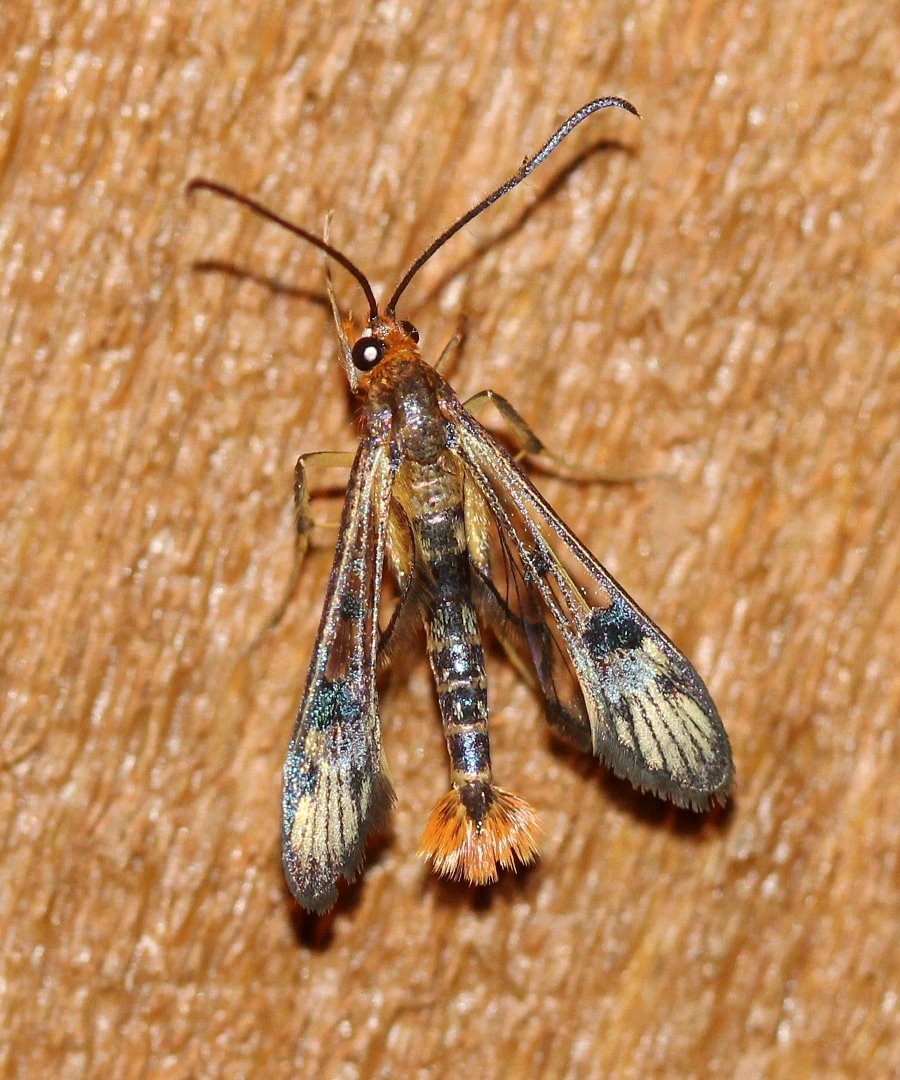
Synanthedon acerni (Family Sesiidae, Subfamily Sesiinae, Tribe Synanthedonini) is one such very wasp-like moth. Its wasp-like appearance allows it to be active during the day while it visits flowers, feeding on nectar.
The larvae of Synanthedon acerni are not quite as benign. Known as the maple callus borer moth, its larvae bore into the trunks of maple (Acer spp.) trees. Eggs are laid near wounds in the bark. Entry into the tree is through these wounds on the tree’s trunk. The larvae bore into the bark and then into the cambium, where they feed on the inner bark and sapwood. Feeding takes place during the summer within galleries. In the winter, they hibernate in the galleries and resume feeding in the spring.
At maturity, the larva constructs an oblong cocoon of wood fragments, frass, and silk within the gallery, close to the surface, covered by a thin escape window. When ready to emerge, the pupa cuts open the cocoon and the escape window. The fully formed Synanthedon acerni moth then exits the pupa, which is left partially stuck in the gallery.
The same tree may be used year after year, weakening it and eventually leading to its demise. A callus will form on the trunk after repeated infestations.
 Not Very Far Away