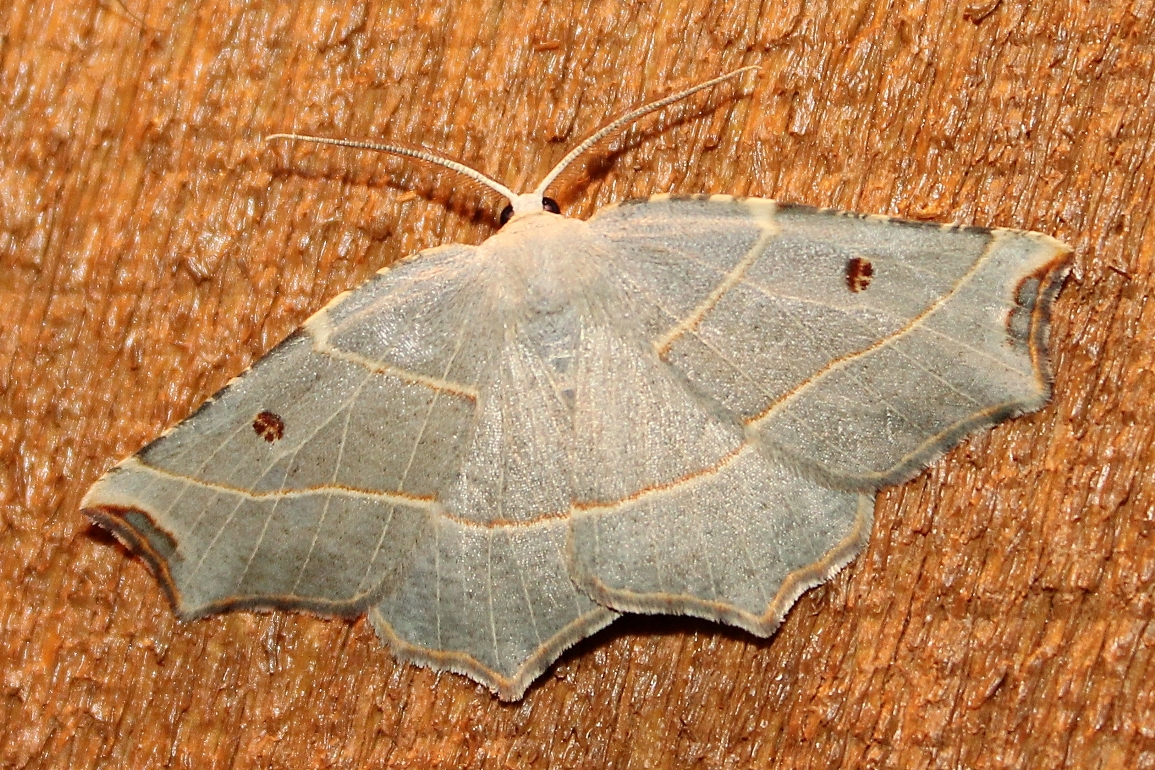
Metanema inatomaria a species seen last summer on warm humid nights.
…during much of July and so will be posting a little less frequently. But summer has arrived and brings with it a new group of moths that love the hot and humid weather. Here are five of the seventeen new moths plus one returning visitor that showed up at my porch light over the weekend. I’ll be writing about these species later in August. There are already a few in the works on the moths Habrosyne scripta (almost done!), Oreta rosea, Phlogophora iris, Campaea perlata, and Monopis spilotella seen this year and last year.
Odontosia elegans
Schizura badia
Drepana arcuata
Autographa ampla
Xanthotype sp, one of three species found here and nearly impossible to tell apart from a photo alone.
Carterocephalus palaemon, Arctic Skipper, widespread in Minnesota. It was previously known from Carlton County by a historical record. There do not seem to be any recent records from the county other than this one.
This small butterfly with dark brown wings and yellow spots is the Arctic Skipper (Carterocephalus palaemon). I saw it a few days ago on a warm, sunny, and humid afternoon on June 12. It was resting on a blade of grass in a sunny opening in an encroaching forest. Although the Arctic Skipper is widely distributed and ranked a G5 or “globally secure” there is only one record that I could find of it from Carlton County and it is historical but there was no information about when or where it was seen or who saw it.
Taxonomy
Class Insecta (Insects)
Order Lepidoptera (Butterflies and Moths)
Superfamily Papilionoidea (Butterflies and Skippers)
Family Hesperiidae (Skippers)
Subfamily Heteropterinae (Intermediate Skippers)
Genus/species Carterocephalus palaemon
Description
The upper wing surface is dark brown to almost black with roughly rectangular yellow spots. Below they are like the color of a deer fawn and marked with black-rimmed yellow spots. Wingspread is 2.5 to 3.2 cm.
Range
A circumboreal species found in North America from Alaska to Canada’s Atlantic coast and south to California and Pennsylvania. Not truly an Arctic species.
Larval Host Plants
Larvae of Carterocephalus palaemon eat grasses. In California purple reedgrass (Calamagrostis purpurascens) is reported as a larval host. In some European countries, brome (Bromus spp.) are preferred larval hosts. Purple moor-grass (Molinia caerulea) has been reported as a larval host in Scotland. Purple reedgrass is rare in Minnesota and purple moor-grass does not grow here. There are bromes both native and introduced in the state as well as the native Canada bluejoint grass (Calamagrostis canadensis). It is likely that Carterocephalus palaemon larvae feed on other grass species besides the few mentioned in the literature.




 Not Very Far Away