Moths and Their Nighttime Floral Visits

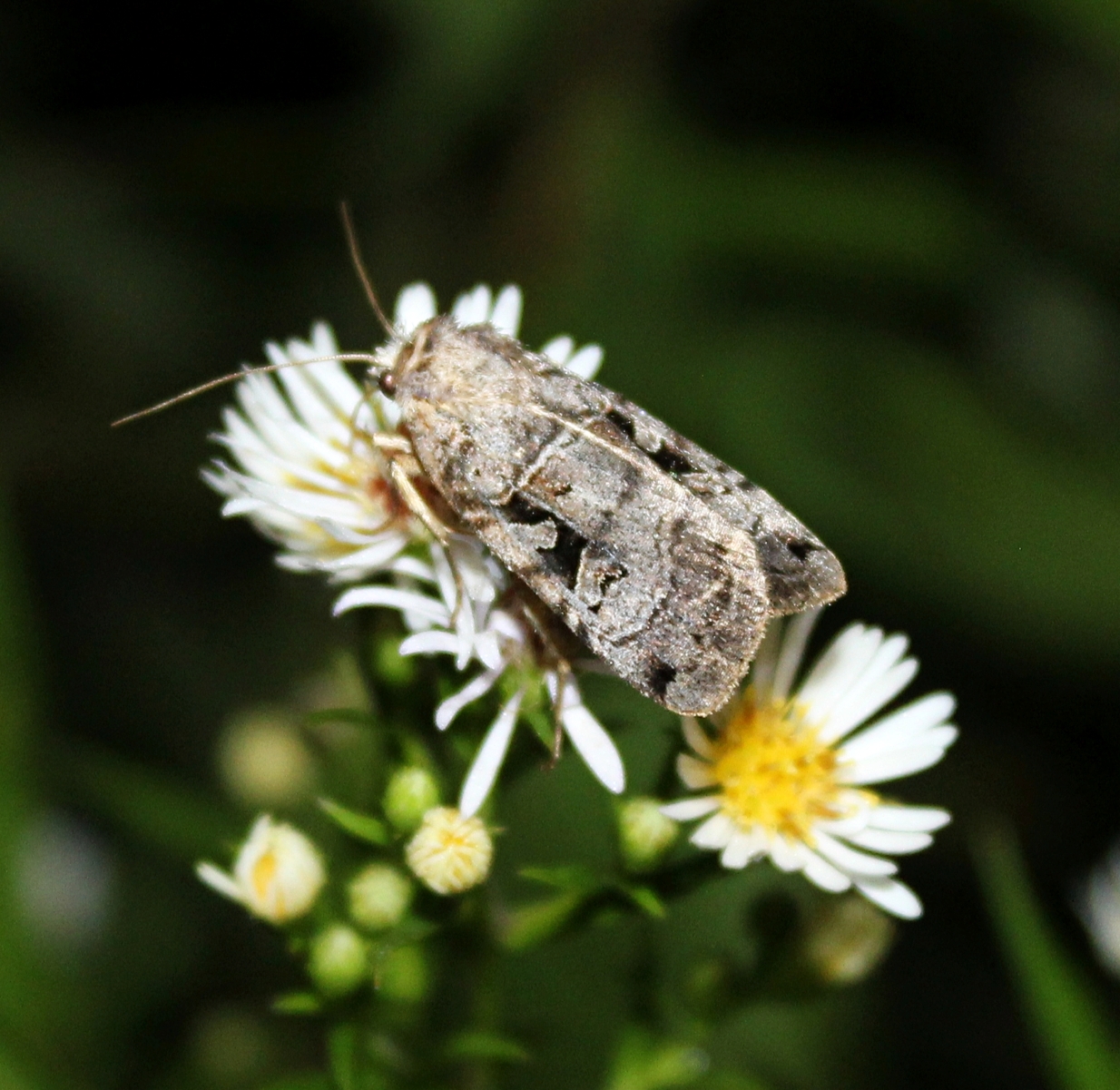
Xestia normanianus, a dart moth, nectaring on lance-leaved aster (Symphyotrichum lanceolatum) at night.

What do moths do at night anyway? Some of them visit flowers for nectar.

Back in August, I was wandering about in the woods at night looking for foxfire fungi. At the head of the trail on my way out, I saw a sunflower plant with something on the flowers. It was a green tree cricket (Oecanthus) eating the stamens in the sunflower florets.

The next night, I went back but this time with my camera, hoping to find more tree crickets. I had my LED headlamp on like the previous night and used it to illuminate the flowers and foliage where I wanted to photograph. I also set the flash of my camera to “on”.

Although I could hear tree crickets in the bushes, I didn’t see any this time. What I did see were lots of moths on sunflowers and asters. Aiming the lamp’s beam at the flowers, I then pointed my camera at the moths and began taking photos. I wasn’t using a tripod, so many were blurry. Some were also overexposed by the bright LED light. But a few turned out.
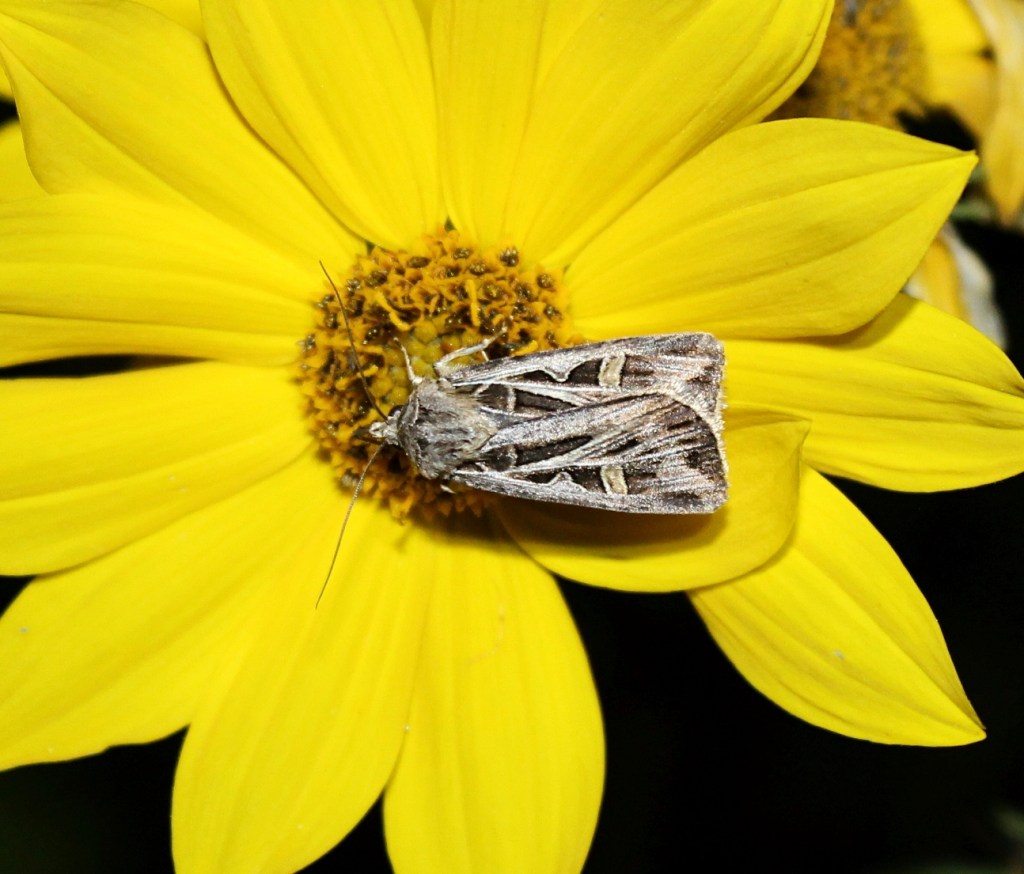
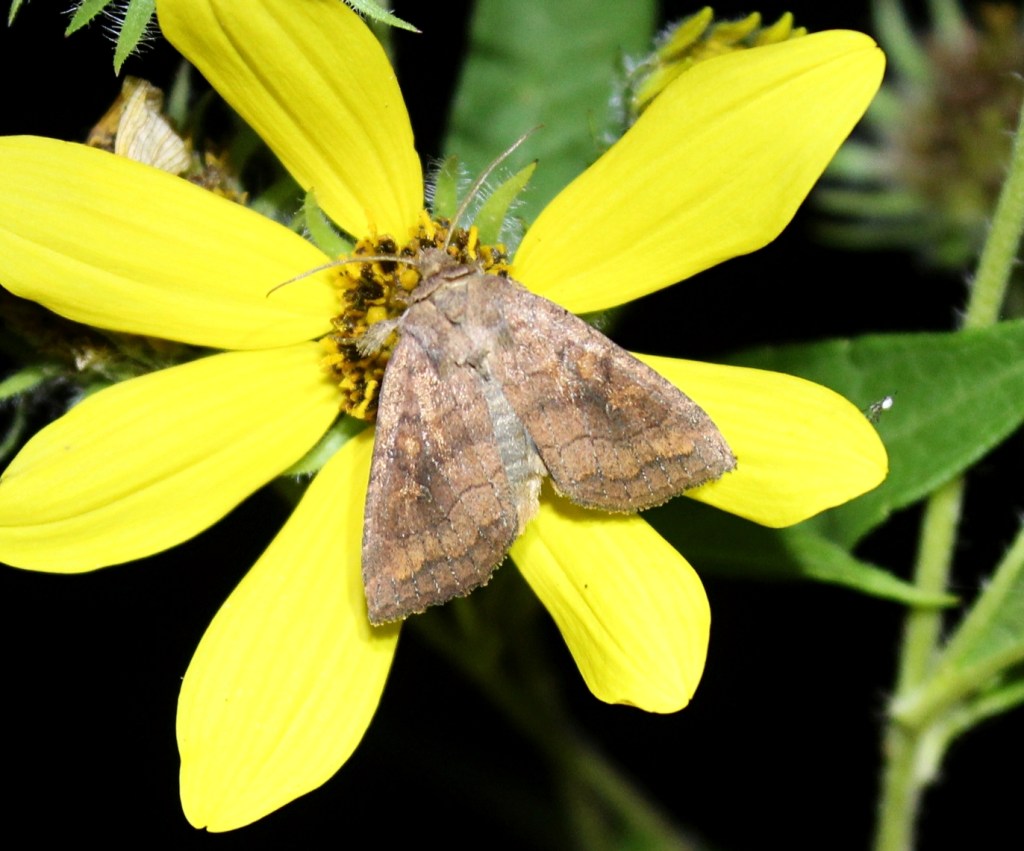
The moth species (Xestia normanianus, Feltia jaculifera, and Nephelodes minians) I found on flowers at night came as no surprise. These and other dart moth species are common visitors to my moth lights. But it was exciting to see them going about their normal activities in a natural setting. I never did find any foxfire this year.
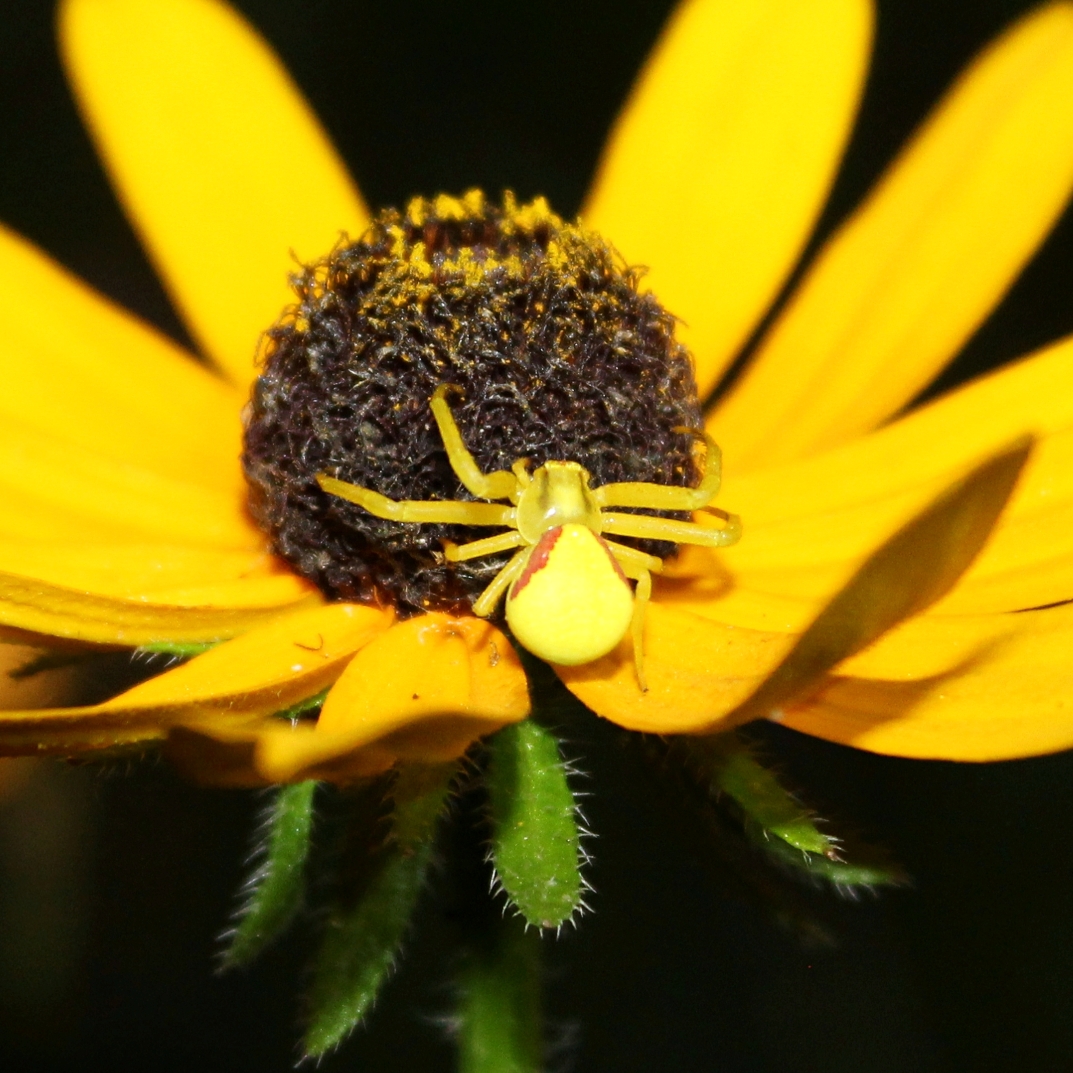
Moths weren’t the only visitors to flowers at night. I wonder if this crab spider was sleeping or waiting for a moth.

Sword-bearing Conehead

My mothing nights find more than moths. Beetles, bugs, flies, wasps, spiders, and crickets, even snakes and frogs, are frequent visitors to the porch light. The latest non-lepidopteran to make an appearance is the sword-bearing conehead (Neoconocephalus ensiger). It is a new addition to my insect checklist and is one of five species of Tettigoniidae (Katydids) that I’ve identified from here.

The sword-bearing conehead is a large insect with males growing 4.5 to 5.5 cm, and females 5.2 to 6.4 cm. The head is conical with the sides pinched-in and black below. The body’s lower surface is edged in black. The stridulatory vein, which is used to make the call song in males, is long and weakly swollen. The ovipositor is blade-like and nearly the length of the body hence the name “sword-bearing”. Two color forms, green and brown, exist.

The call song of the sword-bearing conehead is a series of rapid tsst-tsst-tsst sounds. At higher temperatures the call song is faster. Singing begins at dusk and may continue all night if temperatures are warm. Singing Insects of North America (SINA) and Songs of Insects have recordings of this species and others on their websites.

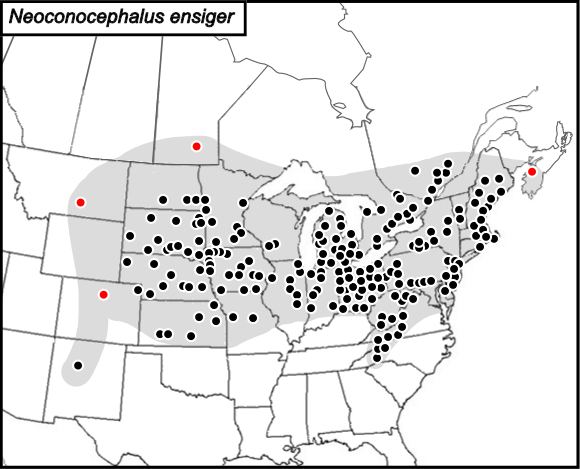
Sword-bearing conehead is common across much of the eastern and north-central US and ranges as far north as Manitoba, Ontario, Quebec, and New Brunswick in Canada. Habitat includes damp grassy areas, roadsides, and weedy areas where they feed on grasses and sedges including the flowers and developing seeds.

Range map of the sword-bearing conehead.

SOURCES

Bug Guide
Singing Insects of North America
Songs of Insects