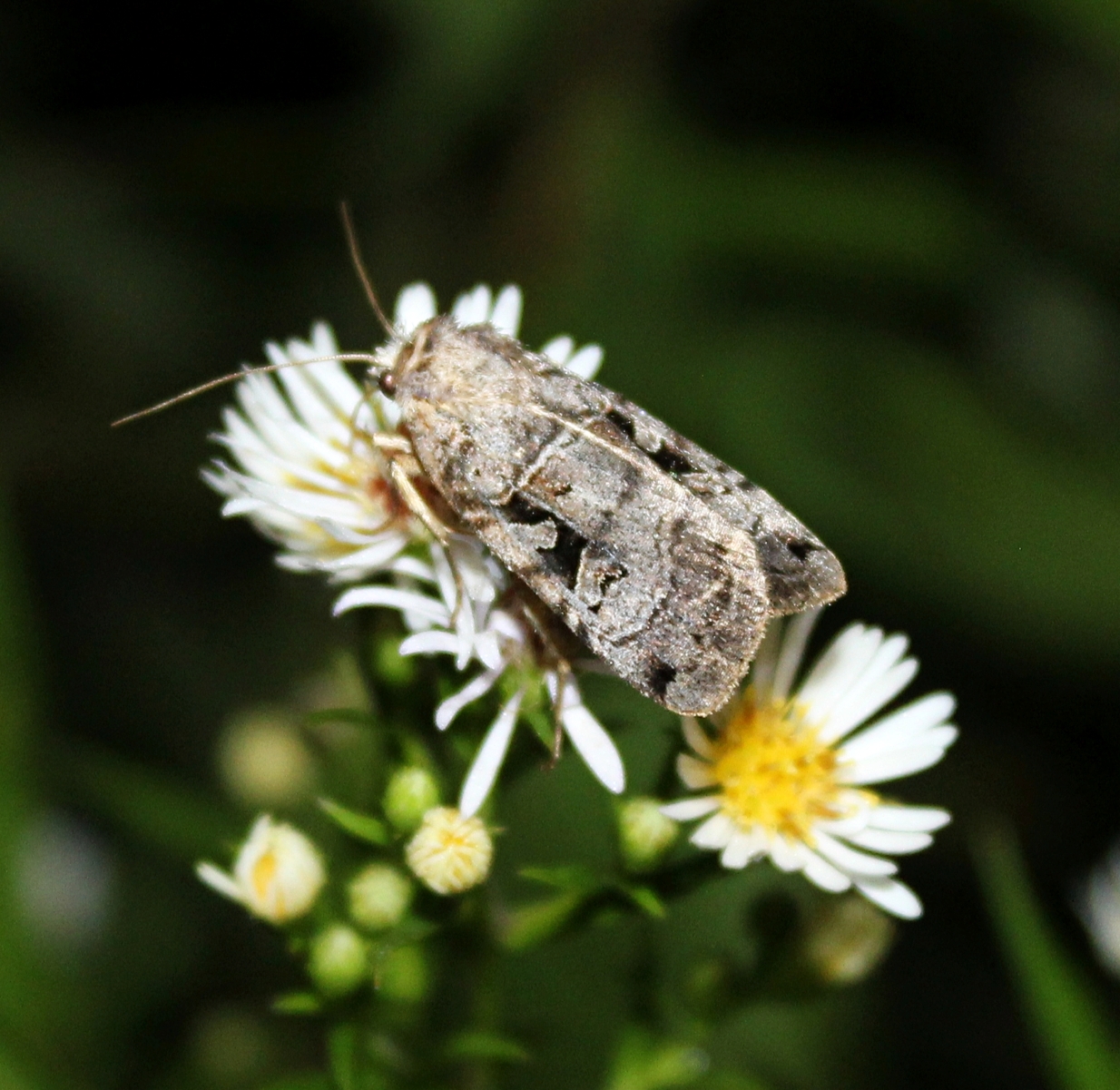
Xestia normanianus, a dart moth, nectaring on lance-leaved aster (Symphyotrichum lanceolatum) at night.
What do moths do at night anyway? Some of them visit flowers for nectar.
Back in August, I was wandering about in the woods at night looking for foxfire fungi. At the head of the trail on my way out, I saw a sunflower plant with something on the flowers. It was a green tree cricket (Oecanthus) eating the stamens in the sunflower florets.
The next night, I went back but this time with my camera, hoping to find more tree crickets. I had my LED headlamp on like the previous night and used it to illuminate the flowers and foliage where I wanted to photograph. I also set the flash of my camera to “on”.
Although I could hear tree crickets in the bushes, I didn’t see any this time. What I did see were lots of moths on sunflowers and asters. Aiming the lamp’s beam at the flowers, I then pointed my camera at the moths and began taking photos. I wasn’t using a tripod, so many were blurry. Some were also overexposed by the bright LED light. But a few turned out.
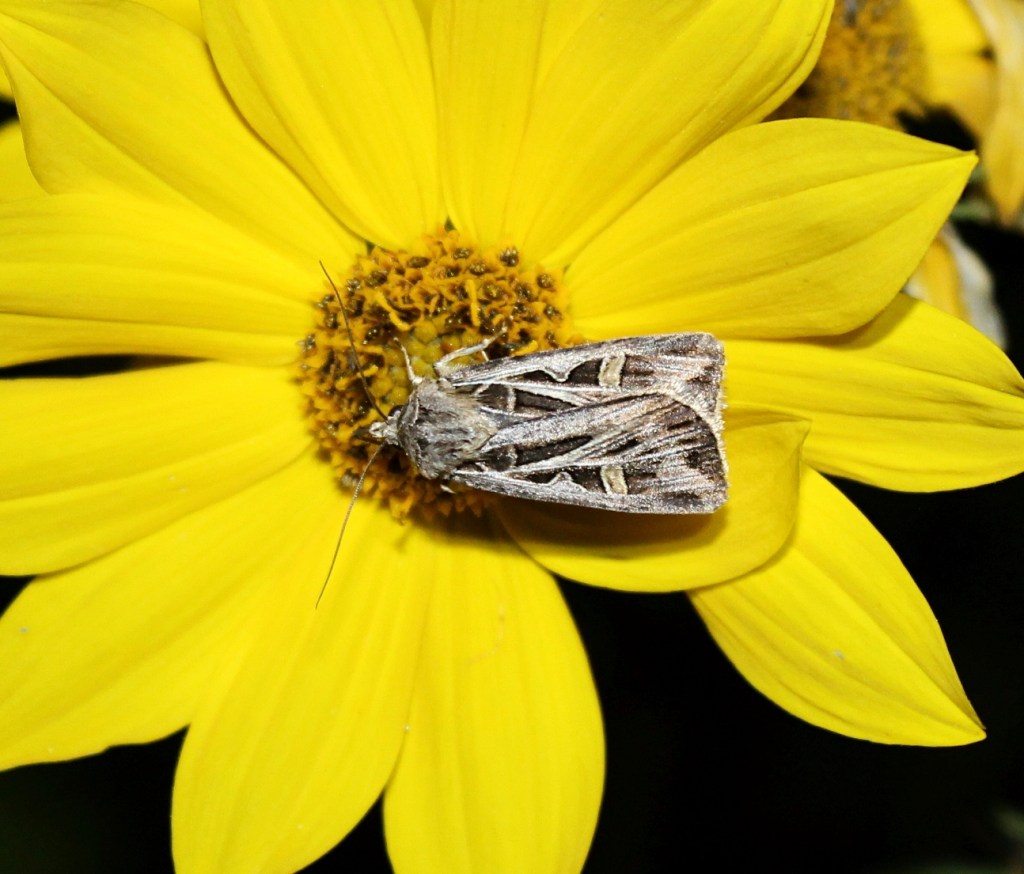
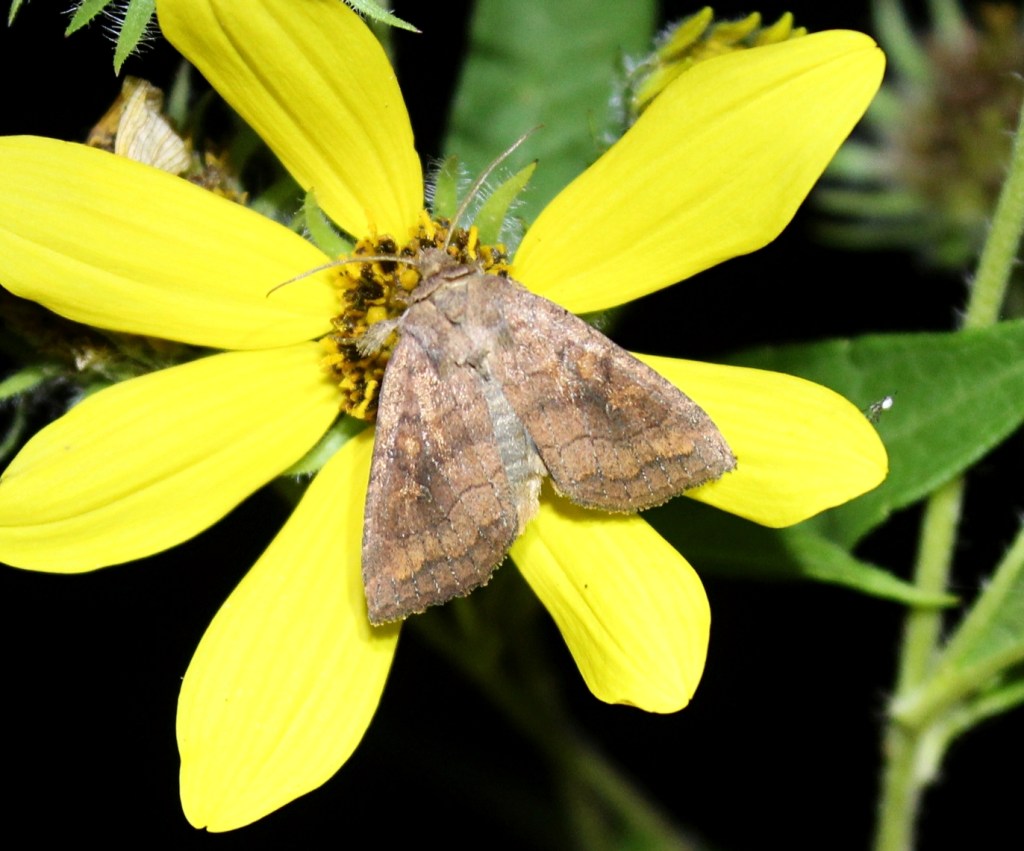
Feltia jaculifera nectaring on a sawtooth sunflower (Helianthus grosseratus)Nephelodes minians nectaring on a sawtooth sunflower (Helianthus grosseratus)
The moth species (Xestia normanianus, Feltia jaculifera, and Nephelodes minians) I found on flowers at night came as no surprise. These and other dart moth species are common visitors to my moth lights. But it was exciting to see them going about their normal activities in a natural setting. I never did find any foxfire this year.
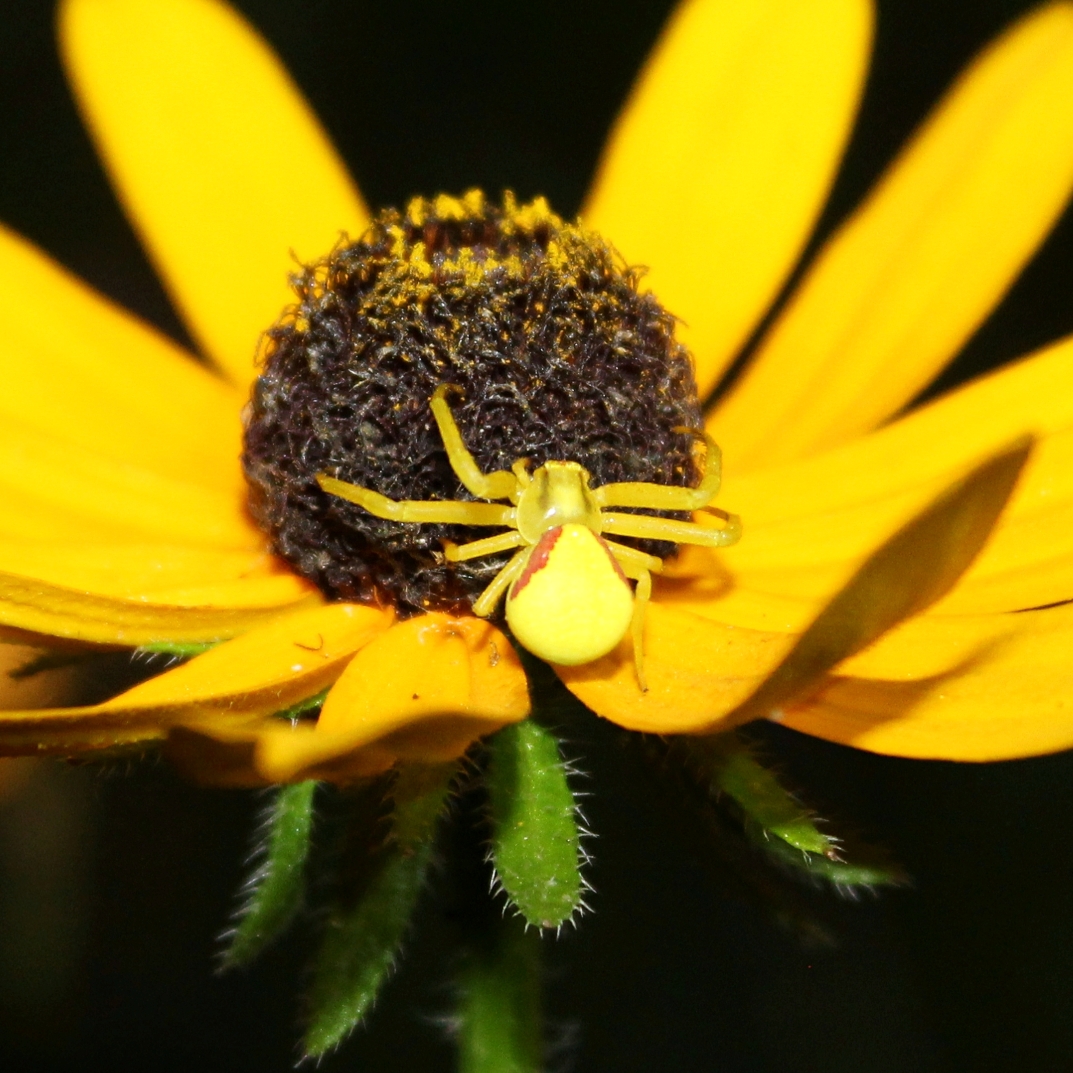
Moths weren’t the only visitors to flowers at night. I wonder if this crab spider was sleeping or waiting for a moth.
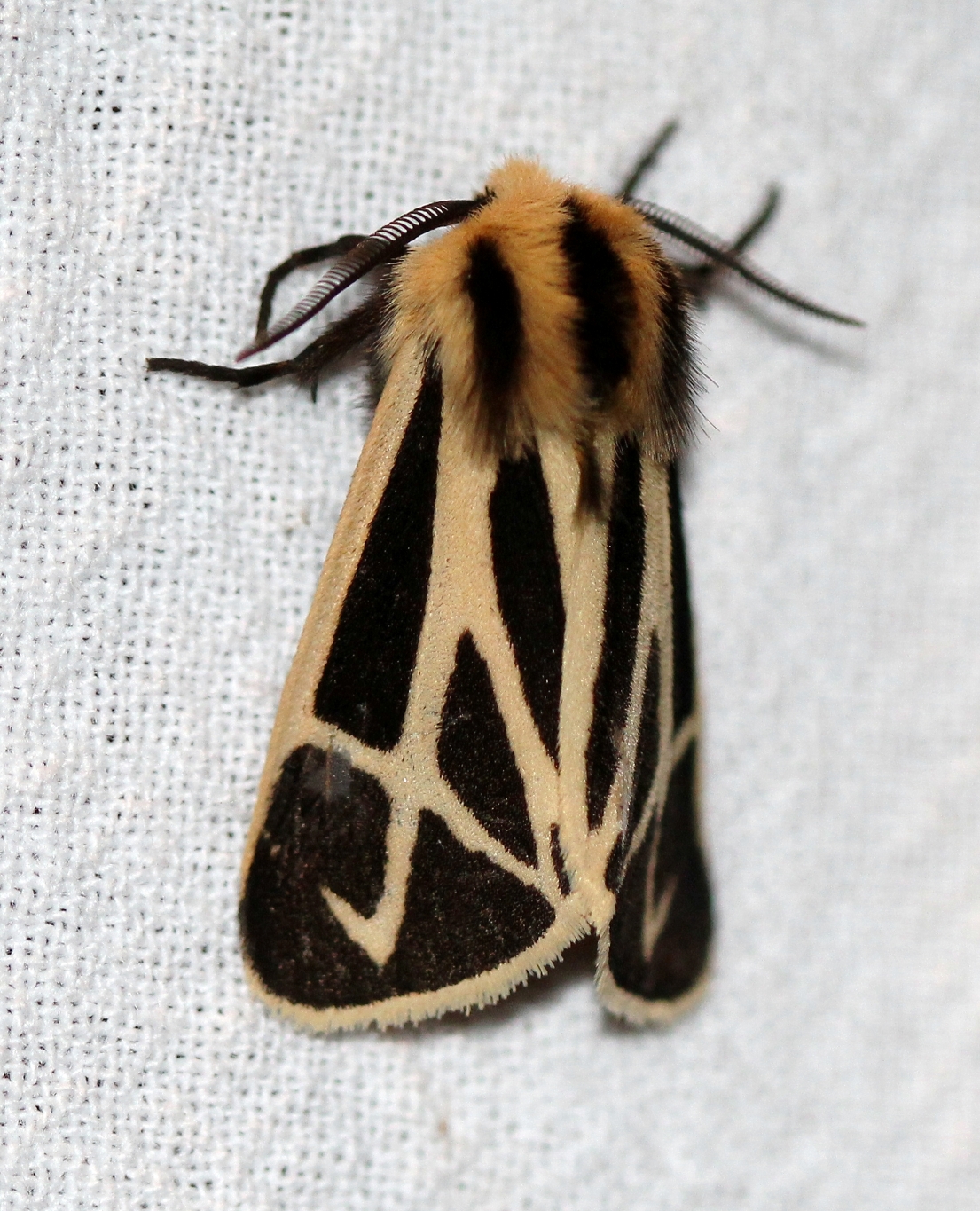
Apantesis phalerata (Harnessed Tiger Moth). The pectinate antennae indicate this is a male. Photographed on June 25, 2022.
In an earlier post, I wrote about Williams’ tiger moth (Apantesis williamsii). In this one, I present two more Apantesis species: Apantesis phalerata (Harnessed Tiger Moth) and Apantesis virgo (Virgin Tiger Moth).
Most Apantesis moths are characterized by dark forewings and numerous, often parallel, crisscrossing white or off-white lines. The patterns are usually distinctive enough to determine species, but not always.
What’s in a name?
The genus name Apantesis is from the Greek word “apantēsis”, translated as “meeting, an encounter/reply” and “to meet face to face“. It describes a custom of meeting visiting dignitaries where citizens would gather to welcome and escortthe dignitary or hero in a procession. I’m not sure why this word was used to name the genus.
Harnessed Tiger Moth (Apantesis phalerata)
Harnessed Tiger Moth (Apantesis phalerata) is part of a group of similar species that includes Apantesis nais, Apantesis carlotta, and Apantesis vittata. Characteristics of the forewing pattern overlap in all four species, making accurate determination difficult, if not impossible, from a photograph. Had this moth spread its wings, exposing the underwings, then the choice might have been between Apantesis phalerata and Apantesis carlotta. Or maybe not.
Genital dissection is considered to be the only reliable way to determine these Apantesis species accurately, but I’m not willing to chop up a moth that rarely gets this far north. I’m just going to call my moth Apantesis phalerata because it looks more like identified specimens than it does the other three species. Additionally, the orange thorax appears to be another characteristic in photos of moths identified as Apantesis phalerata, distinct from the other three. Of course, I could be completely wrong.
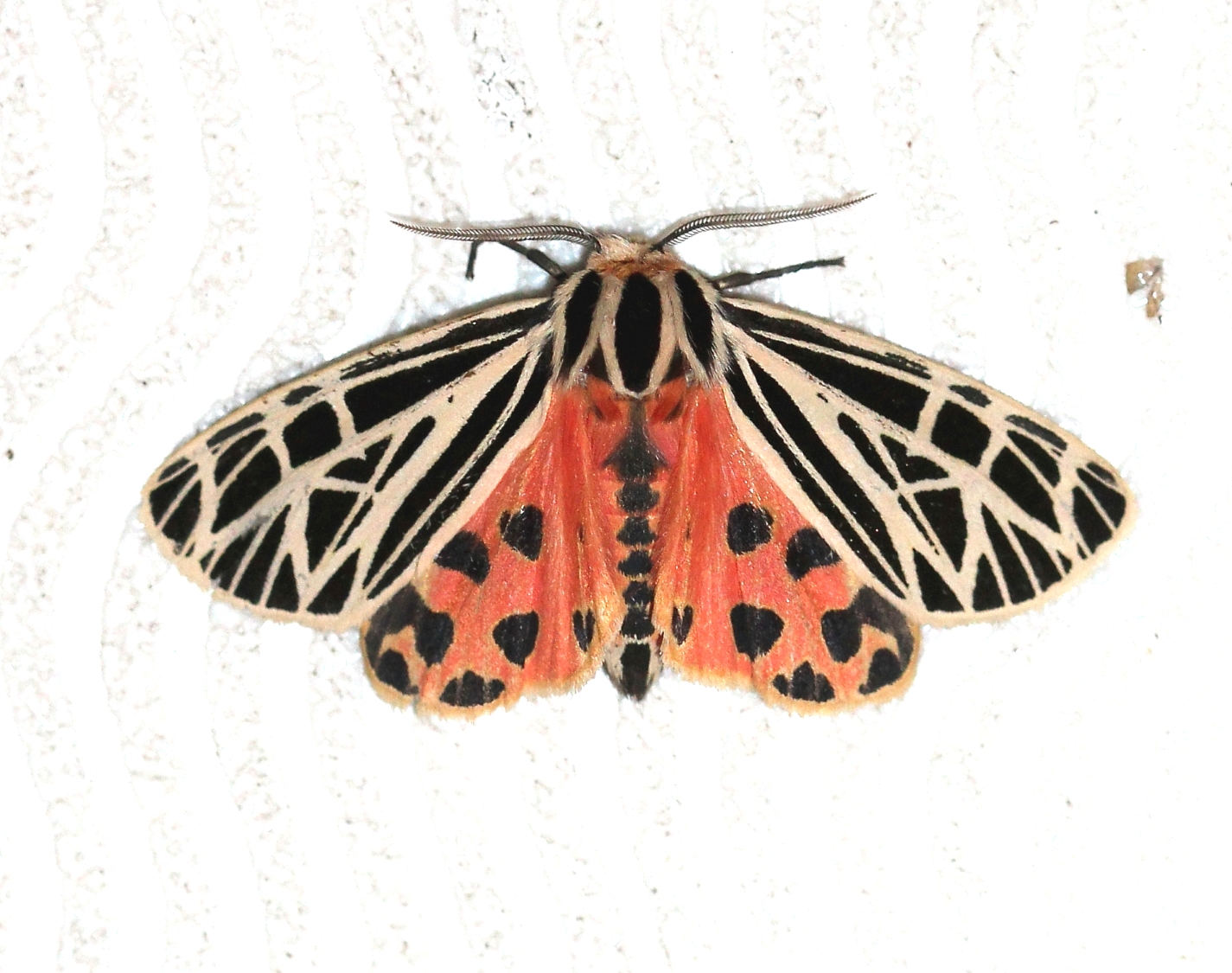
Apantesis virgo (Virgin Tiger Moth) showing the underwings. The pectinate antennae indicate this is a male. Photographed on July 22, 2019.
Virgin Tiger Moth (Apantesis virgo)
Identifying Virgin Tiger Moth (Apantesis virgo) is not as fraught as it is with Apantesis phalerata. Apantesis virgo is a large white, black, and red moth, 20 to 27 mm long. Black in color, the forewing has distinct off-white veins and transverse lines in the postmedial and subterminal areas. The hindwing may be bright pink, red, orange, or occasionally yellow, with an antemedian and outer margin lined with a row of black spots. There is also a patchy marginal band.
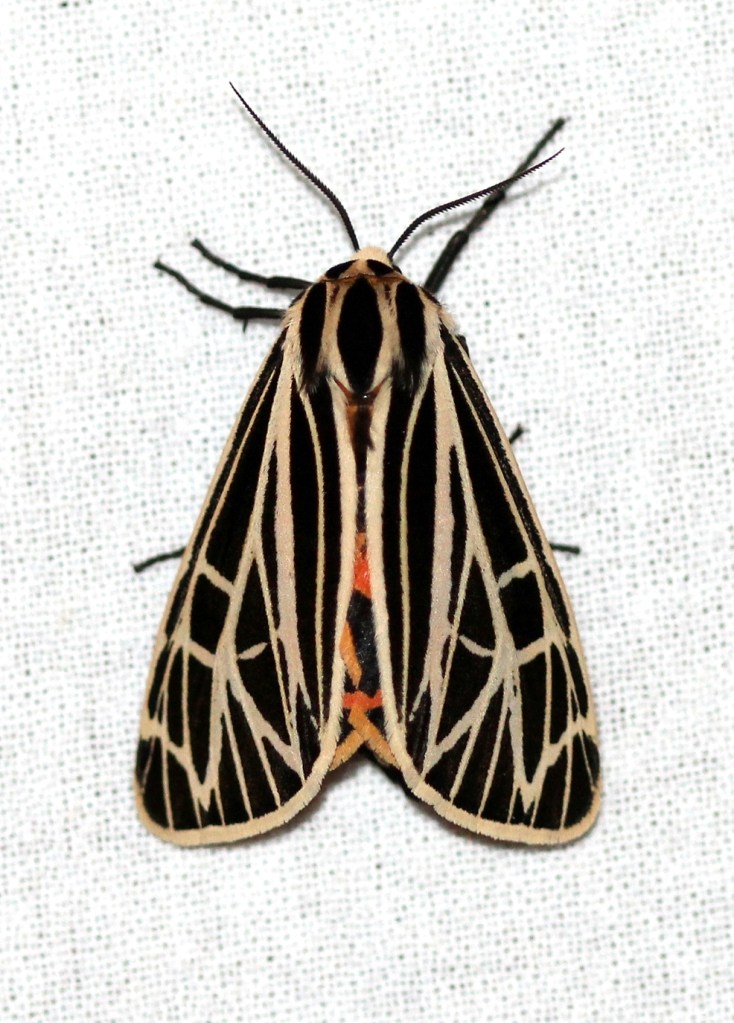
Apantesis virgo on July 10, 2018Apantesis virgo on July 19, 2022 Apantesis virgo on August 25, 2025
Larvae and host plants
Larvae of Apantesis moths are similar in appearance. Black and bristly, Apantesis virgolarvae have orange-brown spiracles; the setae beneath the spiracles may be orange. Brown to black bristles cover the black larvae of the Apantesis phalerata, which frequently have a pale dorsal line. Larvae of both species feed on low-growing herbaceous plants.
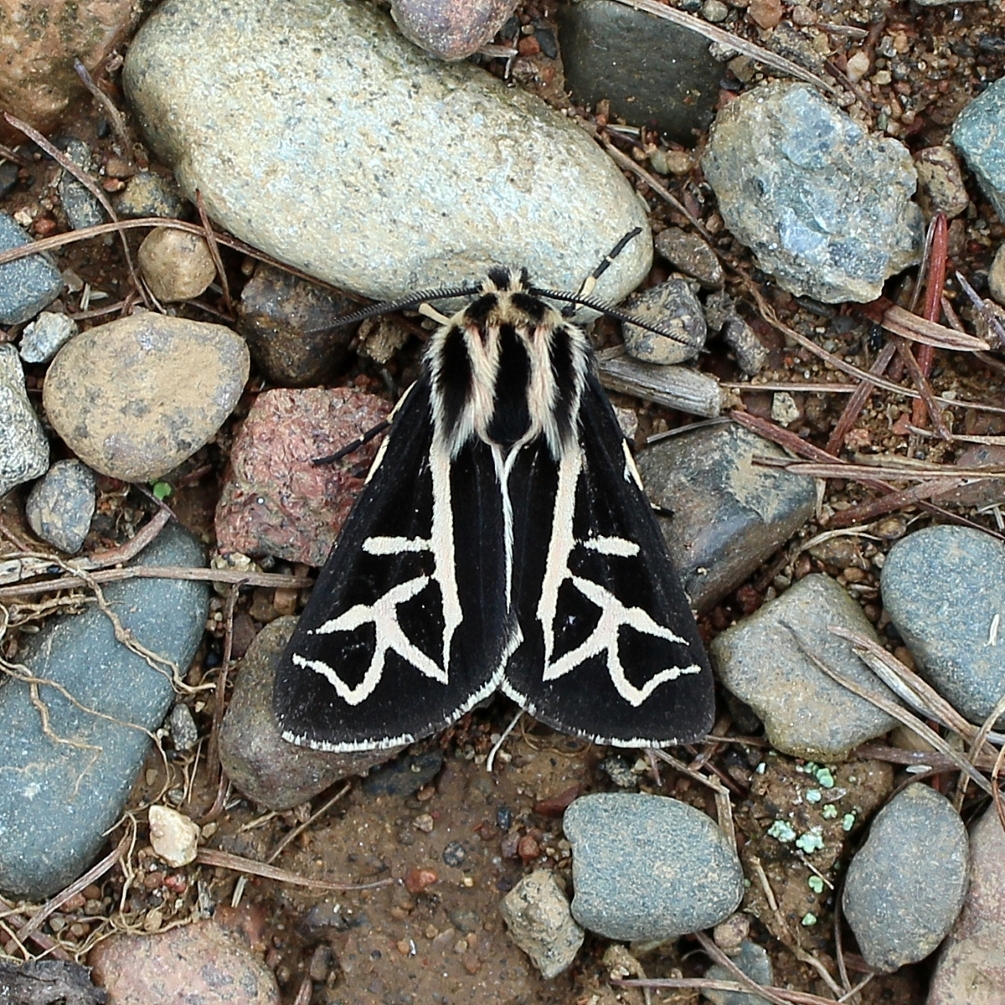
The Williams’ Tiger Moth (Apantesis williamsii) I found in the SNF. Photographed on July 20, 2018.
In a previous life, I searched for and documented rare plant species. But I was always curious about everything in nature, so I made it a point to learn as much as I could about all the things in the forests, glades, lakes, and swamps I explored. Sometimes I would make an interesting discovery, like the moth in the above photo.
I find a new moth
A few years back, while on a rare plant survey, I found a tiger moth that I later identified as Apantesis williamsii (Williams’ Tiger Moth). I found the moth in Cook County, Minnesota, in the Superior National Forest (SNF). It was simply lying in the middle of an old logging road just waiting to be found, I guess.
I’d never seen a moth quite like this one. I photographed it (I would have anyway no matter if it was new to me or not) and took some notes about the surrounding area. Then I GPS-ed the location, which is about 20 miles south of the US-Canadian border.
Because blueberry pickers were using the road that day, I carefully moved the moth to a safe spot. Then I got back to that day’s mission, searching for rare plants in the forest and the rare Nabokov’s blue butterfly (Lycaeides idas nabokovi). It might have been in the area as its larval host plant, Vaccinium cespitosum (dwarf bilberry), grew nearby in a prescribed burn. I found plenty of dwarf bilberry that day, but no sign of Nabokov’s blue butterfly. Not even a caterpillar.
Not a common species in Minnesota
Apantesis williamsii is uncommon in Minnesota. It appears that there are only two records before 2018. One record is from Cook County, the same county where I found this one, up in the northeastern corner of the state. The other is from Lake of the Woods County in the Northwest Angle, right on the US-Canadian border, found in 2017.
Since then, additional sightings of Apantesis williamsii have been made. Two other sightings (here and here) were made in Minnesota in 2018, but from northern St. Louis County, about 50 miles west near Ely, and also close to the Boundary Waters and Canada.
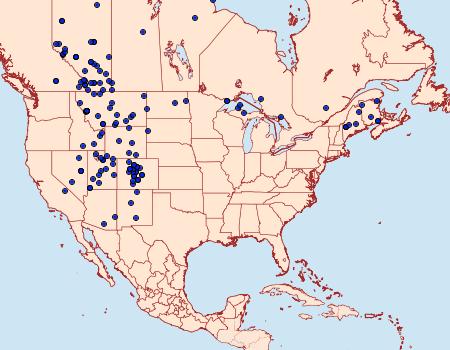
Apantesis williamsiirange map. The distribution of Apantesis williamsiiis concentrated in the Cordillera.
Globally secure
This is not a rare species globally, but based on the small number of sightings, it appears to be uncommon in Minnesota. Most records of Apantesis williamsiiare from the Cordillera, starting in Saskatchewan, Canada, and then south through Montana, Idaho, Wyoming, Colorado, Utah, California, Nevada, Arizona, and New Mexico in the western US. It occurs sporadically elsewhere, with scattered reports from Alberta, Manitoba, Ontario, Quebec, and New Brunswick in Canada, and in Michigan and Maine in the US.
Habitat preferences
In the main part of its range, Apantesis williamsii can be found in mountain meadows at middle to high elevations. It also occurs in quaking aspen forests and dry coniferous forests with sandy soil. The latter isn’t too different from the site where I found it. This was in a forest of aspen, birch, spruce, and fir with some jack pine and white pine on sandy soil. The weather is also cool in the summer, although climate change may upend that.
What does it it eat?
Larval food plants of Apantesis williamsiiare not known, but it may feed on low-growing herbaceous vegetation like other species of Apantesis.
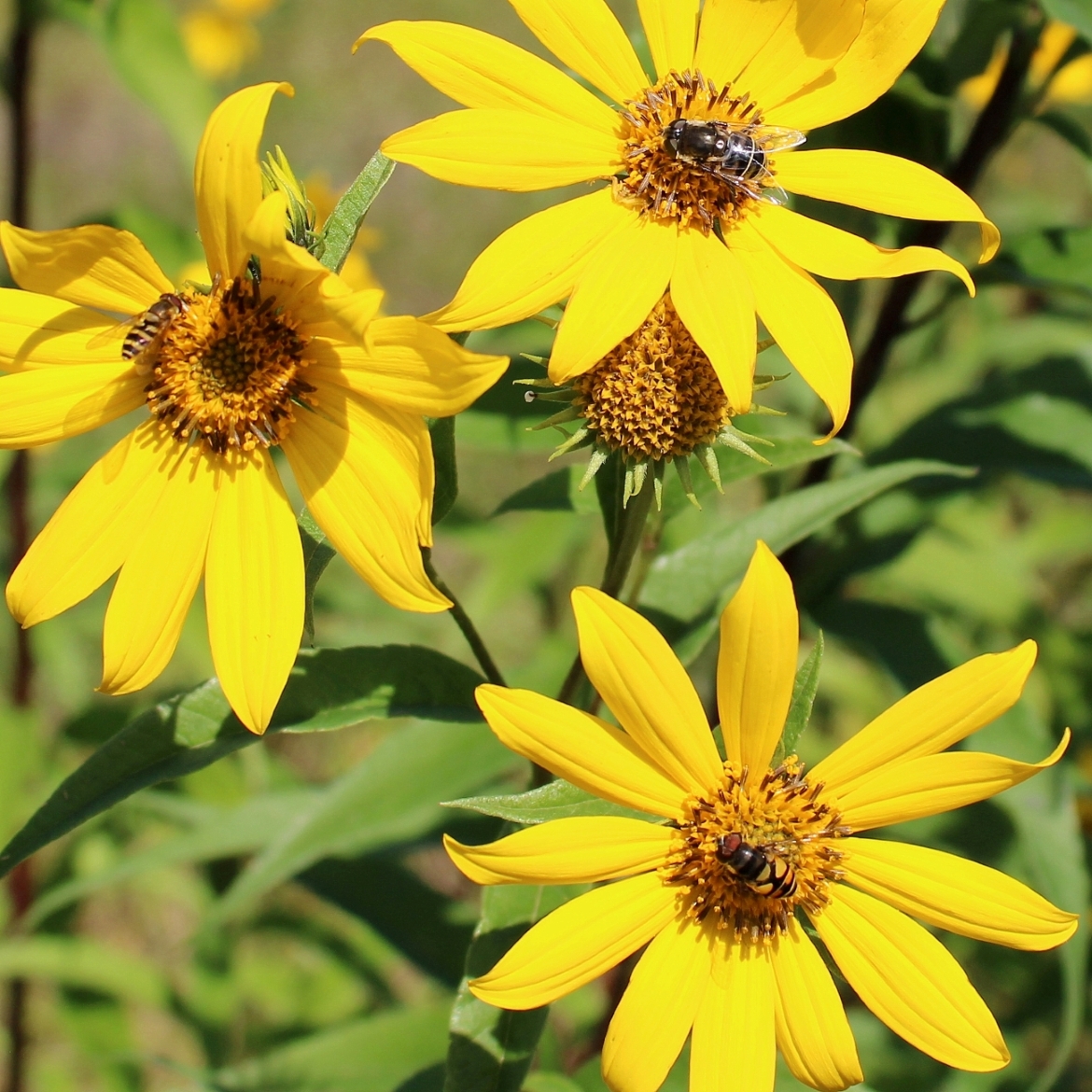
Three species of syrphid flies on sunflowers. Eristalis dimidiata (upper right), Eristalis transversa (lower right), and maybe a Syrphus sp. (upper left).
This was an unusual sight. Three species of syrphids, each on a separate wild sunflower head, are getting a meal of pollen and nectar. Two of the species I could identify are Eristalis dimidiata (upper right) and Eristalis transversa (lower right). The third one in the upper left didn’t show enough details. I could only place it as possibly a Syrphus sp.
A swarm of bees?
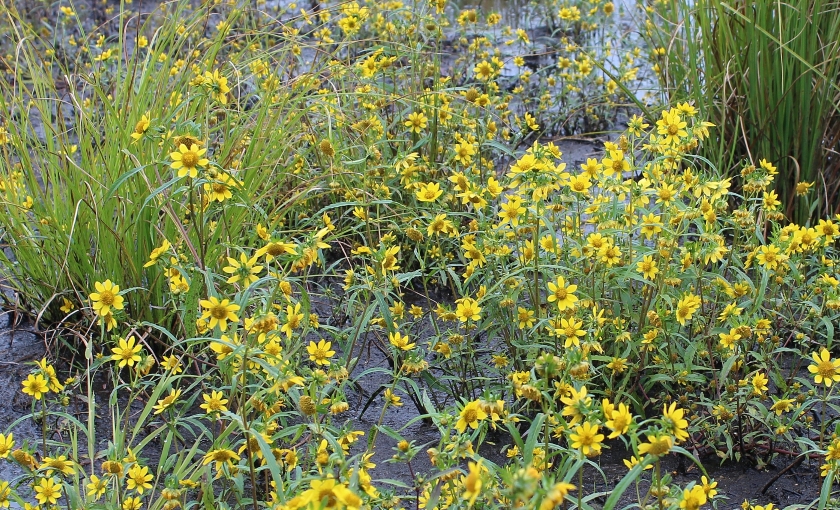
I first got interested in syrphid flies about two decades ago when I was doing an inventory of plant species in a fen. Suddenly, I became aware of what sounded like a swarm of bees in a large patch of nodding bur-marigold and asters. To my relief, they were not bees but hundreds of syrphid flies nectaring at the flowers. Over the years, I’ve gradually learned more about these bee-like insects and their importance.
Bidens cernua (Nodding Bur-Marigold) in early September, flourishing in a restored fen.
When to see them
Late summer is one of the best times to observe syrphid flies. You can see them on sunflowers, coneflowers, goldenrods, joe-pye-weed, bur-marigolds, and asters, all members of the aster family. Buzzing loudly, they go from flower to flower like bees, and with the bees, in search of pollen and nectar.
A wet meadow in late August carpeted with joe-pye-weed (Eupatorium maculatum) and smooth goldenrod (Solidago gigantea). Perfect foraging habitat for syrphids and other pollinators.
Syrphid flies can also be seen in spring and early summer. But to see them, you may need to go into the woods. Some of these forest-dwelling species can be attracted to sugary baits painted on tree trunks or boards attached to posts. They can also be found on woodland wildflowers like Canada mayflower.
Bee and wasp mimics
Many syrphids have body patterns and body shapes that resemble those of bees and wasps. This mimicry (Batesian mimicry) is a form of camouflage to deter potential predators. The resemblance to wasps and bees is striking.
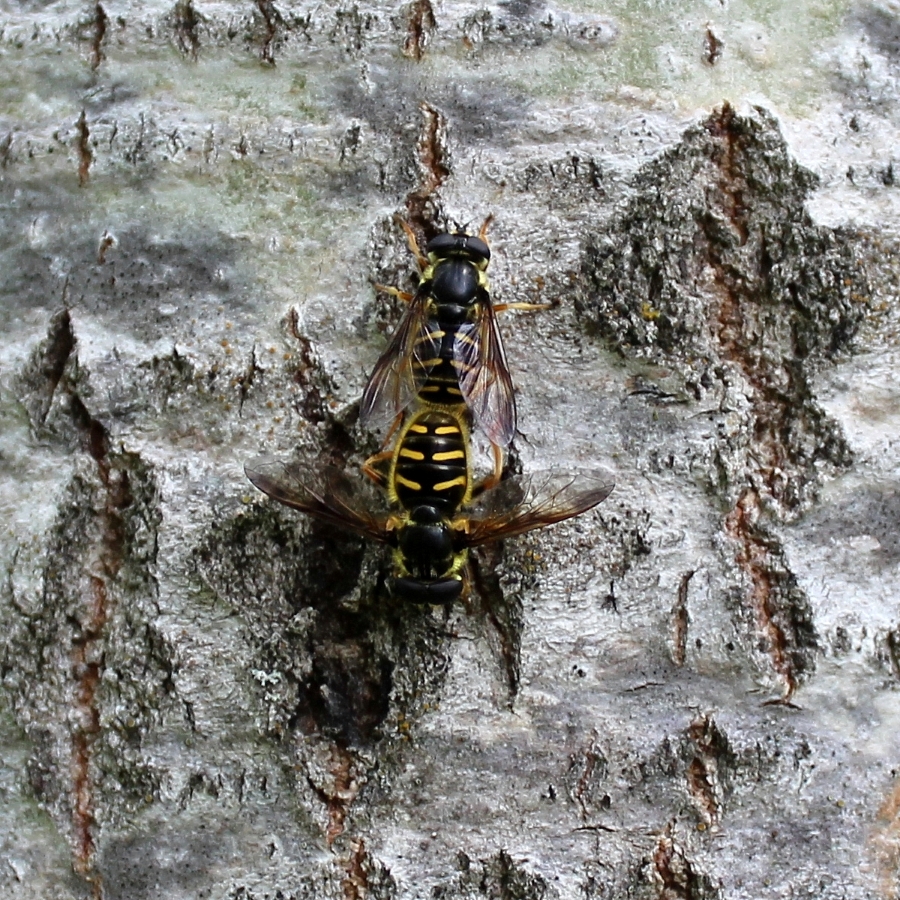
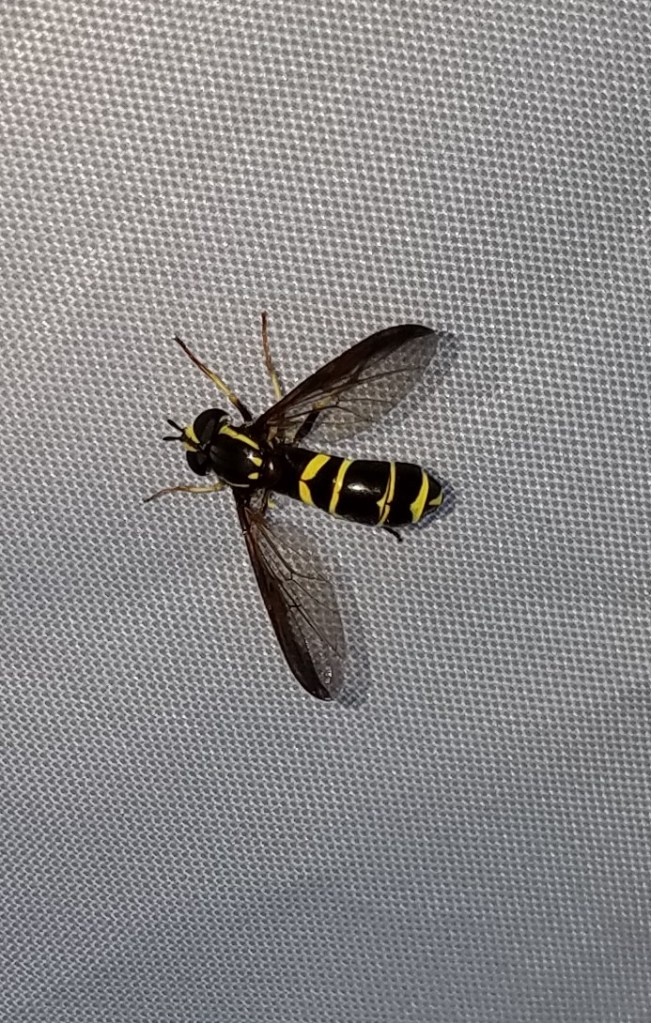
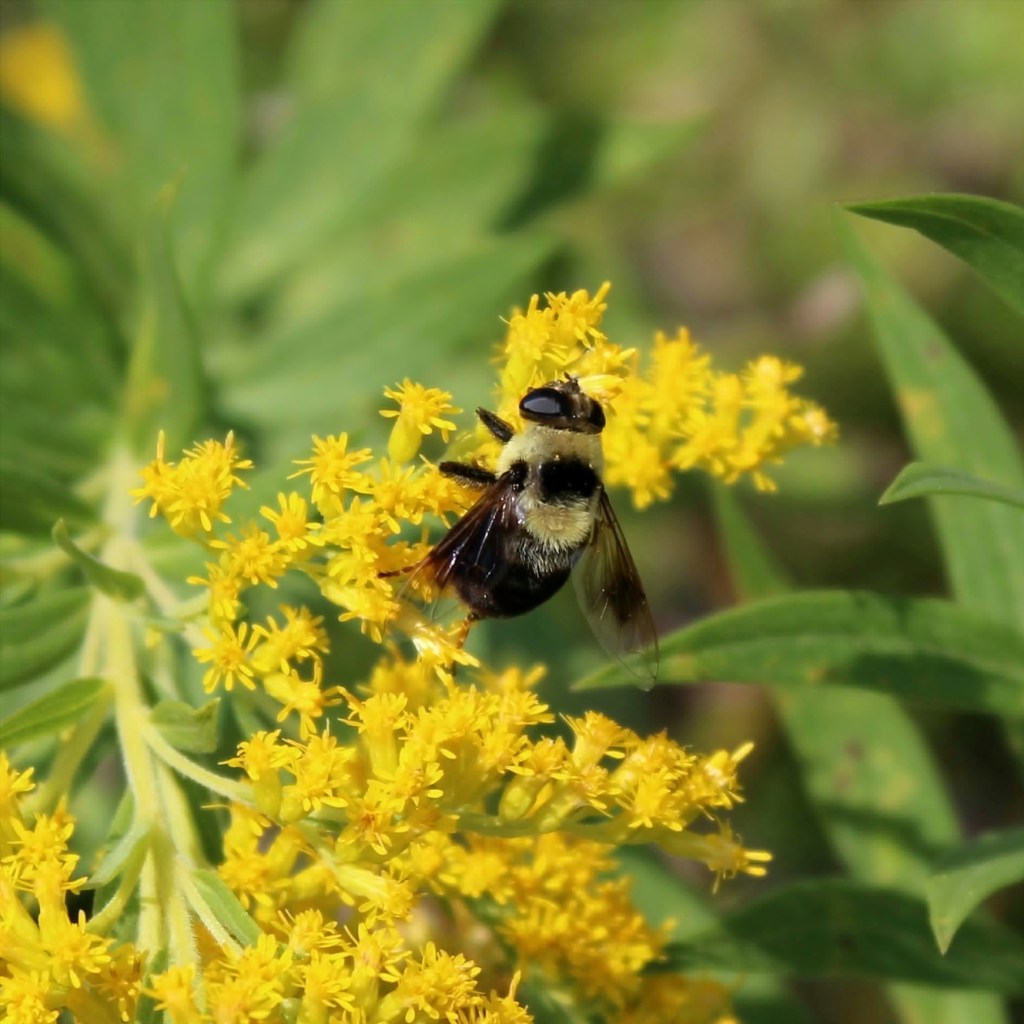
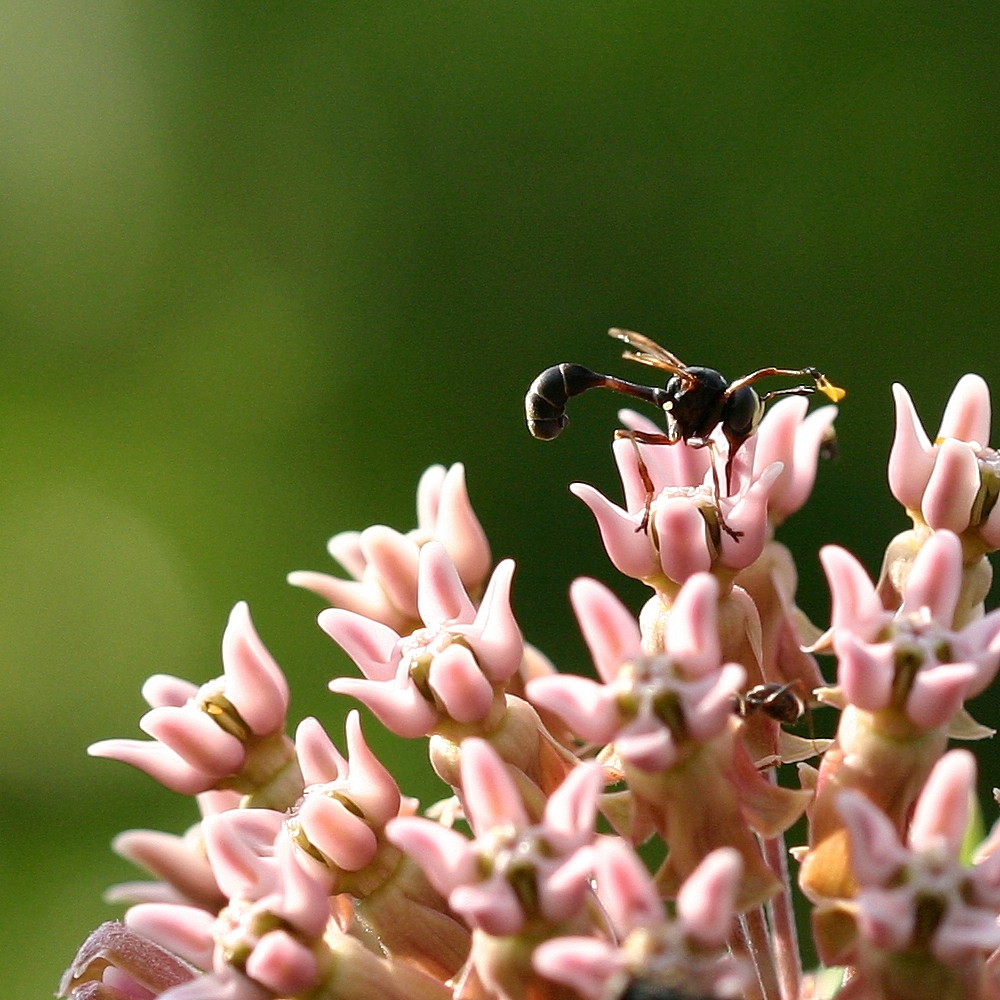
Physocephala furcillata, Eumenes crucifera, and Doros aequalis resemble potter’s wasps, and Ocyptamus fascipennis, an ichneumon. Sericomyia chrysotoxoides looks like a yellow jacket wasp, and Eristalis flavipes could be mistaken for a bumblebee.
Sericomyia chrysotoxoides (Oblique-banded Pond Fly), a yellow jacket wasp mimic. The larvae live in mud rich in organic matter, filtering out microorganisms.Doros aequalis, an Ancistrocerus mimic, lives in forests. It’s a pollinator of spring ephemerals. The larvae live in ant nests and eat aphids.Eristalis flavipes (orange-legged drone fly), a bumblebee mimic. Its larvae feed on small organisms in stagnant water.
Syrphids are pollinators
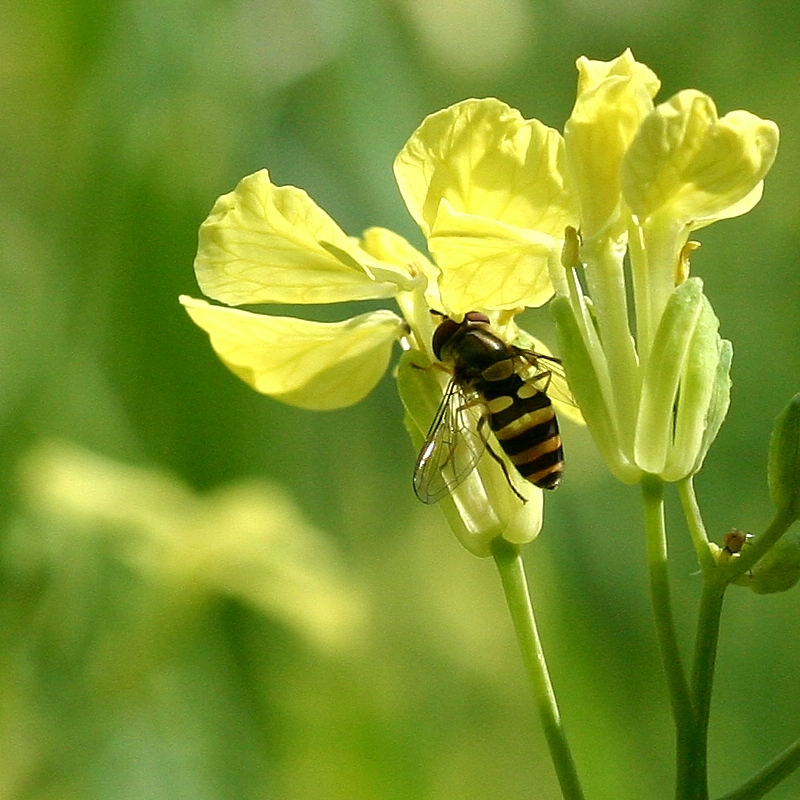
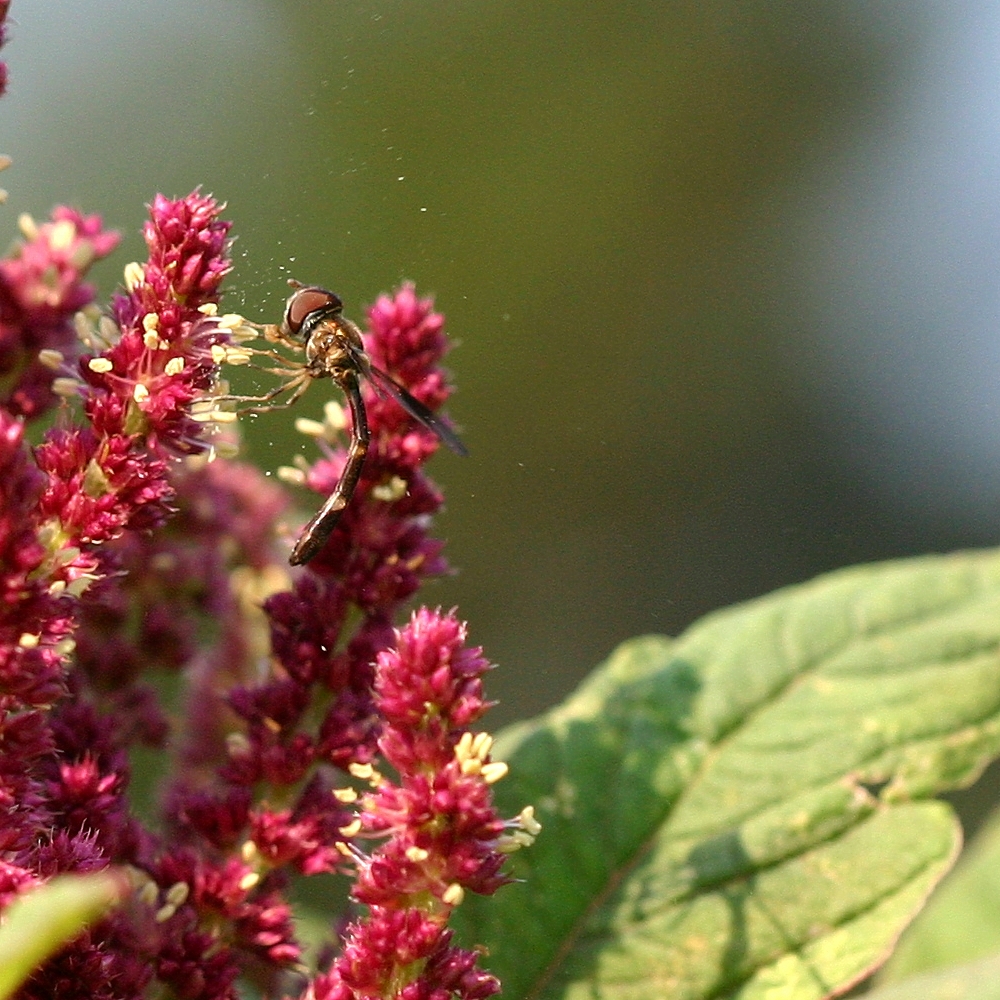
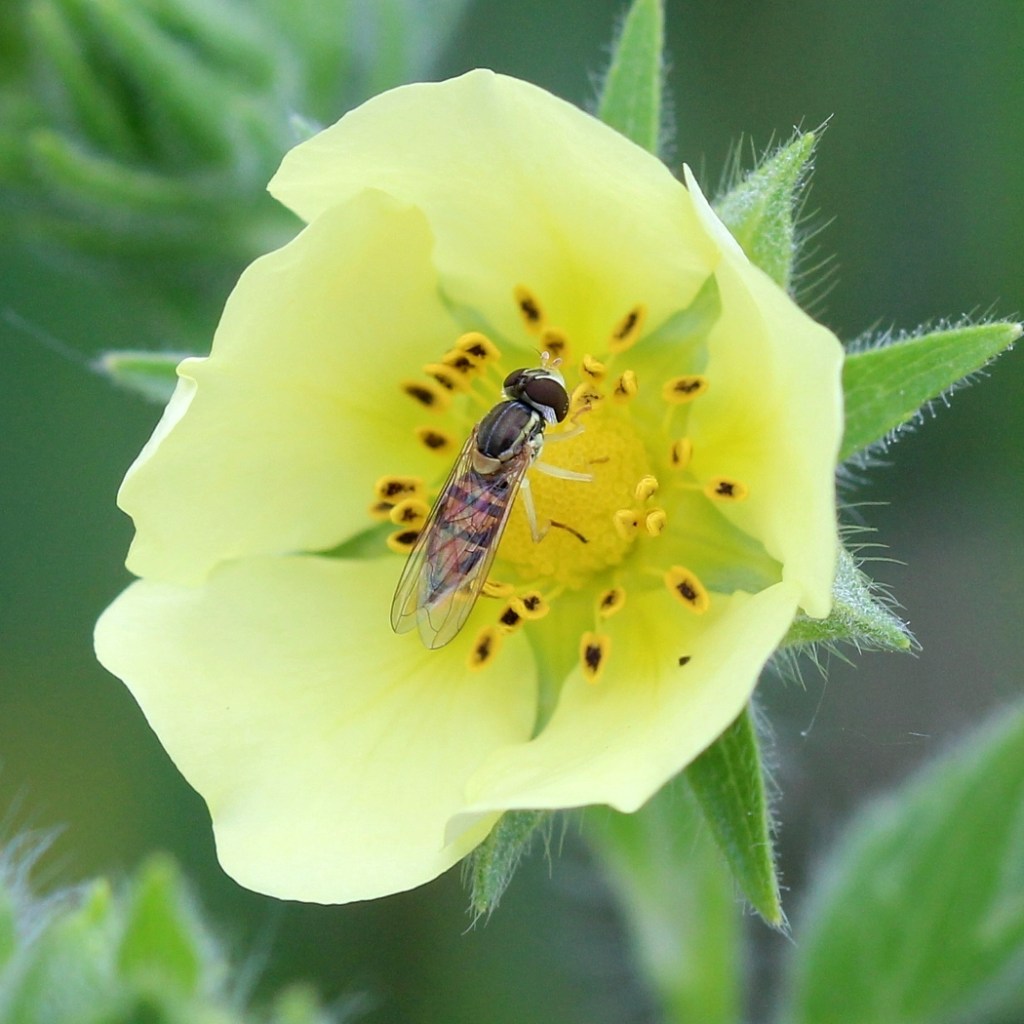
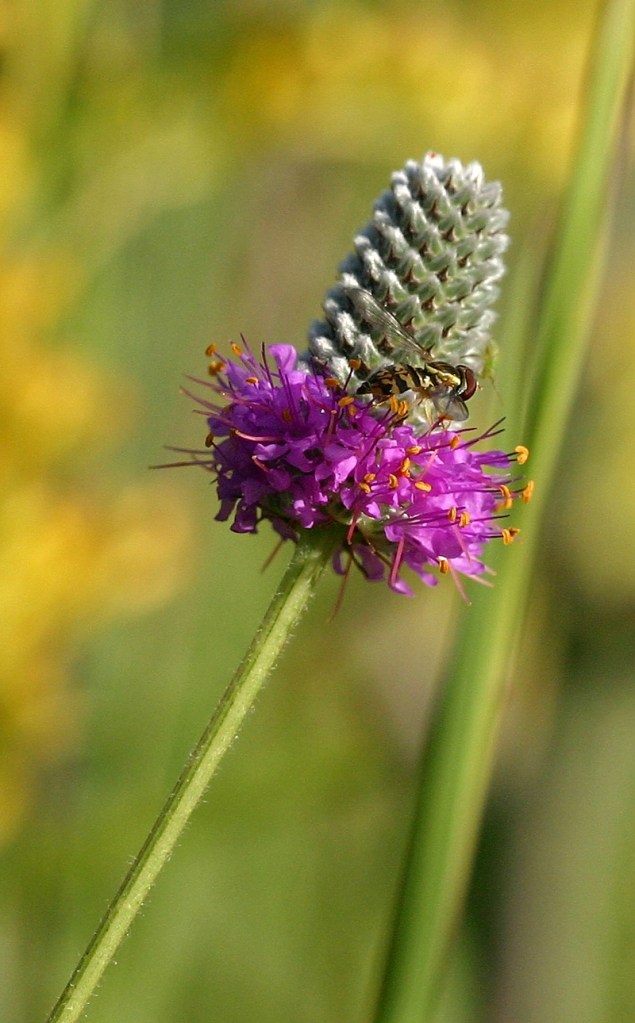
Like bees, syrphids are pollinating insects. But it is not just aster family plants they seek out. I have seen syrphids on mustard (Brassica nigra), amaranth (Amaranthus cruentus), milkweed (Asclepias syriaca), purple prairie clover (Dalea purpurea), grass-of-parnassus (Parnassia sp.), and cinquefoil (Potentilla recta).
Physocephala furcillata on milkweed (Asclepias syriaca) flowers. This species is a wasp mimic incorporating features of Eumenes potter wasps.Probably Eupeodes (Metasyrphus) americanus on the flower of a mustard plant (Brassica nigra). The fly resembles a small yellow jacket wasp.Ocyptamus fascipennis on amaranth (Amaranthus cruentus). This species is an an ichneumon wasp mimic.Toxomerus marginatuson cinquefoil (Potentilla recta) flower.Toxomerus geminatus on purple prairie clover (Dalea purpurea).Toxomerus marginatus on a Parnassia flower.
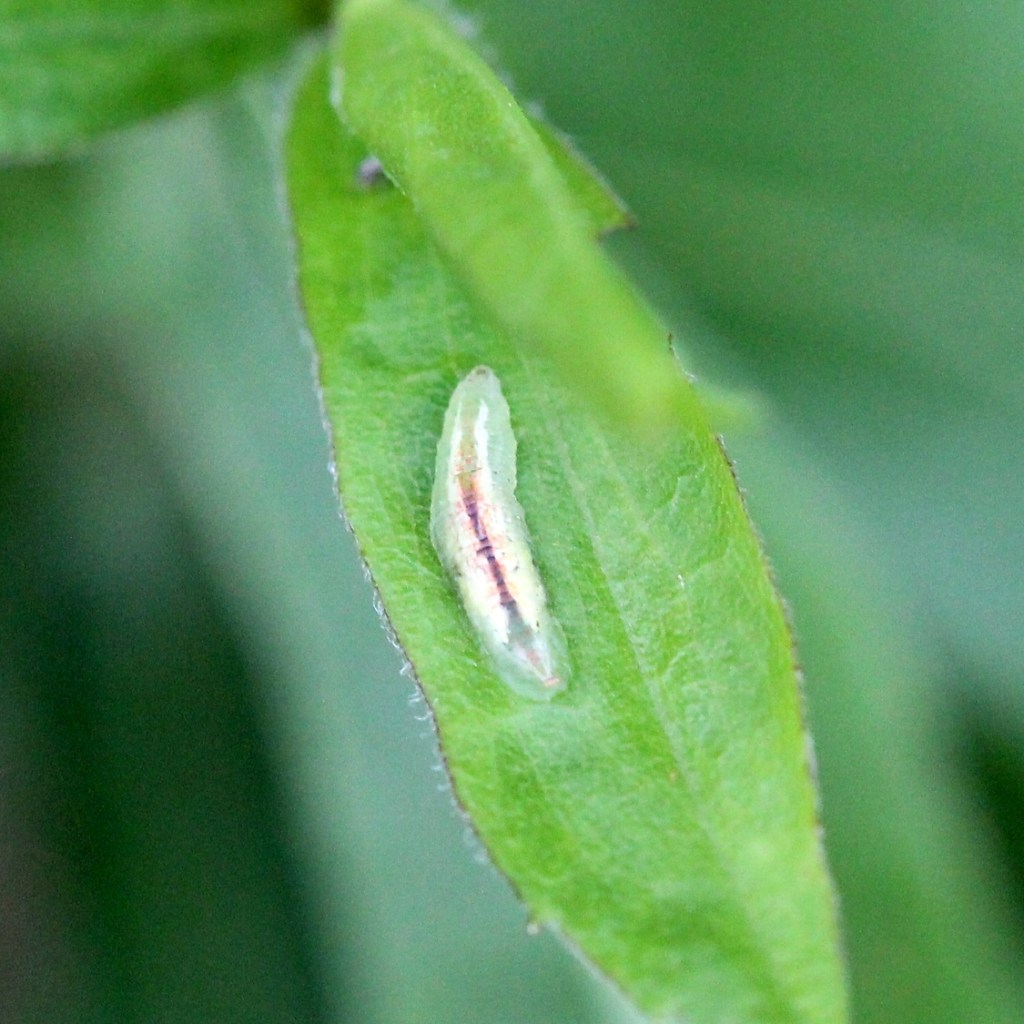
Syrphid fly larva on an aster leafSyrphid fly larva on a willow leaf
Encouraging syrphids
Syrphid flies, like the bees and wasps they often mimic, are important parts of the pollinator fauna. They don’t sting or bite, but their appearances can give you pause.
Planting nectar-rich domesticated plants like buckwheat, sunflowers, coriander, and dill, and wildflowers. Even small patches will help them. From there, they can launch forays into gardens and fields, pollinating crop plants. Predatory species will lay eggs that hatch into maggots that eat pest insects like aphids, scale insects, and spider mites.







 Not Very Far Away