
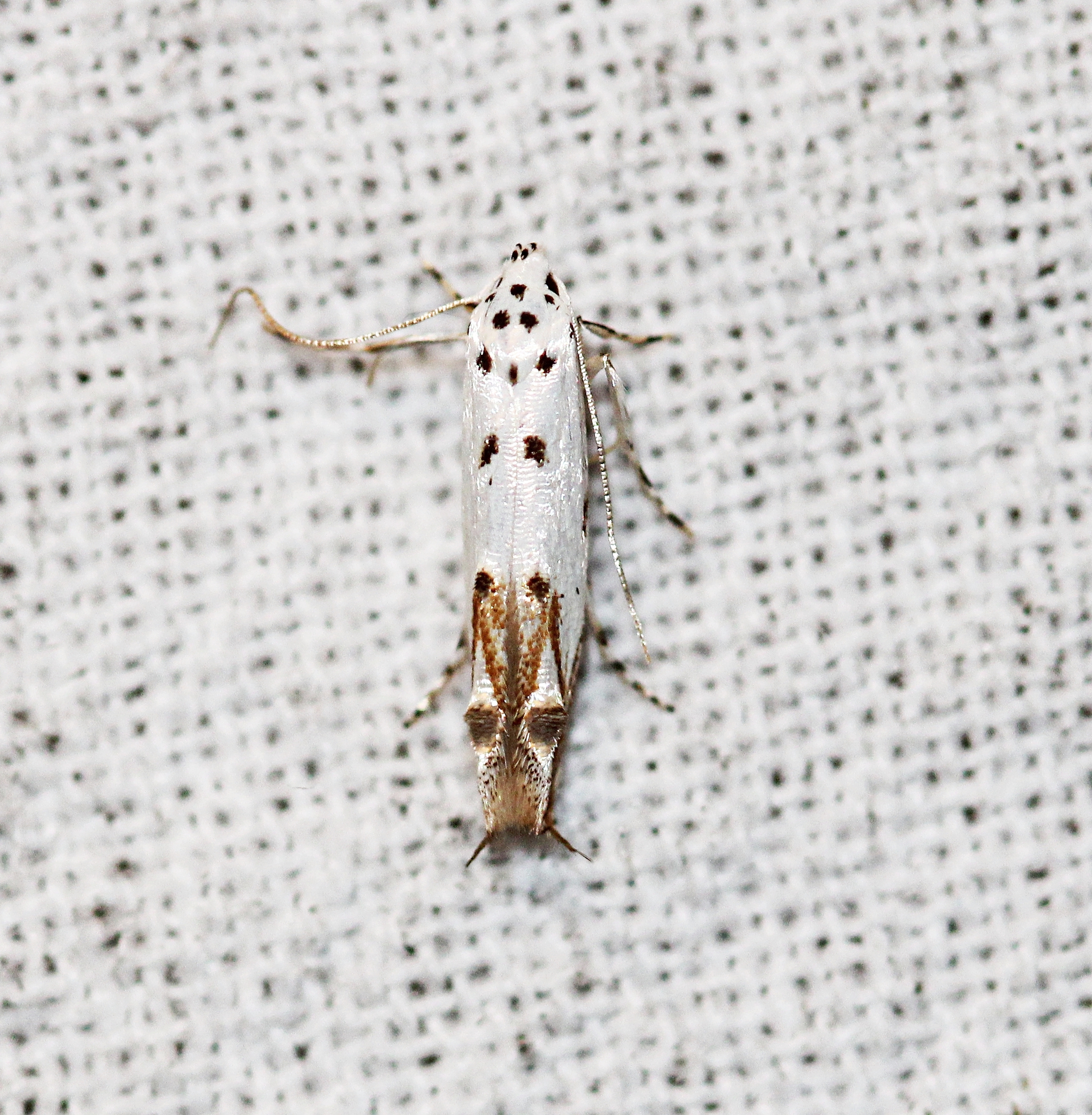
This is Mompha eloisella (Red-streaked Mompha), a tiny moth with beautiful satiny white wings speckled with symmetrically placed dark brown spots on the head, thorax, and wings, and red diagonal lines on the wing tips. The patterning of the wing tips resembles a face, but who or what will notice something that small and possibly be deterred by it? Or maybe that’s what the markings are for at all.
Mompha eloisella is in the family Momphidae, which worldwide contains at least 115 species. In North America, there are 45 species just in the genus Mompha and probably many more yet to be discovered and described. All are tiny and have unique patterns, often colorful, on their wings. The larvae of most Mompha species feed on plants in the Onagraceae (evening primrose family) as stem, flower, or fruit borers or as leaf miners. Mompha eloisella larvae are stem borers in evening primrose (Oenothera spp.). This one may have been attracted to the small stand of Oenothera biennis growing in my garden.
Mompha eloisella is widespread in the US, but available range maps show it as not present in Minnesota. Now we know it does occur in Minnesota, with this first sighting more than 120 miles north of a previous sighting in Wisconsin.
This isn’t the first Mompha moth I’ve seen here. There are four other species, all very tiny and beautifully patterned. The small size of these moths makes them easy to miss and difficult to photograph, but with a little effort and patience, they can be found and sometimes photographed clearly. Of course, not all of my Mompha photos are clear, but clear enough. They seem skittish, which also makes photographing them a challenge.
To attract more Mompha moths, I have planted Oenothera biennis, Epilobium angustifolium (fireweed), and let the weedy annual Epilobium coloratum (willow-herb) have a place in my flower garden. Not only are these plants food for Mompha moth larvae, but their flowers, sweet with nectar, are food sources for bees, small and large, and even hummingbirds. After blooming, the plants continue to benefit wildlife. A few days ago, I saw an eastern goldfinch in my flower garden feeding on the small seeds of evening primrose.
References and sources:
Genus Mompha https://bugguide.net/node/view/41654
Species Mompha eloisella – Red-streaked Mompha – Hodges#1443 https://bugguide.net/node/view/67246
Mompha eloisella (Clemens, 1860) http://mothphotographersgroup.msstate.edu/species.php?hodges=1443
A more technical description of this Mompha species, and several others, can be found at the Moths of North Carolina website.
 Not Very Far Away