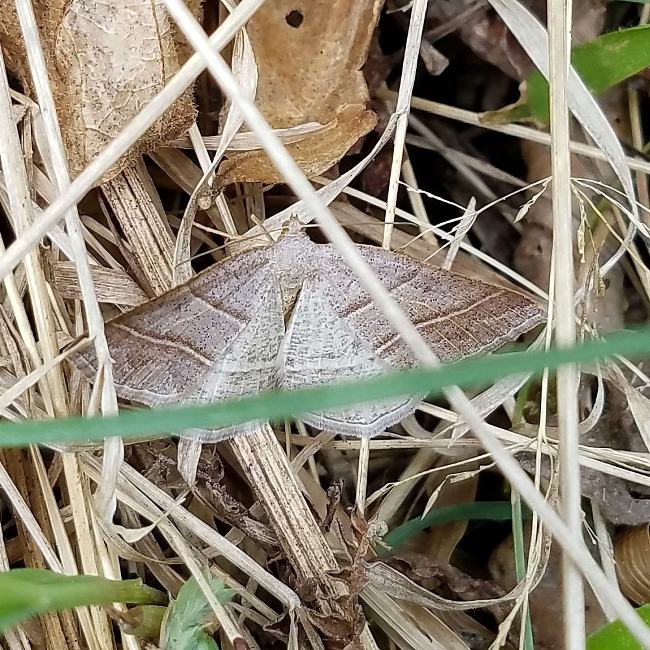
I was out taking a walk Sunday afternoon and saw many different small moths flying out from hiding in the grass and blueberry bushes. Most were too small and fast to get a good look at them. The one shown above flew and ducked under some grass blades just long enough for me to get a few snapshots before it took off. Later I went out again and saw dozens of them in a forest clearing full of bracken fern. The species is Northern Petrophora (Petrophora subaequaria, Family Geometridae) and its larvae feed only on ferns with bracken fern (Pteridium aquilinum) apparently the principle host plant. Photos at Bug Guide show the larvae on fronds of Osmunda fern.
Some brief information on Northern Petrophora (Petrophora subaequaria)
Taxonomy
Superfamily Geometroidea (Geometrid and Swallowtail Moths)
Family Geometridae (Geometrid Moths)
Subfamily Ennominae
Tribe Lithinini
Genus/species Petrophora subaequaria
Description
Wing span to 19 mm, speckled tan forewings with yellowish veins, antemedial and postmedial lines white edged and parallel. There is a small black dot in the center of the wings.
Life cycle
As with many moths not directly injurious to crops and forestry there is little information on the life history of Northern Petrophora. With so many adult moths appearing now in my bracken field it seems that mating and egg laying occur in the spring.
Range
Northern Petrophora occurs in North America from New Brunswick to Alberta, along the Great Lakes east to New England, and then south sporadically along the Appalachians to North Carolina.
SOURCES
Beadle, D. and Leckie, S. (2012). Peterson Field Guide to Moths of Northeastern North America. Houghton Mifflin Harcourt Publishing Company, Boston. 640 pages.
Voss, Edward G. (1991) “Moths of the Douglas Lake Region (Emmet and Cheboygan Counties), Michigan: IV. Geometridae (Lepidoptera),” The Great Lakes Entomologist: Vol. 24 : No. 3 , Article 11. Available at: http://scholar.valpo.edu/tgle/vol24/iss3/11
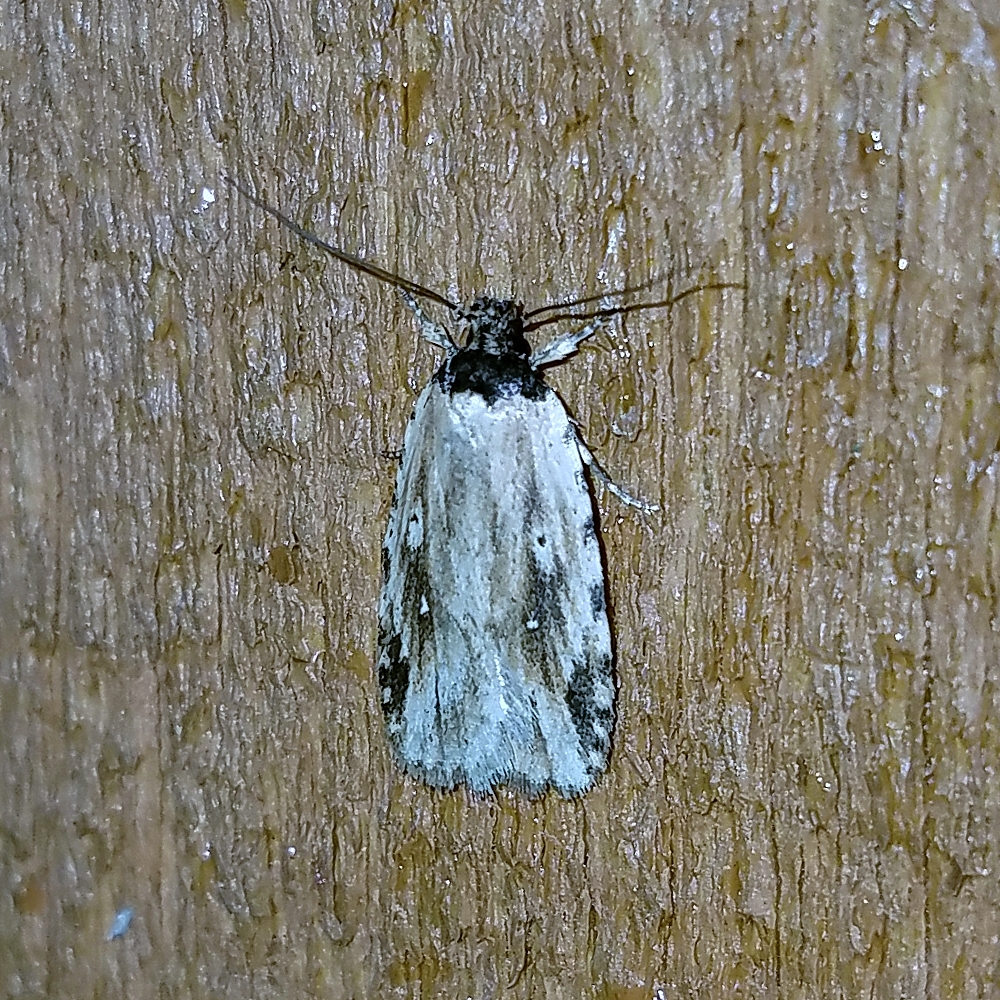
For some reason micro-moths (not a proper taxonomic group but a group of convenience) were well represented under my porch light the past two nights. Getting a clear picture of these 2 to 4 mm long moths is no easy task with a cellphone and some are just tantalizing blurs. Still, I recorded fourteen species of micro-moths which, with the exception of Diamondback Moth (Plutella xylostella, Family Plutellidae), a Leaf Blotch Miner Moth (Caloptilia stigmatella, Family Gracillariidae), and Many-plume Moth (Alucita montana, Family Alucitidae), and two species of Agonopterix (Agonopterix pulvipennella and Agonopterix atrodorsella, Family Depressariidae), are unidentified. There are two micro-moths, Mompha (Family Momphidae) and Parornix (Family Gracillariidae), identified to genus only because microscopic features are necessary for accurate determination.
As for larger moths (macro-moths) six species were seen. They are Sigmoid Prominent (Clostera albosigma, Family Notodontidae), Powdered Bigwing (Lobophora nivigerata, Family Geometridae), Small engrailed (Ectropis crepuscularia, Family Geometridae), Bicolored Woodgrain (Morrisonia evicta, Family Noctuidae), Norman’s Quaker Moth (Crocigrapha normani, Family Noctuidae), and Large Ruby Tiger Moth (Phragmatobia assimilans, Family Erebidae).
Morrisonia evicta, Crocigrapha normani, Ectropis crepuscularia, Phragmatobia assimilans, and Agonopterix atrodorsella are new records as are Mompha (M. luciferella?) and Parornix (P. obliterella?), neither of which can be properly identified to species by visual inspection of gross morphology alone, thus bringing the moth checklist up to 204 species.
Bicolored Woodgrain (Morrisonia evicta)
Norman’s Quaker Moth (Crocigrapha normani)
Large Ruby Tiger Moth (Phragmatobia assimilans)
Small engrailed (Ectropis crepuscularia)
Some brief notes on the new macro-moths and the micro-moth Agonopterix atrodorsella
Morrisonia evicta
Superfamily Noctuoidea (Owlet Moths and kin)
Family Noctuidae (Owlet Moths)
Subfamily Noctuinae (Cutworm or Dart Moths)
Tribe Orthosiini
Larval host plants: A large variety of woody plants including blueberry (Vaccinium), cherry (Prunus), chokeberry (Aronia), dogwood (Cornus), and hazel (Corylus).
Range: Northeastern US to Georgia and North Carolina and southern Canada. Scattered reports from Montana, Florida, and Texas.
Crocigrapha normani
Superfamily Noctuoidea (Owlet Moths and kin)
Family Noctuidae (Owlet Moths)
Subfamily Noctuinae (Cutworm or Dart Moths)
Tribe Orthosiini
Larval Host plants: ash (Fraxinus), aspen (Populus), birch (Betula), cherry and plum (Prunus), oak (Quercus), mountain ash (Sorbus), elm (Ulmus), and willow (Salix).
Range: Northeastern US to Georgia and South Carolina and in southern Canada.
Phragmatobia assimilans
Superfamily Noctuoidea (Owlet Moths and kin)
Family Erebidae
Subfamily Arctiinae (Tiger and Lichen Moths)
Tribe Arctiini (Tiger Moths)
Subtribe Spilosomina
Larval Host plants: balsam poplar (Populus balsamifera), raspberry (Rubus), and paper birch (Betula papyrifera).
Range: Northeastern US to Georgia and South Carolina and in southern Canada.
Ectropis crepuscularia
Superfamily Geometroidea (Geometrid and Swallowtail Moths)
Family Geometridae (Geometrid Moths)
Subfamily Ennominae
Tribe Boarmiini
Larval Host plants: balsam fir (Abies balsamea), hemlock (Tsuga canadense), larch (Larix), spruce (Picea), apple (Malus), alder (Alnus) and many other tree and shrub species.
Range: Over much of North America and in Eurasia.
Agonopterix atrodorsella
Superfamily Gelechioidea (Twirler Moths and kin)
Family Depressariidae
Subfamily Depressariinae
Larval Host plants: joe-pye weed (Eupatorium), beggars ticks (Coreopsis and Bidens).
Range: New England, Great Lakes Region, Quebec, Ontario, New Brunswick, and few locations in Kentucky, Maryland, and North Carolina.
Agonopterix atrodorsella
SOURCES
Beadle, D. and Leckie, S. (2012). Peterson Field Guide to Moths of Northeastern North America. Houghton Mifflin Harcourt Publishing Company, Boston. 640 pages.
Large Maple Spanworm (Prochoerodes lineola) on August 16, 2017
Gray Leafroller (Syndemis afflictana)
I didn’t find five new species last night like I had hoped to but I did find two, Curved-toothed Geometer (Eutrapela clemataria) in the Family Geometridae (Geometrid Moths) and Gray Leafroller (Syndemis afflictana) in the Family Tortricidae (Tortricid Moths), which, like almost all the moths I’ve found to date, are new records for Carlton County. These two species bring the checklist to 197 species.
Curved-toothed Geometer is similar in appearance to Large Maple Spanworm (Prochoerodes lineola, Family Geometridae) but can be told apart by its scalloped wing margins, hooked wing tips, and the pale yellow postmedial line across the forewings. Color of the forewings varies from light brown to dark purplish brown to brownish gray and may be mottled with fine spots. The range of Curved-toothed Geometer is east of the Mississippi River and north into southern Canada. Larvae of Curved-toothed Geometer feed on many trees including ash (Fraxinus spp.), basswood (Tilia spp.), birch (Betula spp.), elm (Ulmus spp.), and poplar (Populus spp.).
Two moths seen in the last several days returned: Agonopterix pulvipennella (Family Depressariidae) and Black-dashed Hydriomena (Hydriomena divisaria, Family Geometridae (Geometrid Moths)).
Agonopterix pulvipennella
Black-dashed Hydriomena (Hydriomena divisaria)
And there were some moths first seen here last summer. Two of them, Pale Metanema (Metanema inatomaria) and Dark Metanema (Metanema determinata) are in the Family Geometridae (Geometrid Moths). The other, Apical Prominent (Clostera apicalis), is in the Family Notodontidae (Prominent Moths) and is one of two species of Clostera I have found the other being Sigmoid Prominent (C. albosigma). Apical Prominent differs from Sigmoid Prominent by the wavy postmedial line that borders a large rust colored apical patch and by the kinked oblique median line of the forewing as compared to the parallel lines of Sigmoid Prominent. The larvae of all four species feed on aspen (Populus spp.) and willows (Salix spp.). These moth species occur over most of the US and southern Canada.
Pale Metanema (Metanema inatomaria)
Dark Metanema (Metanema determinata)
Apical Prominent (Clostera apicalis)
Sigmoid Prominent (Clostera albosigma) with an unknown white moth on July 15, 2017
Although I am feeling a bit tired I think I will put in a few hours tonight looking for moths again.
SOURCES
Beadle, D. and Leckie, S. (2012). Peterson Field Guide to Moths of Northeastern North America. Houghton Mifflin Harcourt Publishing Company, Boston. 640 pages.
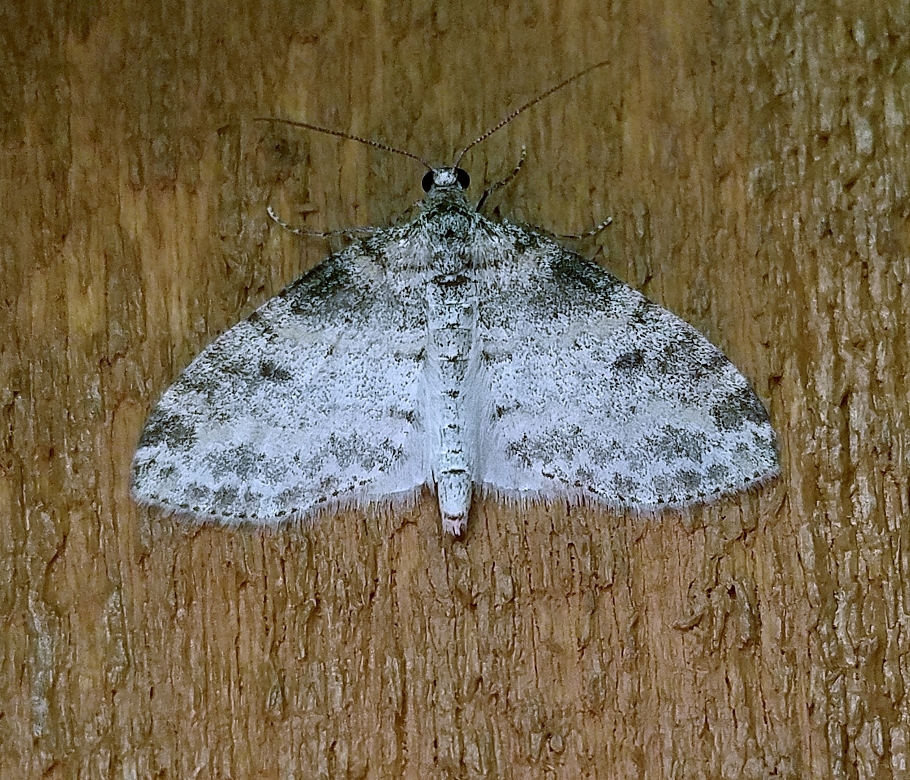
The previous moth count on May 18 was 190 species but after last night it stands at 195 species. The moth shown above is the Powdered Bigwig (Lobophora nivigerata) and species 195. I’m not sure why it is called Powdered Bigwig although the wings do have a powdery look. It is one of the Geometers (Family Geometridae). The Powdered Bigwig was one of several that came to my porch light after sunset until about 2 AM when I decided to call it a night. Other species seen and added to the list in the last few days are Lesser Aspen Webworm Moth (Meroptera pravella, Family Pyralidae), Signate Melanolophia (Melanolophia signataria, Family Geometridae), Black-Dashed Hydriomena (Hydriomena divisaria, Family Geometridae), and One-eyed Sphinx (Smerinthus cerisyi, Family Sphingidae).
I’m hoping tonight to add five more species.
Lesser Aspen Webworm Moth (Meroptera pravella)
Signate Melanolophia (Melanolophia signataria)
Black-Dashed Hydriomena (Hydriomena divisaria)
One-eyed Sphinx (Smerinthus cerisy)
One-eyed Sphinx (Smerinthus cerisy) detail of eyespot.







 Not Very Far Away