Homaemus aeneifrons – Bronze-Headed Shield Bug

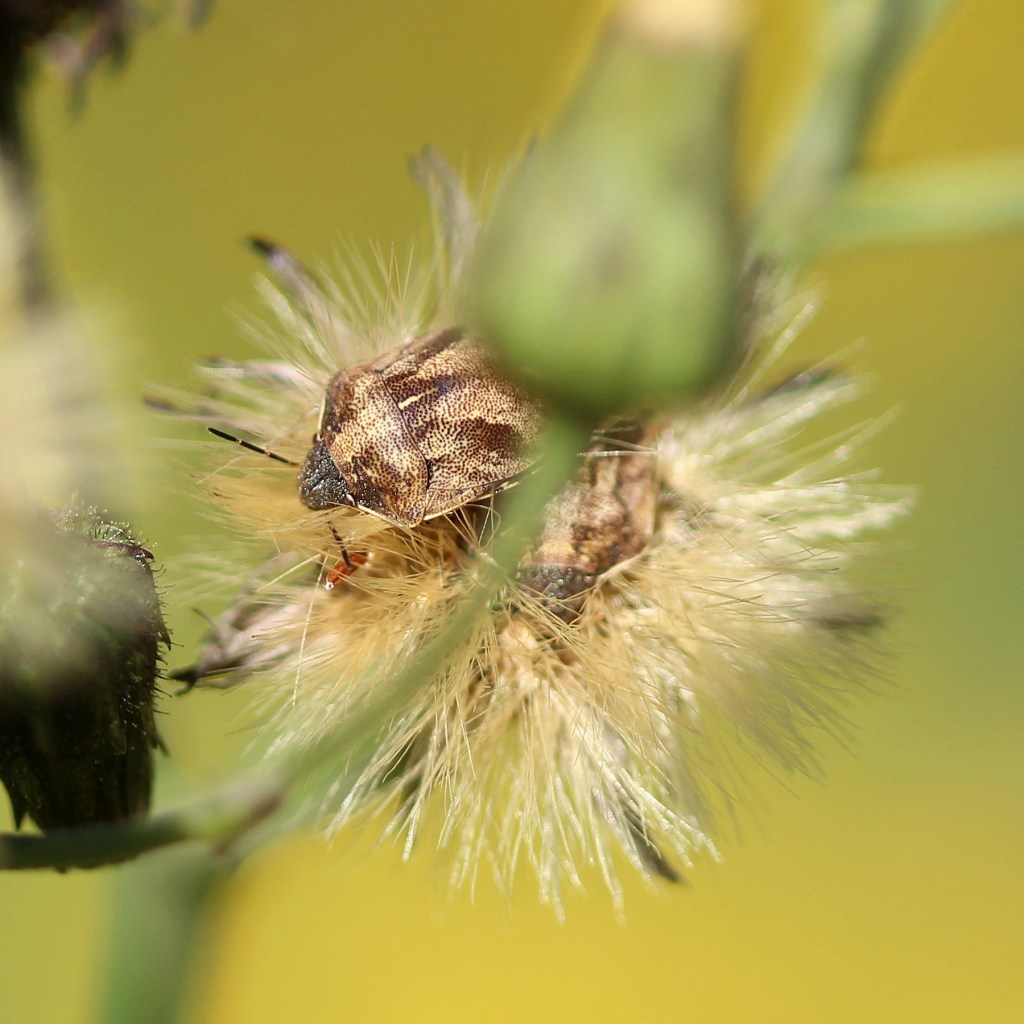
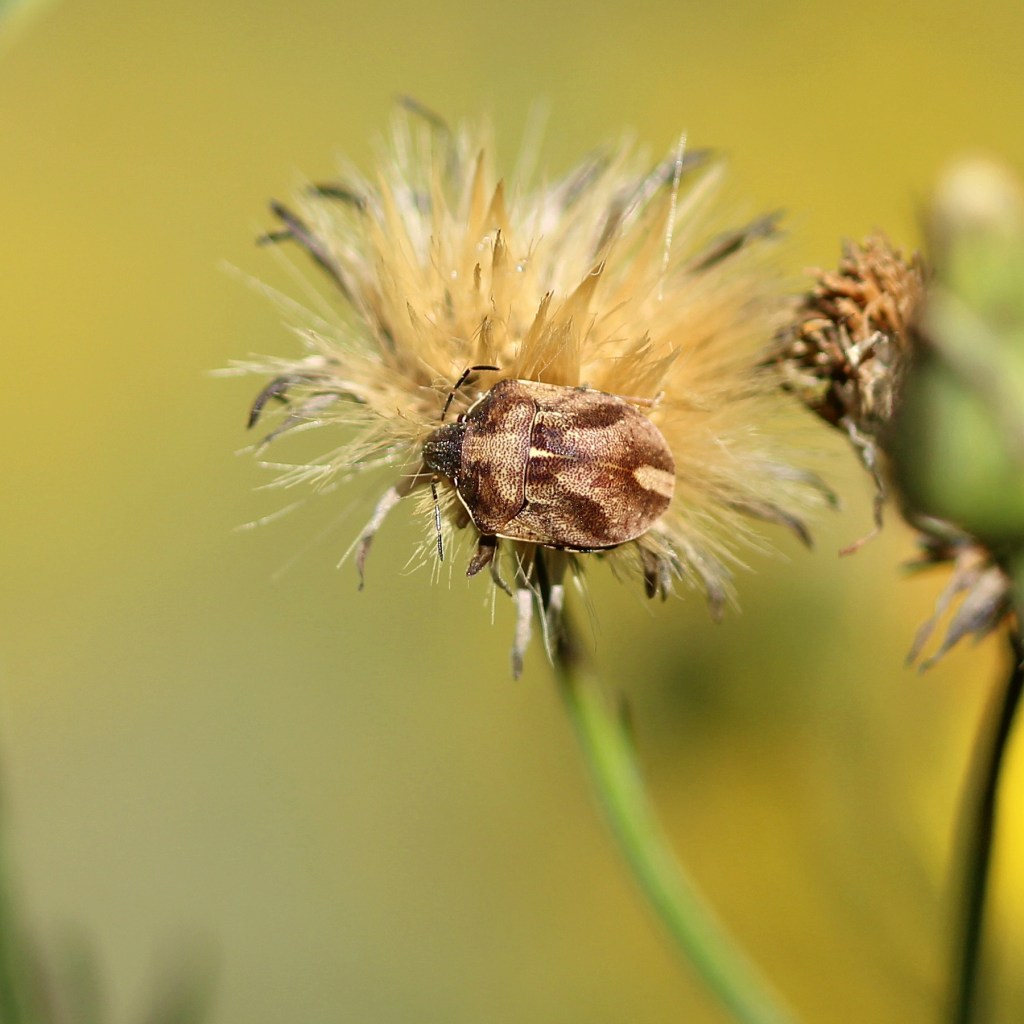
Early Sunday morning I saw a group of bronze-headed shield bugs (Homaemus aeneifrons) sunning themselves on the seed heads of Canadian hawkweed (Hieracium umbellatum). The previous night had been very cool with temperatures dipping to 40 degrees F and this cluster of seed heads facing due east into the sun was a perfect place to warm up. In all, there were six bugs catching the early morning sun.

Homaemus aeneifron is widespread in North America occurring as far south as Kansas and Arizona and as far west as Alaska, British Columbia, and California. It is frequently found in moist meadows and weedy areas. Some reports state that it feeds on grasses and sedges (Carex) and rushes (Juncus) but one has it feeding on Monarda fistulosa (wild bergamot) and Oenothera biennis (evening primrose). These on hawkweed did not appear to be feeding. Beyond catching some rays it was hard to say why they were all there.
CLASSIFICATION
Kingdom: Animalia (Animals)
Phylum: Arthropoda (Arthropods)
Subphylum: Hexapoda (Hexapods)
Class: Insecta (Insects)
Order: Hemiptera (True Bugs, Cicadas, Hoppers, Aphids and Allies)
Suborder: Heteroptera (True Bugs)
Infraorder: Pentatomomorpha
Superfamily: Pentatomoidea
Family: Scutelleridae (Shield-backed Bugs)
Subfamily: Pachycorinae
Genus: Homaemus
Species: aeneifrons (Homaemus aeneifrons)

SOURCES

Bug Guide

Williams, Andrew H. 2004. “Feeding Records of True Bugs (Hemiptera: Heteroptera) From Wisconsin,” The Great Lakes Entomologist, vol 37 (1)

Thomas, Donald B.; Werner, Floyd G. 1981. Grass Feeding Insects of the Western Ranges: An Annotated Checklist. Technical Bulletin (University of Arizona, Agricultural Experiment Station) No. 243

Sword-bearing Conehead

My mothing nights find more than moths. Beetles, bugs, flies, wasps, spiders, and crickets, even snakes and frogs, are frequent visitors to the porch light. The latest non-lepidopteran to make an appearance is the sword-bearing conehead (Neoconocephalus ensiger). It is a new addition to my insect checklist and is one of five species of Tettigoniidae (Katydids) that I’ve identified from here.

The sword-bearing conehead is a large insect with males growing 4.5 to 5.5 cm, and females 5.2 to 6.4 cm. The head is conical with the sides pinched-in and black below. The body’s lower surface is edged in black. The stridulatory vein, which is used to make the call song in males, is long and weakly swollen. The ovipositor is blade-like and nearly the length of the body hence the name “sword-bearing”. Two color forms, green and brown, exist.

The call song of the sword-bearing conehead is a series of rapid tsst-tsst-tsst sounds. At higher temperatures the call song is faster. Singing begins at dusk and may continue all night if temperatures are warm. Singing Insects of North America (SINA) and Songs of Insects have recordings of this species and others on their websites.

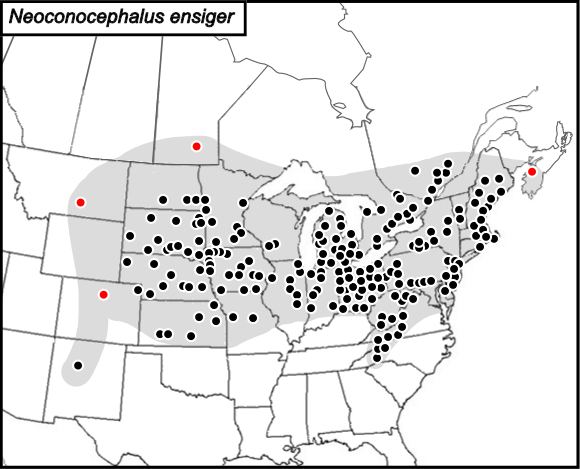
Sword-bearing conehead is common across much of the eastern and north-central US and ranges as far north as Manitoba, Ontario, Quebec, and New Brunswick in Canada. Habitat includes damp grassy areas, roadsides, and weedy areas where they feed on grasses and sedges including the flowers and developing seeds.

Range map of the sword-bearing conehead.

SOURCES

Bug Guide
Singing Insects of North America
Songs of Insects

I’ll be away from my desk…

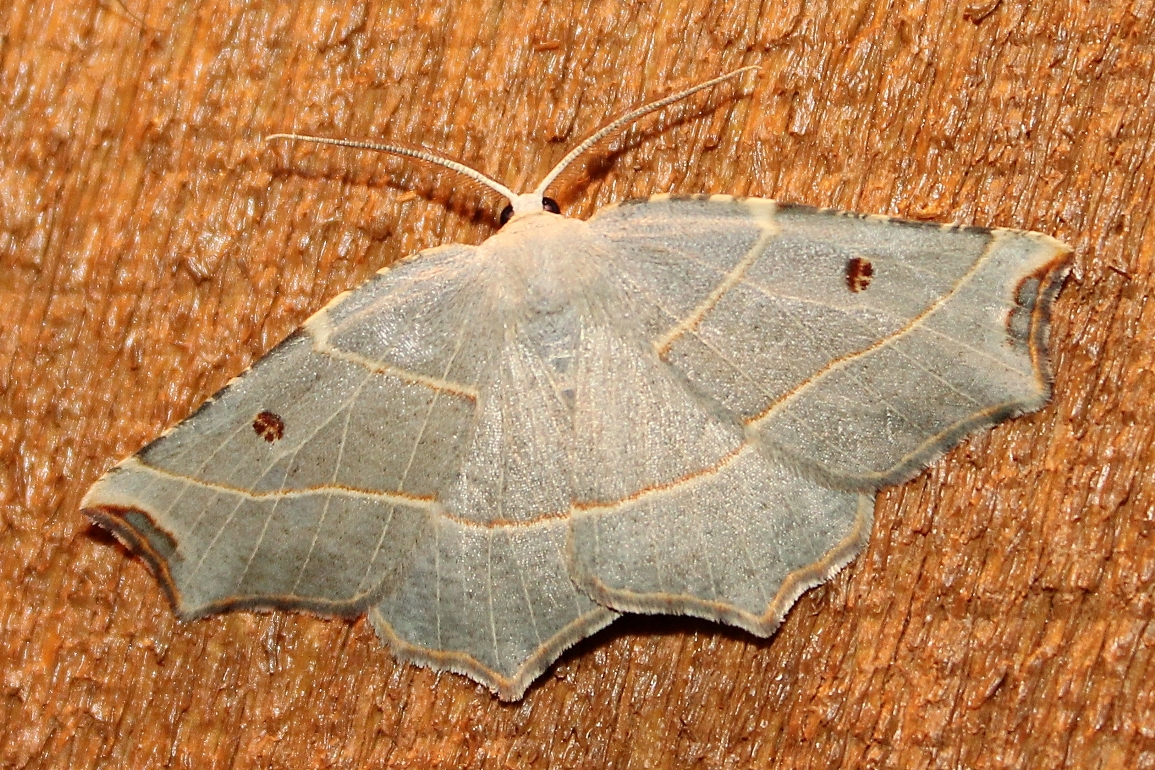
Metanema inatomaria a species seen last summer on warm humid nights.


…during much of July and so will be posting a little less frequently. But summer has arrived and brings with it a new group of moths that love the hot and humid weather. Here are five of the seventeen new moths plus one returning visitor that showed up at my porch light over the weekend. I’ll be writing about these species later in August. There are already a few in the works on the moths Habrosyne scripta (almost done!), Oreta rosea, Phlogophora iris, Campaea perlata, and Monopis spilotella seen this year and last year.


Arctic Skipper

Carterocephalus palaemon, Arctic Skipper, widespread in Minnesota. It was previously known from Carlton County by a historical record. There do not seem to be any recent records from the county other than this one.


This small butterfly with dark brown wings and yellow spots is the Arctic Skipper (Carterocephalus palaemon). I saw it a few days ago on a warm, sunny, and humid afternoon on June 12. It was resting on a blade of grass in a sunny opening in an encroaching forest. Although the Arctic Skipper is widely distributed and ranked a G5 or “globally secure” there is only one record that I could find of it from Carlton County and it is historical but there was no information about when or where it was seen or who saw it.

Taxonomy
Class Insecta (Insects)
Order Lepidoptera (Butterflies and Moths)
Superfamily Papilionoidea (Butterflies and Skippers)
Family Hesperiidae (Skippers)
Subfamily Heteropterinae (Intermediate Skippers)
Genus/species Carterocephalus palaemon

Description
The upper wing surface is dark brown to almost black with roughly rectangular yellow spots. Below they are like the color of a deer fawn and marked with black-rimmed yellow spots. Wingspread is 2.5 to 3.2 cm.

Range
A circumboreal species found in North America from Alaska to Canada’s Atlantic coast and south to California and Pennsylvania. Not truly an Arctic species.

Larval Host Plants
Larvae of Carterocephalus palaemon eat grasses. In California purple reedgrass (Calamagrostis purpurascens) is reported as a larval host. In some European countries, brome (Bromus spp.) are preferred larval hosts.  Purple moor-grass (Molinia caerulea) has been reported as a larval host in Scotland. Purple reedgrass is rare in Minnesota and purple moor-grass does not grow here. There are bromes both native and introduced in the state as well as the native Canada bluejoint grass (Calamagrostis canadensis). It is likely that Carterocephalus palaemon larvae feed on other grass species besides the few mentioned in the literature.


SOURCES
Arctic Skipper Carterocephalus palaemon (Pallas, 1771) at BAMONA.

Carterocephalus palaemon (Pallas, 1771) at the Bourgogne-Nature website.

Chequered Skipper (Carterocephalus palaemon) at the Sottish Natural Heritage website.

Species Carterocephalus palaemon – Arctic Skipper – Hodges#3982 at the Bug Guide website.