
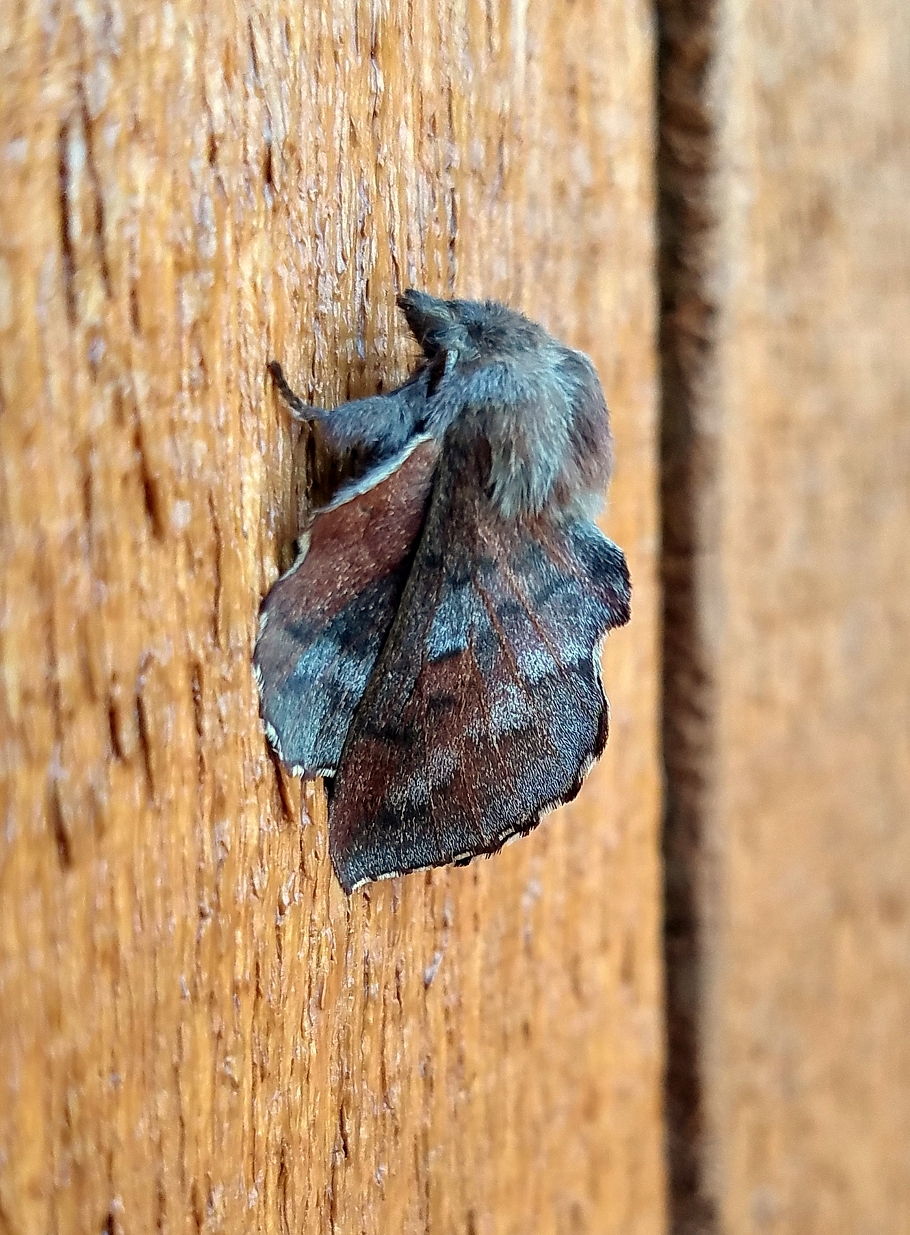
I’ve been trying to wrap up this post but keep finding more moths. At the end of last week I had 6 identified moth species and 5 unidentified species since seeing the first moth of 2018 on April 18th. Over the weekend I added five more: American Lappet Moth (Phyllodesma americana), Willow Dart Moth (Cerastis salicarum), Variable Carpet Moth (Anticlea vasiliata), Featherduster Agonopterix (Agonopterix pulvipennella), and Mottled Black-marked Moth (Semioscopis aurorella) bringing the count to 11 species. But as of Tuesday (May 15) the count now stands at 16 species when I added these five: Multiform Leafroller Moth (Acleris flavivittana), Snowy-shouldered Acleris (Acleris nivisellana), Strawberry Moth (Acleris fragariana), Bent-wing Acleris (Acleris subnivana), and The Herald Moth (Scoliopteryx libatrix). And I have added six more to the “Unknown Moths” file four of which are discussed at the end of the post. So, a lot of new moth species for the property’s species checklist and summer is still a month away.
On to the featured image and the other new moths
The American Lappet Moth shown above is much more blue than is typical for the species which is yellowish-brown or reddish to almost orange. It is in the Tent Caterpillar family (Lasiocampidea) and the larvae feed on alder (Alnus spp.) birch (Betula spp.), oak (Quercus spp.), and rose (Rosa spp.). American Lappet Moth occurs over almost all of North America north of Mexico.


Willow Dart Moth (Cerastis salicarum) is in Noctuidae (Owlet Moths), Subfamily Noctuinae (Cutworm or Dart Moths) but different tribes (Noctuini and Xylenini respectively). Larval host plants of Willow Dart Moth are thought to be willows (Salix spp.) but this may not the case. The range of Willow Dart Moth is from southern Canada to the northern US.
Variable Carpet Moth (Anticlea vasiliata) is in the Family Geometridae (Geometrid Moths), Subfamily Larentiinae. Its larvae feed on red raspberry (Rubus idaeus). Variable Carpet Moth occurs from Newfoundland to North Carolina and Tennessee, west to California and British Columbia.
Featherduster Agonopterix (Agonopterix pulvipennella) and Mottled Black-marked Moth (Semioscopis aurorella) are in the moth Superfamily Gelechioidea (Twirler Moths and kin), Family Depressariidae, Subfamily Depressariinae. The larvae of Featherduster Agonopterix feed on the leaves of goldenrod (Solidago spp.) and stinging nettle (Urtica spp.). Those of Mottled Black-marked Moth feed on leaves of Prunus spp. (plums, cherries). Featherduster Agonopterix occurs from Quebec and New Brunswick to Georgia and Mississippi, and north to Saskatchewan. Mottled Black-marked Moth occurs from southeastern Canada to the northeastern US as far south as Virginia and Indiana.


Multiform Leafroller Moth (Acleris flavivittana), Strawberry Moth (Acleris fragariana), Bent-wing Acleris (Acleris subnivana), and Snowy-shouldered Acleris (Acleris nivisellana) are in the Family Tortricidae (Tortricid Moths), Subfamily Tortricinae, Tribe Tortricini. All four species range from southern Canada to the northeastern US with scattered occurrences from Louisiana to Georgia. Snowy-shouldered Acleris and Strawberry Moth are also found from California to British Columbia.
Strawberry Moth (Acleris fragariana) is a generalist feeder on members of the Rosaceae. Larval hosts include strawberry (Fragaria spp.), blackberry (Rubus spp.), rose (Rosa spp.), plum (Prunus spp.), cinquefoil (Potentilla spp.), and black chokeberry (Photinia melanocarpa).
Snowy-shouldered Acleris (Acleris nivisellana) larvae feed on pin cherry (Prunus pensylvanica) and Multiform Leafroller Moth (Acleris flavivittana) feed on apple (Malus spp.) and pin cherry (Prunus pensylvanica). The larvae of Bent-wing Acleris (Acleris subnivana) are more specialized feeding on red oak (Quercus rubra) but also Vernonia spp. (ironweed) which is a herbaceous plant in the aster family (Asteraceae). Note: The Bent-wing Acleris I have here looks a little like what I thought might be (but wasn’t very sure of) Forbes’ Acleris (Acleris forbesana) in an earlier post. I will have to revisit that one.
The Herald Moth (Scoliopteryx libatrix) is in the Superfamily Noctuoidea (Owlet Moths and kin), Family Erebidae, Subfamily Scoliopteryginae, Tribe Scoliopterygini. Its larvae feed on poplar (Populus spp.) and willow (Salix spp.). There are typically two generations a summer. The last generation overwinters in the adult form in cavities, shed walls, and caves and emerges in the spring. The Herald Moth is a Holarctic species which in the North American part of its range occurs from southern Canada and over much of the US.
Some unknown moths no longer unknown
Also, in the past couple of weeks I have figured out several more moths from last summer’s photos. Among them are Large Mossy Lithacodia Moth (Protodeltote muscosula), Morrison’s Sooty Dart Moth (Pseudohermonassa tenuicula), Jeweled Tailed Slug Moth (Packardia geminata), and Garden Tortix (Clepsis peritana). With the newly identified species from last year and this year the moth species checklist is now at 190 species.


Large Mossy Lithacodia Moth (Protodeltote muscosula) is in the Superfamily Noctuoidea (Owlet Moths and kin), Family Noctuidae (Owlet Moths), Subfamily Eustrotiinae. The larvae are reported to feed on feed on sawgrass (Cladium) which is not a grass but a sedge (Cyperaceae). Because the only Cladium in Minnesota is C. mariscoides, a rare species, I suspect this moth’s larvae also feed on other wetland species of Cyperaceae. Large Mossy Lithacodia occurs over much of the eastern US east of the Great Plains and parts of southern Ontario and Quebec.
Morrison’s Sooty Dart Moth (Pseudohermonassa tenuicula) is in the Superfamily Noctuoidea (Owlet Moths and kin), Family Noctuidae (Owlet Moths) Subfamily Noctuinae (Cutworm or Dart Moths), Tribe Noctuini, Subtribe Noctuinaarvae. Larvae feed on mannagrass (Glyceria spp.) a plant commonly found in wetlands. Morrison’s Sooty Dart Moth ranges across the northern United States and southern Canada and north to Northwest Territories.
Jeweled Tailed Slug Moth (Packardia geminata) is in the Superfamily Zygaenoidea (Flannel, Slug Caterpillar, Leaf Skeletonizer Moths and kin), Family Limacodidae (Slug Caterpillar Moths). The green slug-like larvae are polyphagous and feed on a variety of plants such as cherry and plum (Prunus spp.) and wild raisin and arrowwood (Viburnum spp.). Jeweled Tailed Slug Moth occurs in the eastern US east of the Great Plains and in southern Ontario and Quebec.
Garden Tortix (Clepsis peritana) is in the Superfamily Tortricoidea (Tortricid Moths), Family Tortricidae (Tortricid Moths), Subfamily Tortricinae, Tribe Archipini. Larvae are generalist feeders. Among the plants they have been observed eating are strawberry (Fragaria spp.), cardoon (Cynara cardunculus), hedgenettle (Stachys spp.) and other low plants. Dying or dead leaves are the preferred food source but they will eat the fruit of strawberries. The larvae also eat dead citrus leaves in groves and will switch to live leaves once these are used up or caterpillar populations are high. Garden Tortix occurs widely across North America.
And this

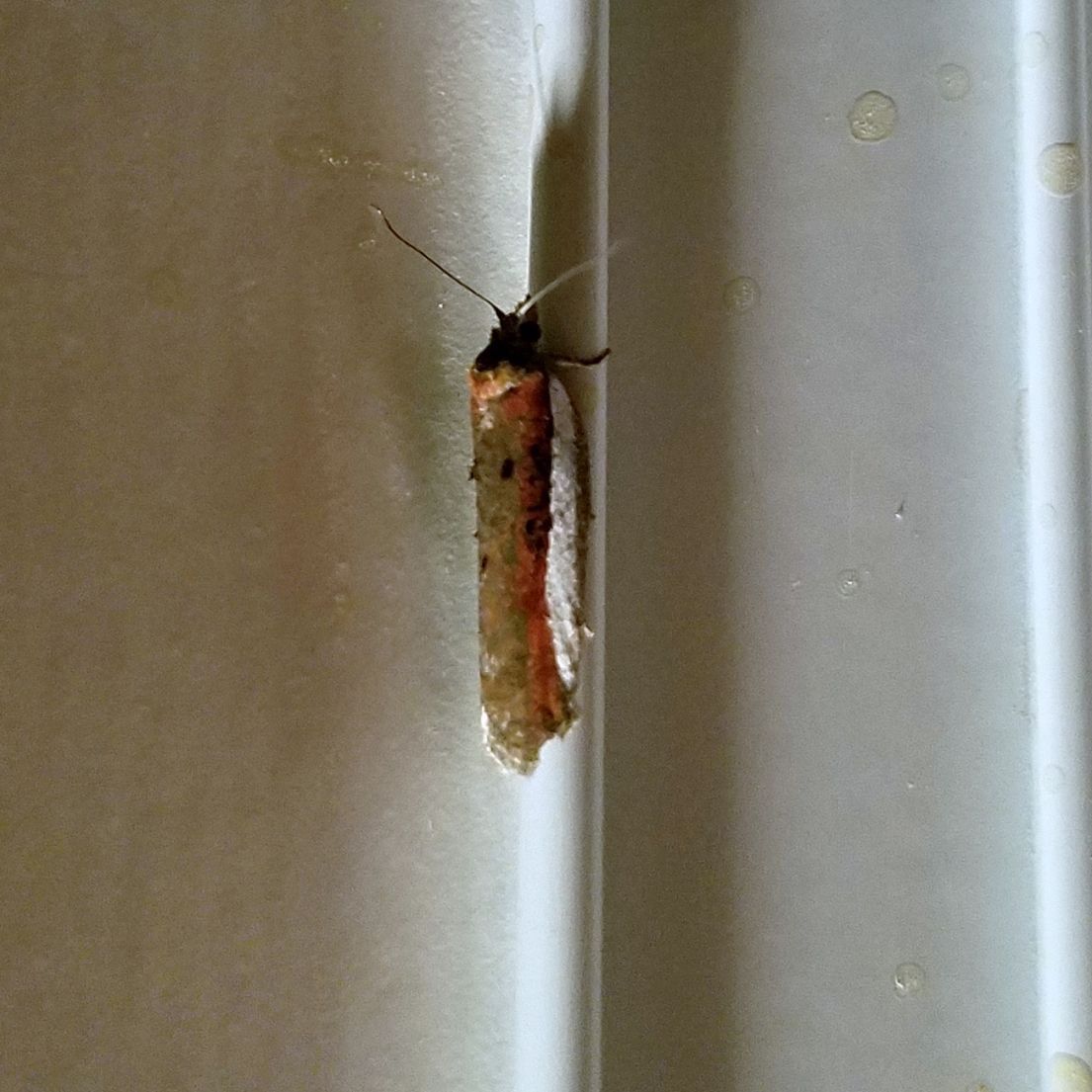
A small brown moth larva I found the other day in a wetland on a clump of Canada bluejoint grass (Calamagrostis canadensis). Species? I don’t yet. That’s it for now.
SOURCES
Beadle, D. and Leckie, S. (2012). Peterson Field Guide to Moths of Northeastern North America. Houghton Mifflin Harcourt Publishing Company, Boston. 640 pages.
Species accounts at Bug Guide, Moth Photographers Group, Tortricid.net, HOSTS – a Database of the World’s Lepidopteran Hostplants, and Butterflies and Moths of North America (BAMONA)
The Garden Tortrix, Clepsis peritana (Clemens): A New Economic Pest in Southern California. Journal of Economic Entomology, Vol. 51(5): 596–598.




 Not Very Far Away