And warm, too, at a sweltering 50° F, so I made plans to be up late looking for moths and caddisflies. I turned on the porch light, made a little cup of espresso, and waited awhile. When I went out I almost couldn’t believe what I saw: Ancylis albacostana. The broad white band on the forewings certainly seemed to point to that species. But there were some differences. First, the wings are not uniformly leaden gray. Instead, there is a very noticeable amount of red forming a narrow triangle above the white band and is separated from that by a narrow black line. Then, below the white band is a narrow ash gray band. The main part of the forewings are leaden-gray. Finally, near the beginning of the forewings are two raised bumps. When I compared this moth to available photos it seemed not match well at all. The description of Ancylis albacostana by Kearfott is also at odds with this moth’s appearance. In an earlier post (here) I stated I had found Ancylis albacostana but later retracted that (there) when it appeared the moth in question was actually Capis curvata.
Also attracted to the light last night were five individuals of the caddisfly Glyphopsyche irrorata and three of the moth Agonopterix argillacea. I’ll be up late again tonight to get more photos of this Ancylis and other moths.
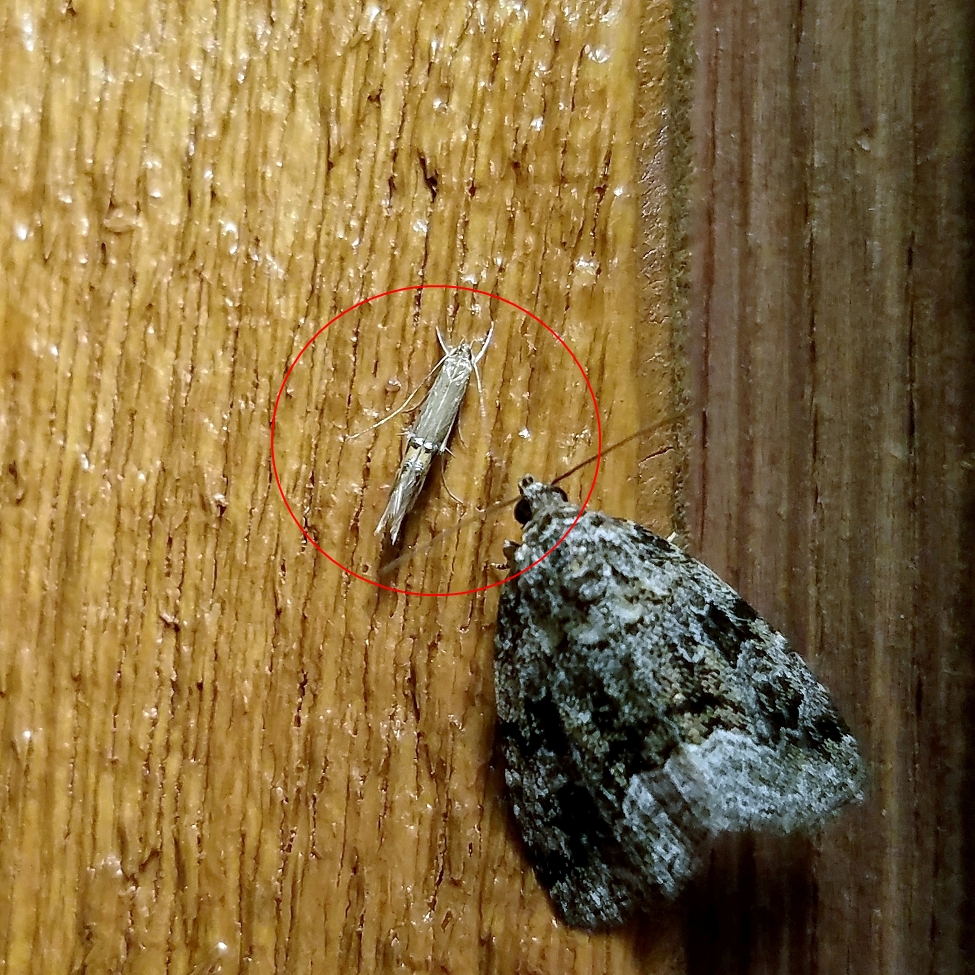
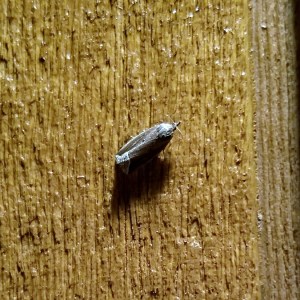
Cosmopterix fernaldella (in red circle). C. fernaldella measures about 5 to 6 mm long. The larger moth is unidentified for now.
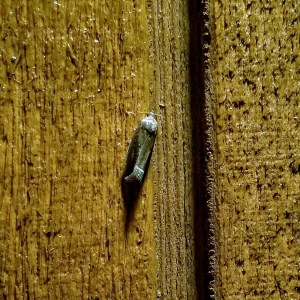
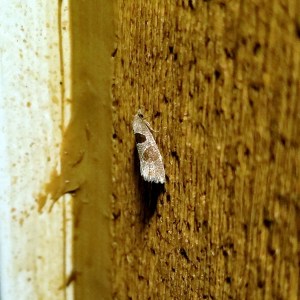
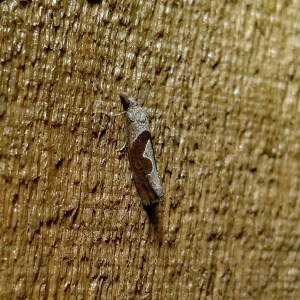
One looks like a positve id: Cosmopterix fernaldella (Fernald’s Cosmopterix Moth). Photos of the other three, Olethreutes glaciana (a leaf-roller moth), Olethreutes permundana (Raspberry Leaf-roller Moth), and Capis curvata (Curved Halter Moth), are little blurry but have sufficient detail I think to make a species determination. O. permundana is the only one I am not completely sure of but it seems to fall within the variation for that species.
Olethreutes permundanalarvae feed on a variety of plant species from many families including meadowsweet (Spiraea salicifolia), ninebark (Physocarpus opulifolius), staghorn sumac (Rhus typhina), hazel (Corylus), sweetgale (Myrica), and hickory (Carya). Range map at Moth Photographers Group.
Update on Eucosma (Pelochrista) dorsisgnatana and E. (Pelochrista) similiana: I found a few photos of the latter in my August files and have added its name back to the checklist which stands at 158 species now. I knew I’d seen E. (Pelochrista)similiana before. Both species are shown below.
D. Beadle and S. Leckie (2012). Peterson Field Guide to Moths of Northeastern North America. Houghton Mifflin Harcourt Publishing Company, Boston. 640 pages.
I’ve been going through my photos of moths from last summer and fall while the snow here slowly melts, comes back again, and then melts some more. As I go through my files of moth photos I am beginning to realize that there may be several hundred moth species in my township. At last count (March 30) I have 147 identified to species and another 175 unidentified species for a total of 322 species. That is a little bit over my original estimate of 300 species in my township. I am going to have to revise that number upwards a bit. The current estimate of moth species in the state of Minnesota where I live is placed at 1,503 so there may be another 300 or more species on top of what I have found.
Digital photos of the unidentified moths are kept in folders named Crambids (23 subfolders, some shown above), Micro-moths (35 subfolders, some shown above), Darts and Prominents (50 subfolders), Tussock Moths (6 subfolders), and many as just “Moth” (55 subfolders) for those in the Geometridae or moths I can’t place in any group. I think I may break that one up into “Geometrids” and “Others”.
There are still many more photos to sort through and the next group to be separated are the Plume Moths (Pterophoridae). This is an interesting group of moths that look like some sort of fixed-wing aircraft. There are three Plume Moths species subfolders (see below) but more might be added later. Moth caterpillars and cocoons also have their own folder called “Unknown Caterpillars” with just three species left until I find more this summer.
Plume Moth
Plume Moth
Plume Moth
Now that I have some of the moths separated and each in its own folder I can begin tackling identification in a more systematic way. Of course no single field guide or website will have all the species possibly present in a geographic region but by getting these photo specimens identified to family or better yet to genus I can narrow my search efforts and maybe hit upon the answer. Right now I am working on the Crambidae or Crambid Moths commonly known as Grass Veneers and Snout Moths. A few days ago the unidentified Crambid files had 29 unknowns. Now it is down to 23 unknowns after confirming three species (Crambus bidens, C. agitatellus, and Chrysoteuchia topiarius) and tentatively identifying three more (Crambus pascuella, C. perlella, and Microcrambus elegans). It is progress.
Warm weather is still in the future it seems but when it does get here and the ice and snow start to melt I will be out in the woods and fields looking for moths and other things that are waking up after a long and sometimes cold winter.




 Not Very Far Away