
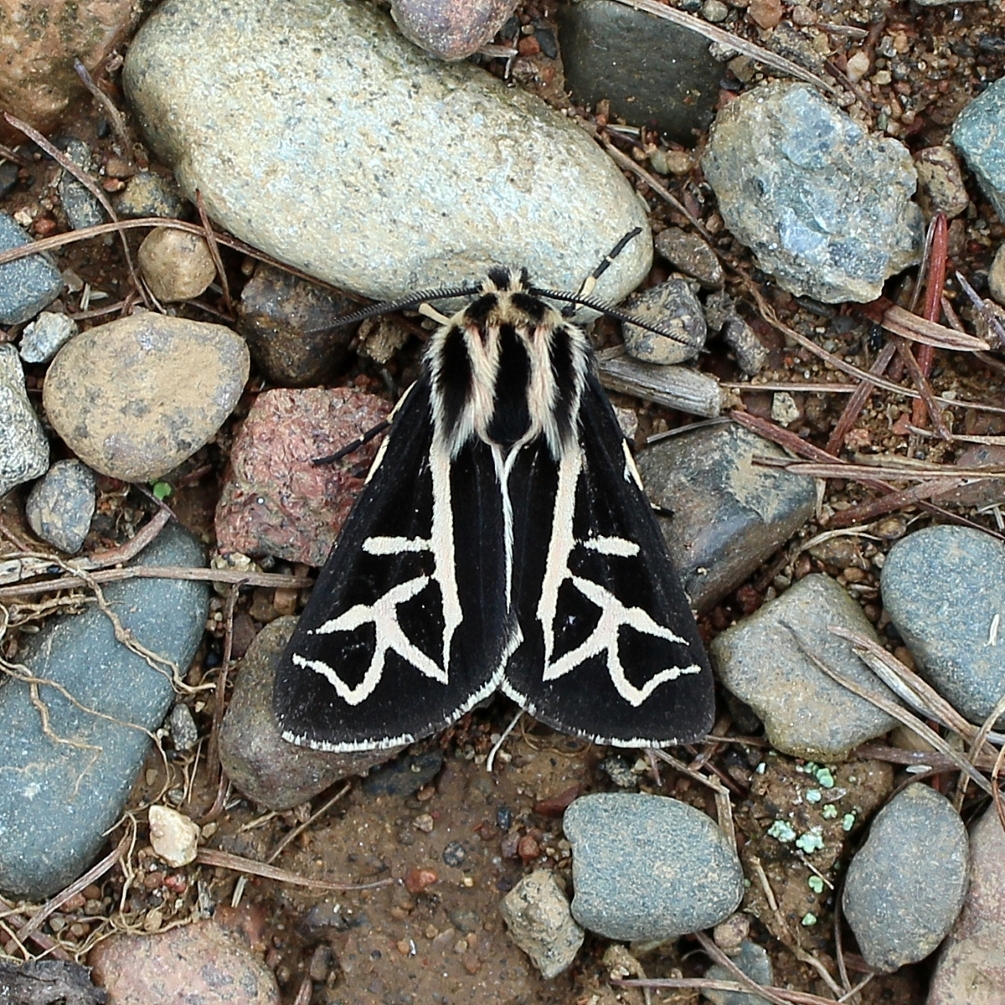
In a previous life, I searched for and documented rare plant species. But I was always curious about everything in nature, so I made it a point to learn as much as I could about all the things in the forests, glades, lakes, and swamps I explored. Sometimes I would make an interesting discovery, like the moth in the above photo.
I find a new moth
A few years back, while on a rare plant survey, I found a tiger moth that I later identified as Apantesis williamsii (Williams’ Tiger Moth). I found the moth in Cook County, Minnesota, in the Superior National Forest (SNF). It was simply lying in the middle of an old logging road just waiting to be found, I guess.
I’d never seen a moth quite like this one. I photographed it (I would have anyway no matter if it was new to me or not) and took some notes about the surrounding area. Then I GPS-ed the location, which is about 20 miles south of the US-Canadian border.
Because blueberry pickers were using the road that day, I carefully moved the moth to a safe spot. Then I got back to that day’s mission, searching for rare plants in the forest and the rare Nabokov’s blue butterfly (Lycaeides idas nabokovi). It might have been in the area as its larval host plant, Vaccinium cespitosum (dwarf bilberry), grew nearby in a prescribed burn. I found plenty of dwarf bilberry that day, but no sign of Nabokov’s blue butterfly. Not even a caterpillar.
Not a common species in Minnesota
Apantesis williamsii is uncommon in Minnesota. It appears that there are only two records before 2018. One record is from Cook County, the same county where I found this one, up in the northeastern corner of the state. The other is from Lake of the Woods County in the Northwest Angle, right on the US-Canadian border, found in 2017.
Since then, additional sightings of Apantesis williamsii have been made. Two other sightings (here and here) were made in Minnesota in 2018, but from northern St. Louis County, about 50 miles west near Ely, and also close to the Boundary Waters and Canada.
Globally secure
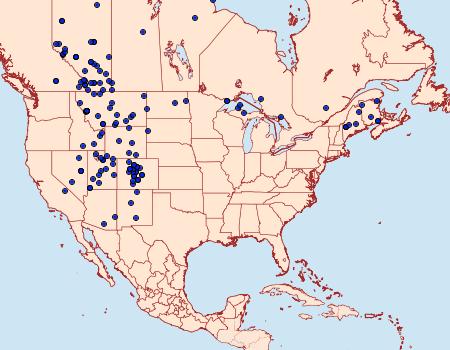
This is not a rare species globally, but based on the small number of sightings, it appears to be uncommon in Minnesota. Most records of Apantesis williamsii are from the Cordillera, starting in Saskatchewan, Canada, and then south through Montana, Idaho, Wyoming, Colorado, Utah, California, Nevada, Arizona, and New Mexico in the western US. It occurs sporadically elsewhere, with scattered reports from Alberta, Manitoba, Ontario, Quebec, and New Brunswick in Canada, and in Michigan and Maine in the US.
Habitat preferences
In the main part of its range, Apantesis williamsii can be found in mountain meadows at middle to high elevations. It also occurs in quaking aspen forests and dry coniferous forests with sandy soil. The latter isn’t too different from the site where I found it. This was in a forest of aspen, birch, spruce, and fir with some jack pine and white pine on sandy soil. The weather is also cool in the summer, although climate change may upend that.
What does it it eat?
Larval food plants of Apantesis williamsii are not known, but it may feed on low-growing herbaceous vegetation like other species of Apantesis.
 Not Very Far Away
I would have bet that I had seen that moth here but I can’t find it on the blog. I know I’ve never seen that beautiful blue butterfly or dwarf bilberry. The closest I could come to bilberry is bearberry (Arctostaphylos uva-ursi) which is also a ground hugger in the heath family.
Interesting that you were a rare plant hunter. I was too but I had no real training so my finds were just dumb luck. In fact a one semester college botany class is the only formal training I’ve ever had. I always dreamed of going to the Amazon and bringing back exotic plants but of course, that never happened.
I’ll be telling people they should go and read your posts this Saturday. The only suggestion I have, if I might be so bold, is to include more common plant names. I know perfectly well why you don’t do that but my blog has always been for the everyday common folk. I have found myself in situations where a botanist or ornithologist was speaking and when I watched the groups they were speaking to, I could tell that they didn’t understand hardly a word of what was being said.
LikeLiked by 1 person
I will take that advice about common names. I have been going through some drafts lately and adding them. I’ve had people in the regulatory side of my business ask what the common names were so I get that. Maybe the scientific name in parenthesis after the common name, if there is one, would be good and then the common name thereafter?
The dwarf bilberry is really small and sometimes hard to spot especially if it is growing with other blueberries that might be towering over it. It has tiny urn-shaped pink flowers. We have bearberry here, too. I was looking over my notes from the day I found the Williams’ tiger moth and noticed it was listed as being there.
I did rare plant surveys for about 25 years mostly in Minnesota but also in Wisconsin and Michigan when I got the opportunity. I did wetland delineations and plant community evaluations, too.
You said you couldn’t find the moth on the blog. Is the photo not showing up in my post? I always worry about that.
LikeLiked by 1 person
I always use “common name (Scientific name)” with the scientific name italicized because that was the way I always found them in books. I tried to get away with not capitalizing the common name and took a lot of heat for it at first. I said “I do that because I want you to pay attention to the scientific name.” But instead they focused on my “mistake” of not using caps. I also said in another post “If you walk into a nursery and ask for a pine tree you’re liable get any one of 10 different trees, but if you ask for Pinus strobus you’ll get a white pine, and only a white pine.
I’ll have to look a little closer for that bilberry.
You were fortunate to land such great jobs. I would have loved to have done either one but being self taught I doubt they would have even considered me. And now I’m too old!
When I said I couldn’t find the moth on the blog I meant my blog. I should have been clearer about that.
Usually if a photo disappears from your blog post it’s size is too big. Try compressing them down to a smaller size if that happens. I use Lightroom for that. You can set Lightroom to limit all exported photos to a certain size. I use 1500 k max and have it maintain the best possible resolution. You do lose some quality but you don’t have Word Press looking for more money because you’ve exceeded their limit.
LikeLiked by 1 person
Okay. I’ve been re-sizing my photos down to 750 kb or a little less. When I first started this blog I wasn’t doing that but found out that large file sizes would cause problems for anyone with slow internet speed. Also, I was having a difficult time uploading because out here internet speeds are slow. Its gotten better but I still reduce the size to save space (and money) in my media files. I also set them for maximum resolution.
In a sense I am self-taught. In college I learned the tools to identify plants and other life forms but there is no course on rare plants of say Minnesota or Wisconsin. I have taught some one day seminars on rare plants but that’s hardly enough. I do have an in-house publication on the wetland plants of the Western Lake Superior Region. That was back in the early 2000s when I was teaching wetland regulators and delineators plant identification. I remember one person asking “what’s the common name” for sedges I was talking about. Really, there aren’t any except for a few like lake sedge or hop sedge. I enjoyed teaching that course.
The protocol for common names seems to vary from source to source. I just use lower case unless there’s a proper name in it like St. Lawrence grape fern (Sceptridium rugulosum) which by the way grows in New England.
Speaking of being of self-taught, I’ve been teaching myself lichens and fungi for about decade or more. Pretty difficult stuff but I like the challenge. And now I’m moving on to learning microorganisms like amoeba and paramecium and diatoms. I even bought new microscope for that and some books for beginners.
You’re right I was very fortunate to get work as rare plant botanist. It was hard work but I got to see so many places off the beaten track up here.
LikeLike
Wow, I hope the internet speed problem has been resolved. Whatever is causing it, I doubt photo size is making them drop out of your posts. So far they’ve shown up on my end.
My real “schooling” comes from simply growing up in a forest with a river and fields, and reading people like Thoreau. That’s when the nature bug bit me.
I wouldn’t worry too much about names. People will let you know if they don’t understand. When I run into a plant with no common name I just tell them that’s the way it is. You get to know people and the regulars become like family so things loosen up over time. They know that you’re doing this for them and they appreciate it.
Good luck with lichens. There are chemical tests you can do in the field but they rely on color and I’m color blind so I was never able to really, absolutely know what I was looking at. But I did and do enjoy seeing them. Speaking of being in the field, I had a lichenologist in Connecticut ask me how I got such great closeups of lichens. The secret is the Olympus TG-6 I use. It fits in a shirt pocket, is “everything proof, and even has “microscope mode.”
I think people are going to love seeing all the natural beauty of Minnesota!
LikeLiked by 1 person
I bought the chemicals for the lichen tests. Can’t wait to start trying them this winter.
I’ve got two lichen post coming soon this month. Both are oddball types that most people would never see. I just noticed the several years ago and by accident. Now I’m always looking for them. One is a former lichen, now placed into non-lichenized fungi. The other is a pin lichen. I’m working on some others for later next year. One will be on the keyhole lichen Menegazzia terebrata. Its very showy and an easy one for people to recognize.
For most of my close-ups I use a Canon Rebel DSLR with a 100mm macro lens. Sometimes I add extension tubes. A tripod really helps especially on cold days when I’m shivering.
I started getting interested in nature when I was young, too. Before we moved to MN our house was in CT. There was a huge property behind the development that was the watershed for three reservoirs for the city’s water. Lots of old trees, woodland pools, rubble caves, rock outcrops, fields full of wildflowers, swamps and the reservoirs. We spent lots of time there, a free roaming childhood, and had a lot of fun exploring. Your posts remind of that place.
I have better internet service now. Its satellite and most of the time it is pretty good. The last one I had worked about 50% of the time. I’d be uploading a photo and it would almost be done and then disconnected. Before that I used my copper wire landline.
LikeLiked by 1 person
Here is an excellent lichen site that I used to use. https://www.flickr.com/groups/1050078@N24/pool/
LikeLiked by 1 person
What a beauty of a moth ❤
LikeLiked by 1 person
That’s for sure! All the moths in that genus have such interesting patterns of lines on the wings. They’re one of my favorites to see.
LikeLiked by 1 person