
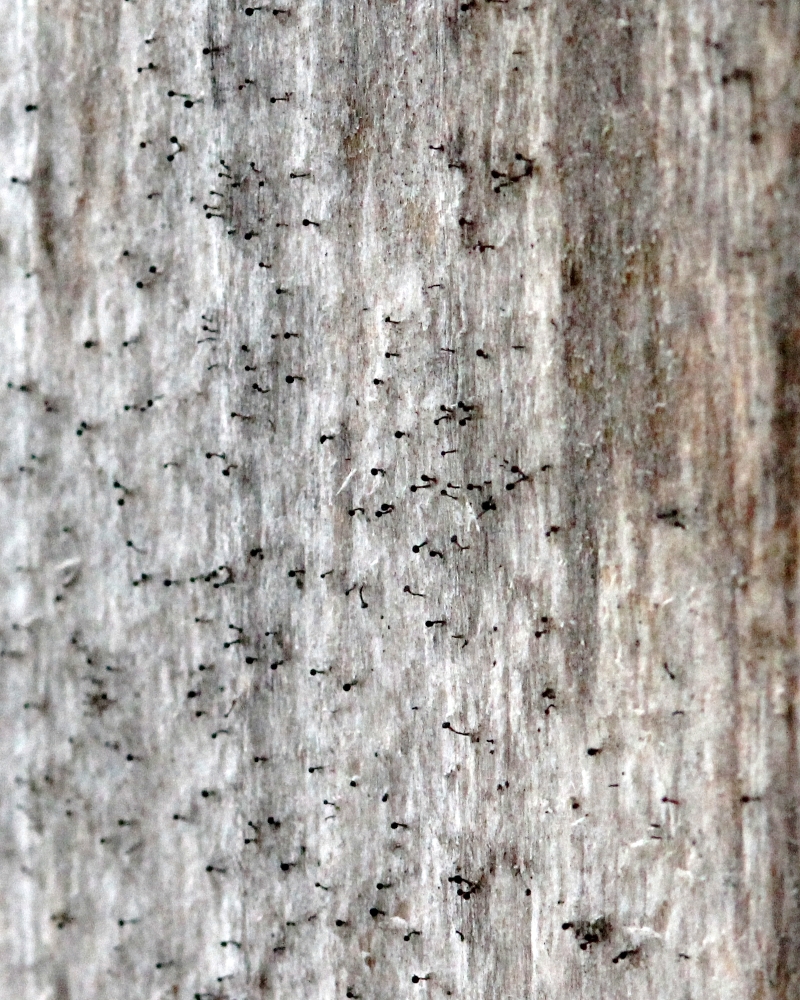
The black stubble in the top photo are the fruiting bodies of a lichen. I found them growing on a piece of weathered cedar of an old birdhouse. I had set up that birdhouse about twenty-five years ago at the edge of a field and forest. Over the years, as the forest grew around the birdhouse, these tiny lichens began growing on the wood.
Lichens are a varied lot. Depending on the species, they can look like dust, little shrubs, gossamer, leaves, or overlapping shingles. Some lichens, like the one in the top photo, resemble whisker stubble or tiny straight pins. They are, fittingly, called whisker lichens and pin lichens.
Whisker lichens are minute, measuring just 1 to 2 millimeters in size. Most only grow on old wood or the bark of old trees. Many species are considered indicators of stable forest environments with long-term ecological continuity.
Taxonomy
The fungal partner (mycobiont) in whisker lichens are members of the Ascomycota, a group of fungi known as cup fungi or sac fungi. Familiar Ascomycota include morels, penicillium molds, and yeasts that are used to ferment bread and beer.
The algal partner (photobiont) is a green alga, usually a species of Trebouxia, a genus of unicellular algae that exists in almost all habitats. They can be free-living, but many species form symbiotic relationships with fungi to form lichens.
Description and terminology
The thallus (body) of whisker lichens may be minutely rough-surfaced (verruculose-granular) or immersed. If immersed, the fungal hyphae and the algae photobiont grow just below the surface of the substrate.
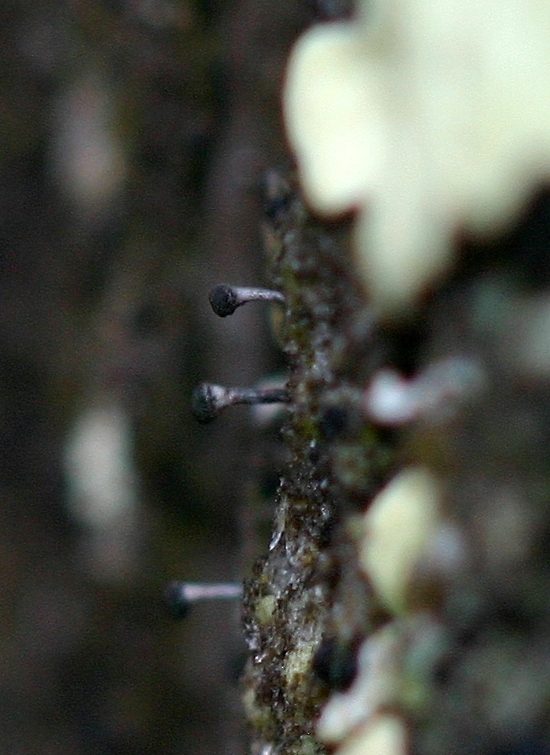
Whatever the thallus form, the apothecia (fruiting bodies) are borne on a long or short stalk, or rarely, sessile. They may be gray, blackish-brown, or greenish-black. At the top of the apothecia is a globose to lenticular capitulum (“little head”), a cup-shaped structure that produces spores.
Determining species
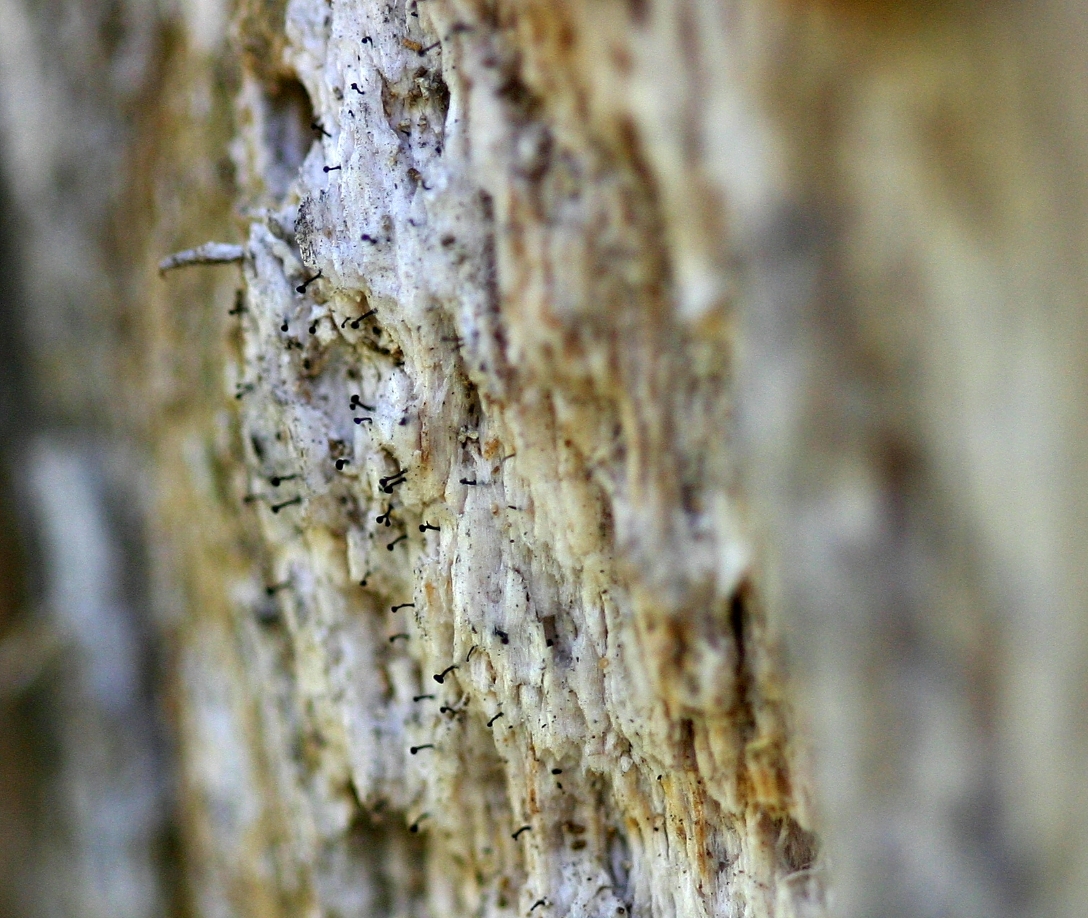
Species determination in whisker lichens is complicated. Morphological characters can only go so far. At best, you might get to genus. For positive identification, microscopic examination of the capitulum and spores is necessary.
Finding whisker lichens
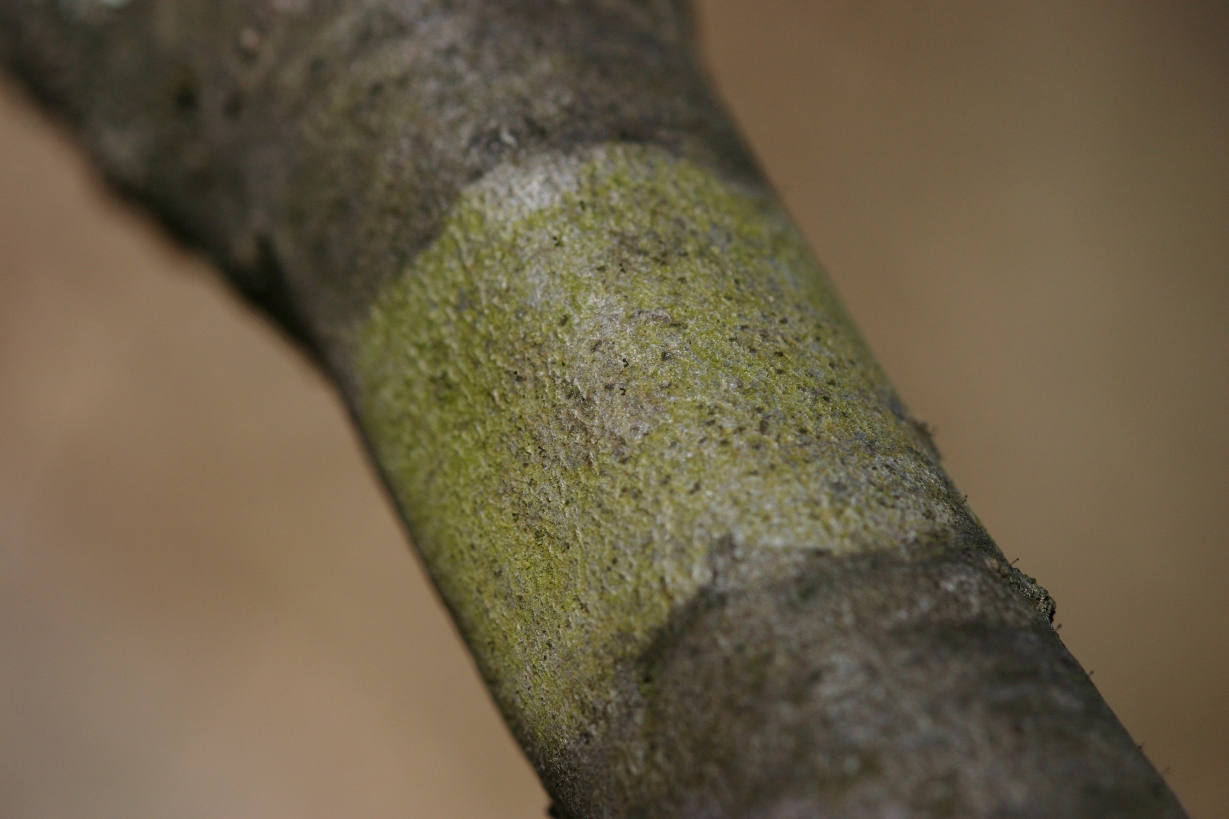
I have found whisker lichens growing on weathered jack pine twigs while photographing other lichens. Most of the ones I have seen seem to prefer old, weathered wood, but I did find one on green crustose lichen that was growing on an alder branch. It may have been a lichen parasite. These are interesting fungi that you can find with a hand lens, or in my case, a macro lens, scanning up and down the trunks and branches of trees, weathered wood, and other lichens.
 Not Very Far Away
Nice! I’ve never been able to find these. My lichenologist friend Steve Messier from Connecticut gave me excellent input on how and where to find them but I never could.
Steve wrote a book titled “Traprock Ridge Lichens of Connecticut” and sent me a copy for Christmas one year. He was also a big background helper on my blog. His book can be found at the Connecticut Botanical Society, under field guides / natural history if you’re interested. It has two different examples of pin “lichens” in it.
Steve points out that they’re good indicators of forest quality and age. I’ll keep looking!
LikeLiked by 1 person
The first time i found pin lichens was by accident. I was looking at some other greenish lichens on a stump and saw these pin lichens while focusing the camera. Now I use a jeweler headset with multiple lenses to exam potential habitat. Some of the best spots besides old trees and stumps are old wooden barns that haven’t been painted in years.
I just sent an email to the CT Botanical Society asking about Steve Messier’s book.
LikeLiked by 1 person
Steve told me they also grew on turkey tail fungi and violet tooth fungi but I still haven’t seen any. Of course a lot of the time I just forget to look for them.
Steve’s book is important because as I’m sure you know, there aren’t many out there. I paid over a hundred dollars for Lichens of North America when it first came out but you can get it for less now, I think. It’s a great book but it’s not a field guide. It’s too big to fit in any bookcase in this house. It’s kind of a coffee table book full of lots of fantastic photos and excellent information, and worth every penny if you’re serious about lichens.
When Steve’s book was first published he asked that I tell people to write to him for a copy because all the details hadn’t been ironed out but that was in 2021 so I’d guess that you shouldn’t have any problem with the historical society now. If you do let me know and I’ll dig up that email where he gave me his address.
LikeLiked by 1 person
Sharnoff’s book is certainly not for the average backpack or bookshelf but it is my go to source. I just a got a new book that will fit easily in a backpack: The Macrolichens of Ontario and the Great Lakes Region of the United States by Troy McMullin. A good internet source is Ways of Enlichenment with plenty of good photos. The Consortium of Lichen Herbaria is good but very technical.
I’m going to have to check fungi that look like turkey tail for pin lichens. I’m thinking I may have seen some but never photographed them. I did see a small black cup fungus that looks like Sarea on a much larger Phellinus. Can’t find it now. I think something ate the the Phellinus. There’s a beetle that chews them up but there are plenty of these bracket fungi locally.
I don’t think my request got through to the Botanical Society (it seems the page got stalled) so I’ll try again.
LikeLiked by 1 person
Good Morning Gary, I’ve been searching for the best way to get a copy of Steve’s book and apparently it sold out in 2021, the year it was published! I found this Facebook page about it: https://www.facebook.com/photo.php?fbid=4184494791626138&id=486881834720804&set=a.490338007708520
I don’t know if Steve has more copies or if it was ever reprinted but if you send me an email I’ll give you his email address. I don’t think it’s a good idea to add it here.
LikeLiked by 1 person
I subscribed to your blog so I guess you can get my email that way? Or you could go to my contact page.
LikeLike