
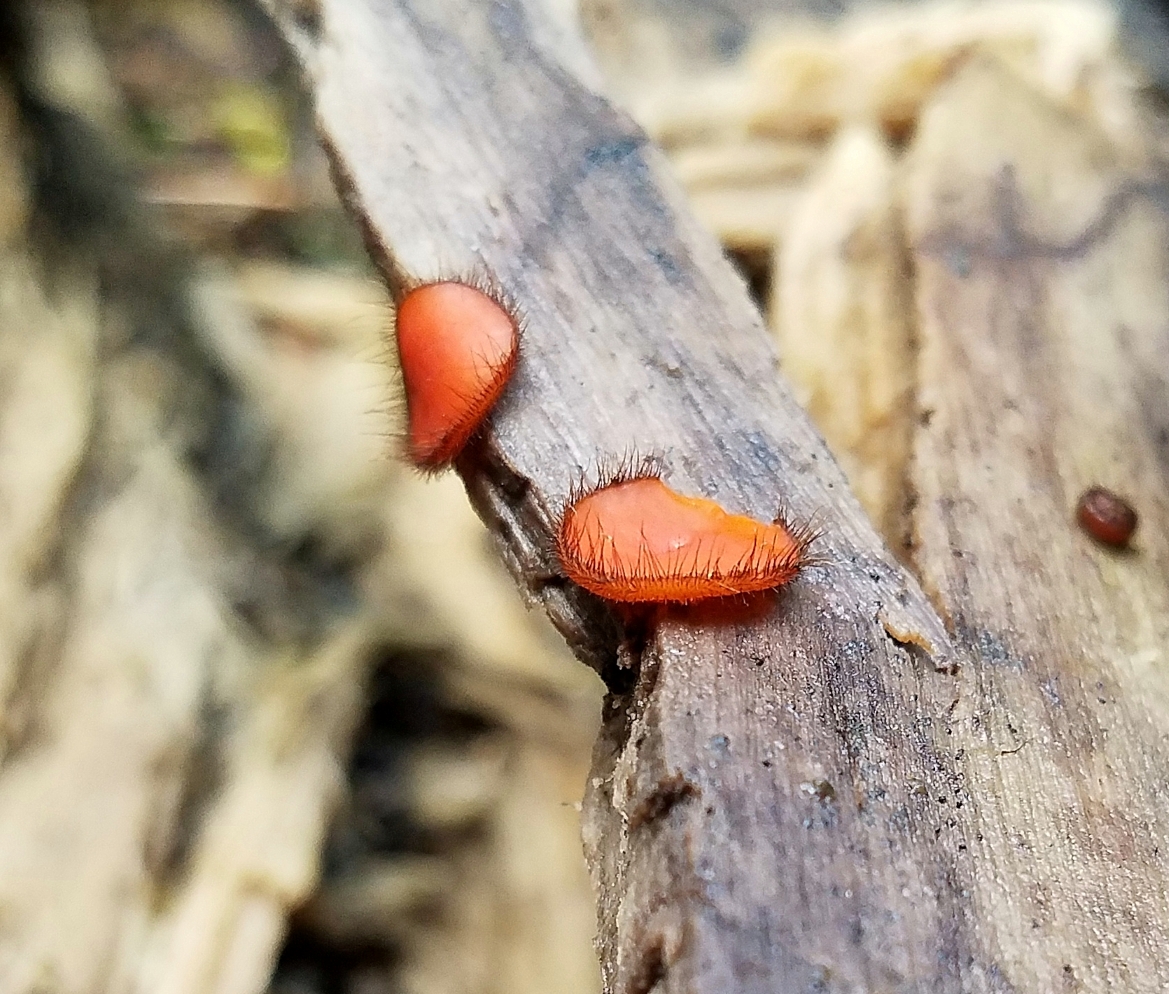
This pretty orange fungus with the fringe of fine black hairs is Scutellinia scutellata (Eyelash Cup Fungus). It is an Ascomycota, like the resinicolous Sarea difformis and the old wood-dwelling whisker lichens (Calicium species).
Scutellinia scutellata is a saprophytic fungus that decomposes decorticated damp wood in forests. I often find it on spongy wet logs and fallen branches. Sometimes it grows by itself, but other times it may grow with small, leafy liverworts and mosses.

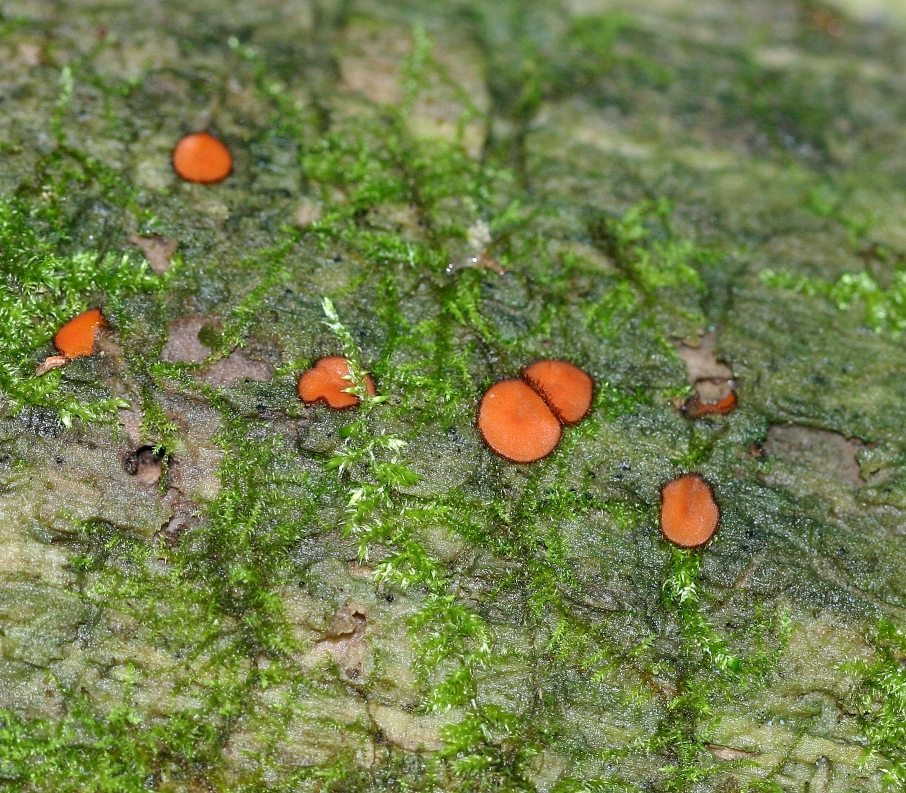
I’ve noticed that many Ascomycota species exhibit seasonal fruiting. For example, hairy ebony cups (Pseudoplectania sp.) fruit in April, morel mushrooms (Morchella angusticeps) fruit in May, and the false morel (Gyromitra infula) fruits in October. Scutellinia scutellata fruits from late June into October, especially if rainfall is abundant.
The fruiting body of Scutellinia scutellata is a disk-shaped scarlet-red to bright orange cup up to 1.5 mm across and fringed by black hairs. The lower surface is brownish and covered with small hairs.
Diversity of species
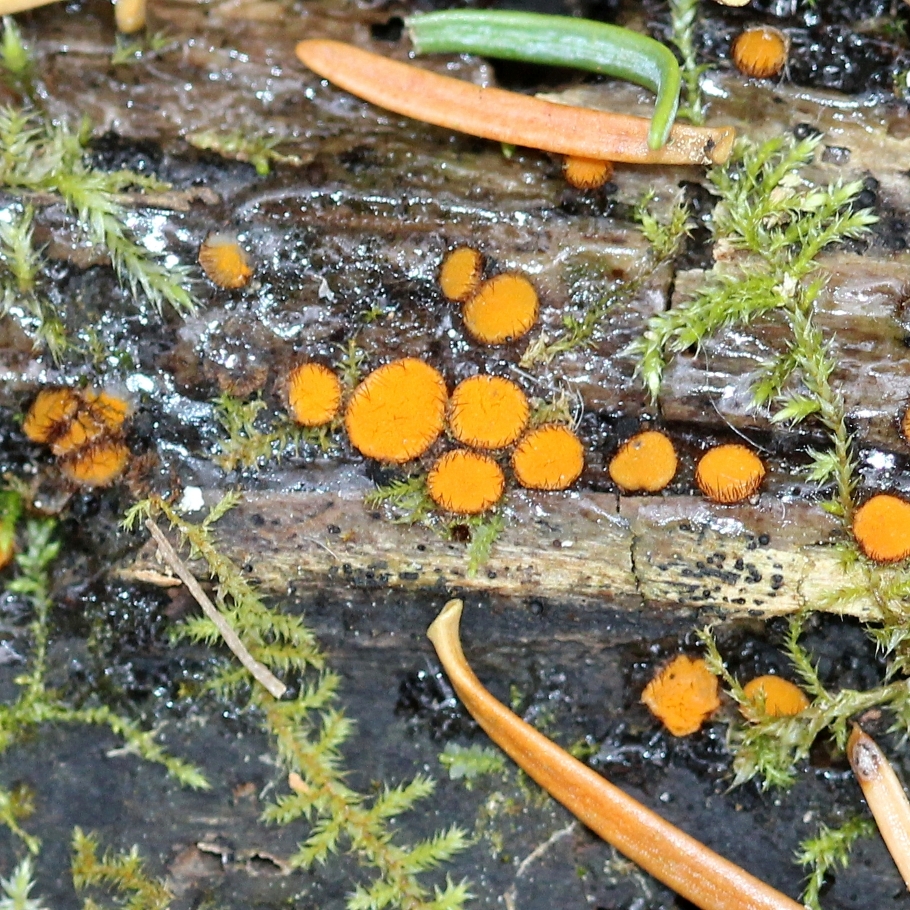
There are at least 100 species in the genus, and identification hinges on microscopic features of the spores and hairs. I’m fairly confident that this one is Scutellinia scutellata. However, reliable identification can be hampered if there is extreme variability and overlapping of morphological characters.
Symbiosis with bacteria
Scutellinia scutellata grows in association with extracellular bacteria. This association is crucial to its survival and growth. “All attempts to culture hyphae in the absence of bacteria failed. To our knowledge, this represents the first report of these versatile Acidovorax-like bacteria having established symbiotic relationships with members of both Fungal and Animal Kingdoms.” (Giordano et al, 2013)
Sources
- Giordano, R., Nardi, J. B., Bee, C. M., Miller, L. A., & Raja, H. (2013). Bacterial symbionts that inhabit apothecia of the cup fungus Scutellinia scutellata. Nova Hedwigia, 97(1-2), 1-18.
- Molecular phylogenetic assessment of the genus Scutellinia (Pezizales: Pyronemataceae)
- MushroomExpert.com: The Eyelash Cup: Scutellinia scutellata
 Not Very Far Away
You got some great shots of this tiny fungus, Gary. I had to laugh at your choice, just as I was recuperating from eye surgery where my eyelashes kept getting in the way. They made a lot of eye drops spill onto my cheek instead going where they belonged.
LikeLiked by 1 person