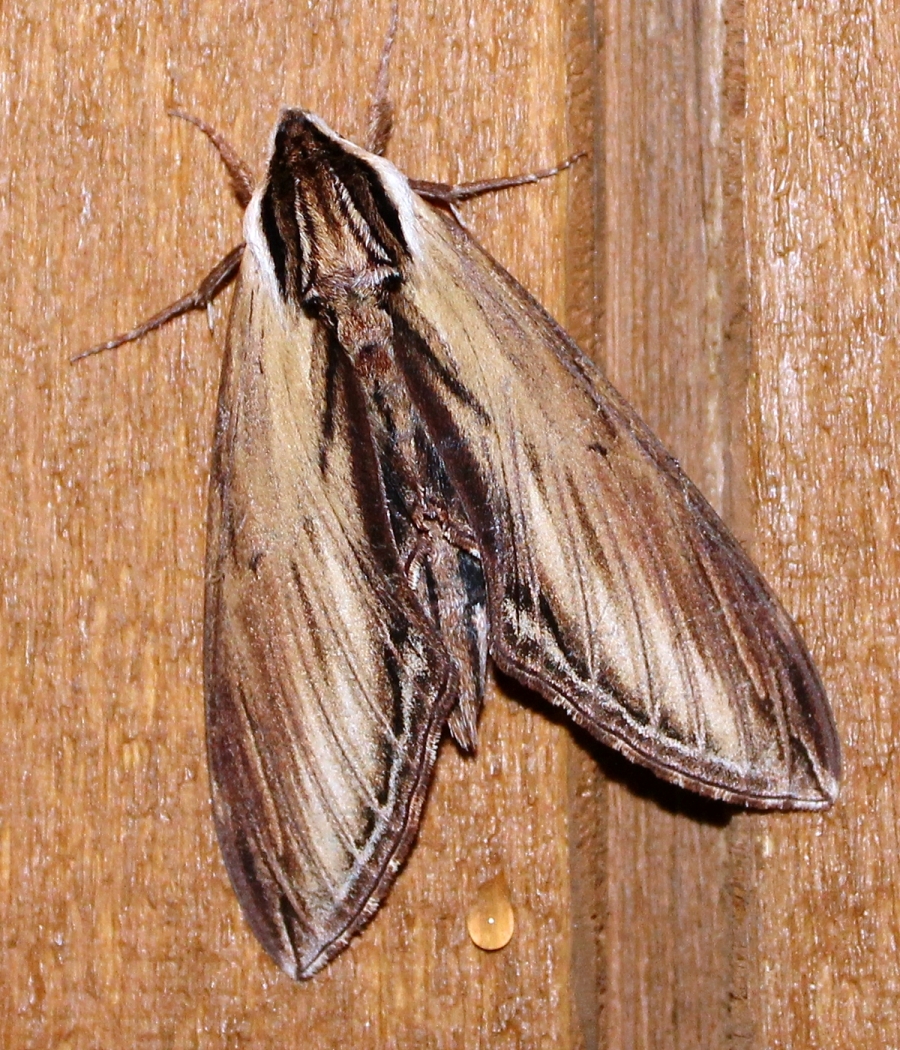
Another busy and late night but a productive one. I added several more species to the checklist but this one was already on the list after I found a caterpillar of the species last fall. It is the Laurel Sphinx Moth (Sphinx kalmiae). There is an abundance of potential food plants (ash and lilac) for this moth to choose from right around my house so I am hoping to find a few caterpillars later this summer.
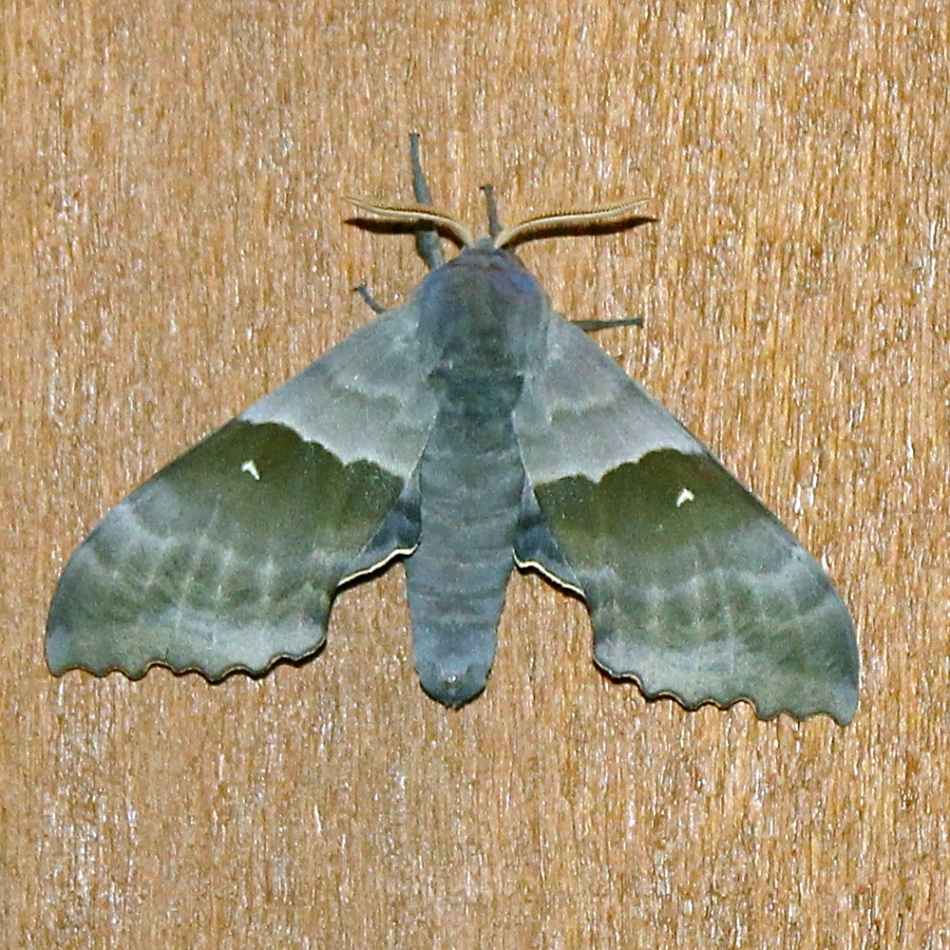
But it was worth staying up late for the past several nights resulting in the addition of another 25 species to the checklist since June 4. The moth shown above, Pachysphinx modesta, is the latest addition and was made late last night. This is a large moth with a total body length between 45 and 65 mm and a wingspread almost twice that. When it flew by me towards the porch light I thought it was a bird. Pachysphinx modesta occurs over much of North America north of Mexico and can be found wherever the larval host plants poplars and cottonwoods (Populus spp.) and willows (Salix spp.) grow. The related Pachysphinx occidentalis is yellowish brown in the pale form and brownish-gray in the dark form. It can be told apart by the large area of red or pink coloration on the hindwings and by the dark lines that contrast with the background color of the forewings. Pachysphinx modesta is greenish-gray, lines of the forewings do contrast with the background color, and the hindwings are greenish-gray with no red or pink.
Taxonomy
Class Insecta (Insects)
Order Lepidoptera (Butterflies and Moths)
Superfamily Bombycoidea (Silkworm, Sphinx, and Royal Moths)
Family Sphingidae (Sphinx Moths)
Subfamily Smerinthinae
Tribe Smerinthini
Genus/species Pachysphinx modesta
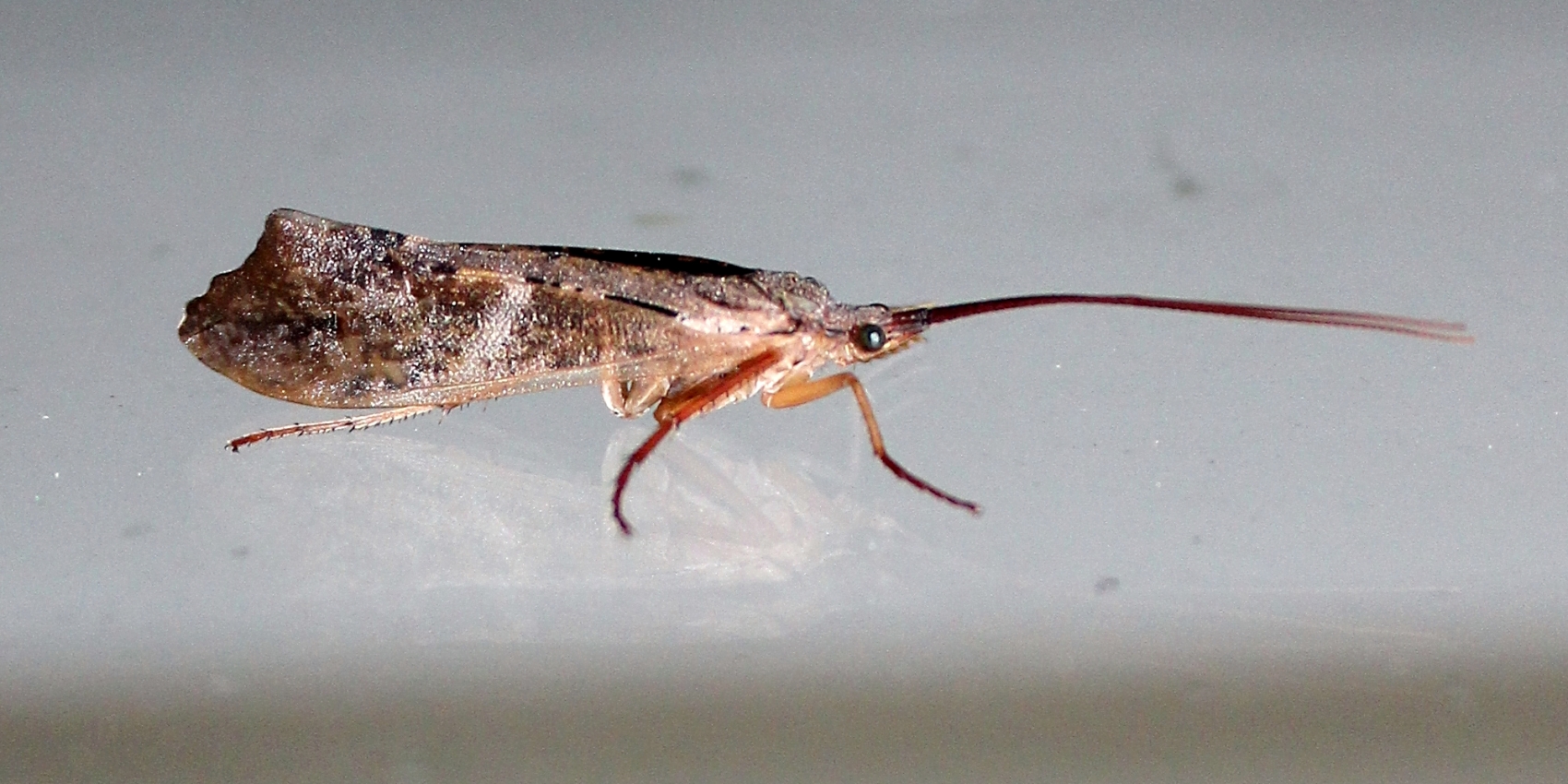
There are about 277 species of caddisflies in Minnesota but my list of caddisflies from Carlton County is dismally low at only eight species three of which are of uncertain identification plus several unknowns. So when I saw this caddisfly a last week (May 31) I felt pretty sure I had a new species to add to the checklist. And it was. This caddisfly species is Nemotaulius hostilis which in Minnesota is known from several counties in the northern forested region of the state (Houghton 2012).
Taxonomy
Class Insecta (Insects)
Order Trichoptera (Caddisflies)
Suborder Integripalpia
Infraorder Plenitentoria
Superfamily Limnephiloidea
Family Limnephilidae (Northern Caddisflies)
Subfamily Limnephilinae
Tribe Limnephilini
Genus/species Nemotaulius hostilis
Larvae
The larvae of Nemotaulius hostilis build cases from large leaf fragments in such a way that they are sandwiched between the layers (Houghton 2012). This is in contrast to the larval cases of other caddisfly species are tubular or rectangular in cross-section. Larvae live in lakes, marshes, and sluggish streams with thick beds of aquatic macrophytes where they feed on plant debris (Houghton 2012). The small stream that meanders through my property with its abandoned channels and ox-bows contains many sites with dense aquatic vegetation where I hope to find Nemotaulius hostilis larvae later this summer.
Description
The following description of Nemotaulius hostilis is after Schmid (1952), Nimmo (1971), and Houghton (2012). Adult N. hostilis are between 25 and 30 mm long. The coloration and patterning of the forewings is the most conspicuous feature. These are a mixture of solid areas of color, mostly shades of brown, gray-brown, or even black, mixed with clear irrorate (speckled) areas. Schmid says of the translucent speckling (“macules claires”) on the wings that it is “more extensive than in other species” and the wings are “riddled” with them (“l’aile dont toute la surface est criblée de macules claires plus grosses que chez les autres espèces”). The costa is hyaline with some basal irroration. About mid-way on the forewings is a narrow, slanted bright zone. The scalloped wing tips are a distinctive feature.
Range Nemotaulius hostilis occurs from Newfoundland to Alberta and Alaska, and from New England to the Great Lakes Region, also in Colorado (Nimmo 1971).
Ecological importance
Case-making caddisflies (there are several families) like Nemotaulius hostilis feed by shredding dead leaves and other plant parts that fall into the water or were growing in the water. Some case-making species are predators on small invertebrates while others scrap the fine layer of fungi, diatoms, and bacteria that grow on submerged objects usually wood. A small number of species feed on living plants or construct nets to trap prey or fine particles on which they feed. Shredders and scrappers are especially important in nutrient and energy cycling in forested streams which receive little direct sunlight that would support photosynthetic plants like algae with their ability to produce carbohydrates. In these systems cellulose and lignified woody plant tissue become primary carbohydrate sources which are first acted upon by bacteria and fungi before the insect larvae consume them. Further processing occurs in the gut of the larvae with the help of symbiotic bacteria which reside there. Organisms that feed on caddisfly larvae and adults thus benefit from the ability of the larvae to transform inedible wood and rotting leaves into edible insect bodies. (see Anderson et al. 1978, Wallace 1996, Cummins 2002, Feio et al 2005, Houghton 2007, Resh et al. 2011)
And this one
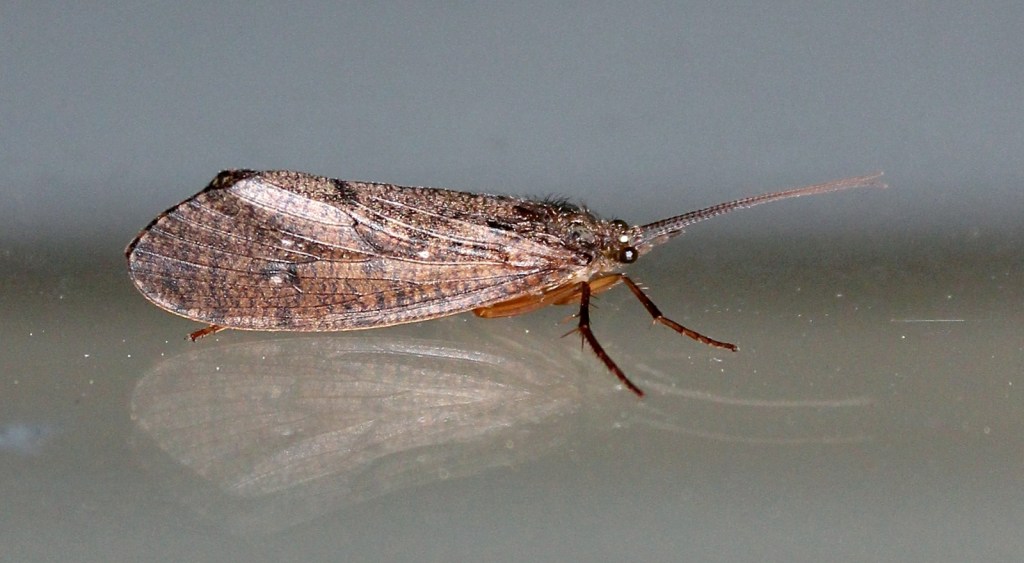
I found this caddisfly Monday night (June 4). It is one of the giant casemaker caddisflies in the Superfamily Phryganeoidea that is probably Ptilostomis ocellifera, a species which is widespread and common in Minnesota. More on Ptilostomis ocellifera in an upcoming post.
Its been a busy month and a half of mothing so far with many new species and as well as returning species seen last summer. As of May 31 the moth checklist for 2018 is now at 57 species with a combined checklist for 2017 and 2018 of 225 species. There are also many new ones in the “Unknown Moths” file. The latest checklist additions, all observed between May 26 and May 31, are Argyrotaenia mariana, Helcystogramma melanocarpa, Acronicta morula, Elaphria versicolor, Eucosma awemeana, Petrophora subaequaria, Acronicta interrupta, Ancylis albacostana, Leuconycta diphteroides, Ectropis crepuscularia, Orthofidonia flavivenata, Palpita magniferalis, Bibarrambla allenella, Plagodis pulveraria, Monopis monachella, Pero morrisonaria, Apotomis funerea, Semioscopis packardella, Tacparia desertata, Hydriomena renunciata, and Galgula partita. Returning species include Caloptilia stigmatella, Pseudeustrotia carneola, Euphyia intermediata, Tetracis crocallata, Gluphisia septentrionalis, Prochoerodes lineola, Metanema determinata, Metanema inatomaria, Plutella xylostella, Clostera albosigma, Acronicta lobeliae, and Idia americalis.



 Not Very Far Away