And warm, too, at a sweltering 50° F, so I made plans to be up late looking for moths and caddisflies. I turned on the porch light, made a little cup of espresso, and waited awhile. When I went out I almost couldn’t believe what I saw: Ancylis albacostana. The broad white band on the forewings certainly seemed to point to that species. But there were some differences. First, the wings are not uniformly leaden gray. Instead, there is a very noticeable amount of red forming a narrow triangle above the white band and is separated from that by a narrow black line. Then, below the white band is a narrow ash gray band. The main part of the forewings are leaden-gray. Finally, near the beginning of the forewings are two raised bumps. When I compared this moth to available photos it seemed not match well at all. The description of Ancylis albacostana by Kearfott is also at odds with this moth’s appearance. In an earlier post (here) I stated I had found Ancylis albacostana but later retracted that (there) when it appeared the moth in question was actually Capis curvata.
Also attracted to the light last night were five individuals of the caddisfly Glyphopsyche irrorata and three of the moth Agonopterix argillacea. I’ll be up late again tonight to get more photos of this Ancylis and other moths.
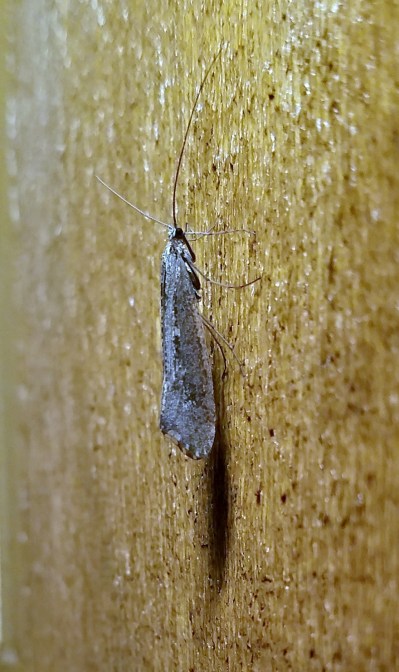
The insect above is a caddisfly and one of many caddisfly species that live in northern Minnesota. Caddisflies (Order Trichoptera) are typically active during the warm months of summer and early fall but this caddisfly was active on the evening of April 25 when air temperatures were in the low 40s. It took me about a couple of days to figure out the species after searching Bug Guide and comparing photos (compare the pattern on the ends of the wings with this) and then doing a literature search. This caddisfly is Glyphopsyche irrorata which is in the Family Limnephilidae and is interesting for a few reasons the first of which is its mode of surviving the winter. Larval G. irrorata live in small ponds such as vernal pools and peatland ponds, shallow marshes, and slow moving streams that may dry up by the end of summer. Many caddisfly species in similar habits lay eggs in gelatinous masses under moist objects in the drying water body where the larvae remain until favorable conditions return. G. irrorata has a different survival strategy. It goes through a rapid larval development after the eggs are laid in May, pupates in August, and emerges as an adult in September. Mating takes place in the autumn and then the adults go into hibernation until the following spring (more mating may take place then) when the females lay eggs in small ponds and slow moving streams. The larvae build cases from bits of organic material and mineral material and are detrivorius shredders feeding on decaying wood and other organic matter.
Another reason G. irrorata is interesting, at least from the standpoint of where this one was found, is that this species has been recorded only twice in Minnesota in 41 years. The first time was in 1977 in Clearwater County and the second was in 2000 in Cook County. This sighting makes the third time and in a new county. Although not on Minnesota’s rare species list it must be uncommon to have only two previous records in the state. This is in spite of several caddisfly surveys conducted in the state in the last 20 years. The range of G. irrorata is Nearctic extending from Newfoundland to Alaska and south to California, in the Great Lakes Region and then east to New Hampshire and Maine. The number of known sites where G. irrorata occurs in Wisconsin, Michigan, New Hampshire, and Maine are few.
G. irrorata is attracted to lights as are many caddisflies. It is also attracted to sweet liquids like maple sap in tapping buckets. Many caddisfly species that fly during the summer are nectar and sap feeders, too. Using a combination of lights and sweet liquids might be a way to attract this species.
Description
The forewings are grayish chocolate-brown with small spots and many larger translucent patches. Length is about 16 mm.
Chadde, Steve W., Shelly, J. Stephen, Bursik, Robert J., Moseley, Robert K., Evenden, Angela G., Mantas, Maria, Rabe, Fred, and Heide, Bonnie. Peatlands on National Forests of the Northern Rocky Mountains: Ecology and Conservation. 80 pages. United States Department of Agriculture, Forest Service, Rocky Mountain Research Station. General Technical Report. RMRS-GTR-11 July 1998.
The tiny gray moth in the photo above is one of the latest moth finds here this month. I’ve seen several of these moths in the last week flying just above the ground or walking on the snow. Some even came to my porch light one warm night (April 22) with an air temperature of 46° F and also my kitchen so I was able to photograph them. They are Agonopterix argillacea. Adult moths in this genus aestivate during the winter and emerge in the early spring to lay eggs. The larvae of A. argillacea feed on willows (Salix spp.) which are abundant in the wetlands around here.
Besides A. argillacea other species of moths are showing up as the temperatures get warmer. By “warmer” I mean between 32° F and 40° F. The three moths shown below were found flying just above the snow when air temperatures were almost 40° F in the early morning (April 18 and 22) and late afternoon (April 22) as the sun was setting. I have not been able to identify them despite going through hundreds of photos at the Moth Photographers Group and Bug Guide websites. One may be in the genus Apotomis.
The first moth of the year. Possibly Apotomis.
An unknown moth species.
And another unknown moth species.
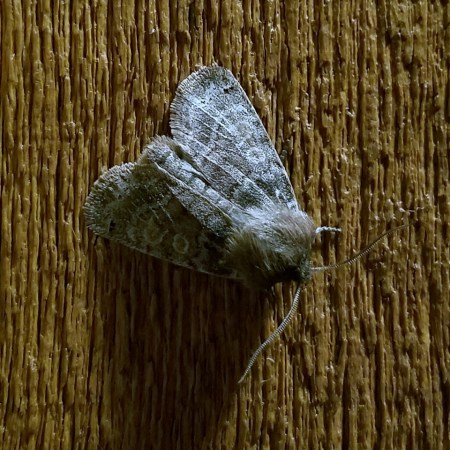
On Sunday night (April 22) when the air temperature was 46° F (after almost reaching 70° F during the day) I turned on my porch light and two individuals of this large moth came to the light. I am not certain of the species but it looks like an Orthosia. I’m going to take a break from trying to figure this one out.
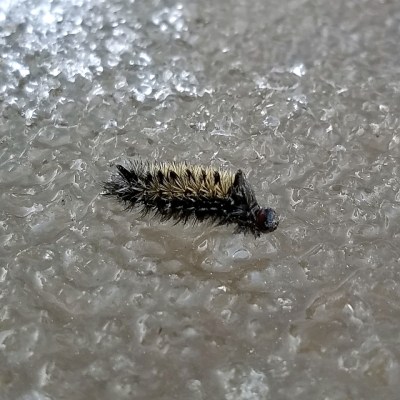
Ctenucha Moth (Ctenucha virginica) and other caterpillars are also coming out of hibernation venturing out onto the snow it seems not wanting to wait for the really warm weather. I found this Ctenucha Moth caterpillar (below) and several others in the late afternoon (April 22) on some icy snow floating in a flooded field. They were soaked and looked dead but after a few minutes in my hands perked up so I moved them to some higher and drier ground. Ctenucha Moth caterpillars overwinter as immature larvae. When warm spring weather comes back they emerge from hiding and begin to eat grasses and sedges their primary food plants. In a few weeks they are fully grown and pupate. By early summer the Ctenucha Moths hatch from their pupa to start the process over. Ctenucha Moths are in the Subfamily Arctiinae which includes the familiar Woolly Bear (Pyrrharctia isabella).
This next fuzzy caterpillar was found on April 19th crawling across the snow in a sedge marsh. The caterpillar, whose species identification is unknown but may be related to the Ctenucha, seemed to have no problem with the cold. I watched it for a little while until it reached a clump of exposed sedge and then went inside. It is fascinating to me that these cold-blooded animals can function just fine when ambient temperatures are only a few degrees above freezing and snow is still on the ground.
Now that most of the snow is gone it is becoming harder to find these tiny moths. But soon other species will emerge as the days get warmer and plants start to grow.
The mothing season here has officially begun with this sighting of the first moth of the year. Yesterday morning I was heading down to the small stream that flows through my property to set up a minnow trap which I use to monitor aquatic life in the stream. On the way a small moth flew towards me and then landed in the snow. I scooped it up into a paper towel and brought it back to the house where I photographed it. I’m not sure of the species but I think this moth is in the Family Tortricidae. It looks a lot like some members of the genus Apotomis but that’s just my guess for now. I wonder if this moth overwintered as an adult or as a pupa.
I went back to the stream in the afternoon to look for more moths. There was a rove beetle (Orochares?), a water scavenger beetle (Hydrobius), and spiders (most were Thanatus) on the melting snow but no moths. Today and into the weekend it will be much warmer with temperatures at or above 60°F. That should increase insect and spider activity which I think I will go see right now.






 Not Very Far Away